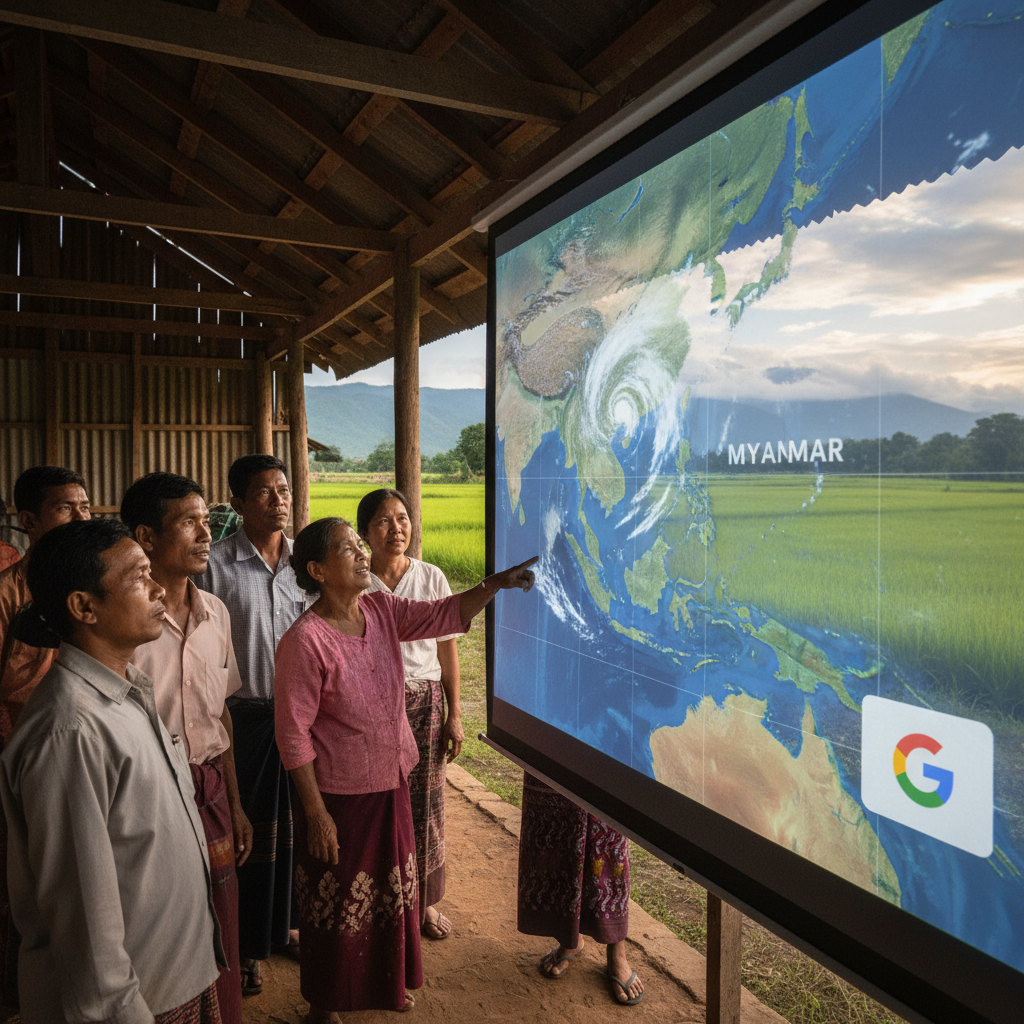

In Myanmar, the rhythm of life is often dictated by the sky. From the farmers in the Ayeyarwady Delta praying for timely rains, to the fishermen along the Rakhine coast watching for storms, weather isn't just small talk, it is the very breath of our existence. For generations, we have relied on ancestral wisdom, local observations, and yes, often, the hope that the worst would pass us by. But with climate change making weather patterns more erratic and violent, hope is no longer enough. This is where the quiet revolution of AI weather forecasting steps in, promising a precision that was once unimaginable, and for us, a potential lifeline.
What Exactly Is AI Weather Forecasting Outperforming Traditional Models?
At its heart, AI weather forecasting is about using artificial intelligence, particularly deep learning, to predict atmospheric conditions with unprecedented speed and accuracy. Think of it like this: traditional weather models are incredibly complex mathematical equations, painstakingly calculated by supercomputers. They divide the atmosphere into a grid and simulate how physics, chemistry, and fluid dynamics will play out across each tiny square. It is a monumental task, requiring immense computational power and time.
AI models, however, approach the problem differently. Instead of simulating every physical process from scratch, they learn from vast historical datasets of weather observations, satellite imagery, radar readings, and traditional model outputs. They identify intricate patterns and relationships that even the most sophisticated human-designed equations might miss. When you hear about AI models outperforming traditional ones by 'orders of magnitude,' it means they are not just a little bit better, they are often dramatically faster and more accurate, sometimes improving predictions by factors of ten or even a hundred, especially for short to medium-range forecasts. Companies like Google DeepMind and Huawei have been at the forefront of this development, pushing the boundaries of what is possible.
Why Should You Care? In Myanmar, the Stakes Are Different.
For many in the developed world, a missed weather forecast might mean a ruined picnic or a delayed flight. Here, in Myanmar, the stakes are different. A sudden, unpredicted cyclone can wipe out entire villages, destroy crops, and claim lives. Flash floods, intensified by deforestation and climate change, can devastate communities that have little infrastructure to begin with. Early, accurate warnings can mean the difference between life and death, between saving a harvest and losing everything.
Consider the farmers in our central dry zone. Their livelihoods depend entirely on understanding when the monsoon will arrive and how intense it will be. A few extra days of accurate warning about a drought or an impending deluge can allow them to protect their crops, secure their homes, or even evacuate to safety. This is about survival, not convenience. It is about empowering communities with knowledge, giving them a fighting chance against forces that often feel overwhelming.
How Did It Develop? A Brief History of Prediction.
Humanity has always tried to predict the weather. From ancient astrologers to the first barometers, the quest for foresight is timeless. Modern numerical weather prediction began in the early 20th century, gaining traction with the advent of computers in the mid-20th century. These traditional models, while revolutionary, are computationally intensive. They require supercomputers to crunch trillions of calculations, often taking hours to produce a single forecast. This delay, however small, can be critical when a fast-moving storm is approaching.
The recent breakthroughs in AI weather forecasting, particularly over the last five to seven years, are largely due to advancements in deep learning, especially neural networks, and the availability of massive datasets and powerful graphics processing units, or GPUs, from companies like NVIDIA. Researchers realized that instead of telling a computer the physics equations, they could show it millions of examples of past weather and let it learn the patterns itself. This paradigm shift has accelerated the pace of innovation dramatically, allowing for models that can generate forecasts in minutes, not hours.
How Does It Work in Simple Terms? Learning from the Sky's Story.
Imagine you have a child who loves to draw. You could teach them the physics of light and shadow, the chemistry of pigments, and the geometry of perspective. Or, you could show them thousands of beautiful paintings and let them try to recreate what they see, learning through trial and error, identifying patterns in how colors blend and forms emerge. AI weather forecasting is a bit like the latter approach.
These AI models, often called neural networks, are fed enormous amounts of past weather data. This includes satellite images showing cloud formations, radar data tracking precipitation, ground sensor readings of temperature and pressure, and even the outputs from traditional weather models. The AI then learns to recognize how these patterns evolve over time. When it sees a new set of current weather conditions, it can predict what will happen next based on all the similar situations it has 'seen' before. It is not calculating physics from scratch, but rather recognizing the 'story' the sky is telling and predicting its next chapter. Google DeepMind's GraphCast, for instance, uses a graph neural network to process global weather data, making highly accurate predictions up to 10 days in advance, often outperforming the European Centre for Medium-Range Weather Forecasts (ecmwf) model, which is considered a gold standard.
Real-World Examples: From Cyclones to Crop Yields.
The impact of this technology is already being felt globally, and its potential in regions like Southeast Asia is immense.
-
Early Warning Systems for Disasters: Imagine a system that can predict the exact path and intensity of a cyclone 72 hours in advance, not just 24. This extra time allows for more effective evacuations, better deployment of aid, and reduced loss of life. For coastal communities in Myanmar, Bangladesh, or the Philippines, this is nothing short of revolutionary.
-
Agricultural Planning: Farmers can make better decisions about planting, irrigation, and harvesting if they have more accurate long-range forecasts. Knowing whether the next month will bring drought or heavy rains can significantly impact food security. This can help prevent crop failures and stabilize food prices, a critical concern in many developing nations.
-
Energy Management: Renewable energy sources like solar and wind are highly dependent on weather. Better AI forecasts allow energy companies to predict energy generation more accurately, optimizing grid management and reducing reliance on fossil fuels. This is crucial for countries striving for sustainable development.
-
Public Health: Weather patterns influence the spread of certain diseases, like dengue fever which thrives after heavy rains. Accurate forecasts can help public health officials anticipate outbreaks and deploy resources proactively, protecting vulnerable populations.
Common Misconceptions: Not a Magic Ball, But a Sharper Lens.
One common misconception is that AI weather forecasting is a 'magic black box' that just pulls predictions out of thin air. While the internal workings of deep neural networks can be complex, they are built on vast amounts of real-world data and sophisticated algorithms. They do not invent information; they learn from it. Another myth is that AI will completely replace human meteorologists. This is unlikely. Instead, AI will serve as a powerful tool, providing meteorologists with more accurate and faster data, allowing them to focus on interpreting complex scenarios and communicating critical information effectively to the public. Human expertise remains invaluable.
Furthermore, while AI excels at pattern recognition, it still relies on the quality and quantity of the data it is fed. Gaps in observation data, especially in remote or conflict-affected areas, can limit its accuracy. This highlights the need for continued investment in global weather monitoring infrastructure.
What to Watch For Next: A Future Shaped by Data.
The field of AI weather forecasting is evolving rapidly. We are seeing continued improvements in model accuracy, longer prediction horizons, and the integration of even more diverse data sources. Companies like Google DeepMind are not just improving existing models, but exploring entirely new architectures. We can expect to see more localized, hyper-accurate forecasts, down to individual neighborhoods or even specific fields, which will be incredibly beneficial for precision agriculture and urban planning. The convergence of AI with satellite technology, drones, and IoT sensors will create an unparalleled network of environmental intelligence.
There is also a growing push for open-source AI weather models, making these powerful tools accessible to researchers and governments worldwide, not just those with deep pockets. This is crucial for ensuring that the benefits of this technology are shared equitably, especially in regions like Southeast Asia that are disproportionately affected by climate change. As Professor Tim Palmer, a leading climate scientist from the University of Oxford, recently stated, "The potential of AI to revolutionize weather and climate prediction is immense, but it must be developed and deployed with global equity in mind. The most vulnerable communities need this technology the most." You can read more about these advancements in publications like Technology Review.
For us in Myanmar, this technology can be a lifeline. It offers a glimmer of hope that we might better prepare for the storms, both literal and metaphorical, that lie ahead. It is a reminder that even amidst hardship, innovation can bring forth tools for resilience, tools that can help us navigate a world increasingly shaped by unpredictable forces. The future of our communities, our farmers, and our children might very well depend on how effectively we harness the power of AI to understand the sky above us. It is a challenge, but also an opportunity, to build a safer, more predictable future. For more on the broader AI landscape, TechCrunch offers regular updates.