For decades, weather forecasting has been a complex endeavor, a delicate dance between physics, mathematics, and raw computational power. Here in Bolivia, where our geography ranges from the high Andean altiplano to the Amazonian lowlands, accurate predictions are not merely a convenience, they are a matter of survival, impacting everything from agriculture to disaster preparedness. Traditional numerical weather prediction, or NWP, models have served us, but their computational demands and inherent limitations often leave critical gaps, especially in regions with complex topography. Now, a new wave of AI driven models is emerging, promising to outperform these established systems by orders of magnitude.
The recent work from entities like Google DeepMind and Huawei is not just an incremental improvement; it represents a fundamental shift. These AI models, particularly those leveraging deep learning architectures, are demonstrating an ability to predict weather phenomena with a speed and precision previously unattainable. This is not mere Silicon Valley hype; the data speaks for itself. For a nation like Bolivia, perpetually navigating the vagaries of climate change and extreme weather events, this development warrants serious, albeit cautious, attention.
The Breakthrough in Plain Language
What exactly has changed? Imagine a traditional weather model as a highly detailed, physics based simulation. It starts with current atmospheric conditions, then uses complex equations to project how those conditions will evolve. This is incredibly resource intensive and takes time, often hours, to run on supercomputers. The AI approach, however, is different. Instead of explicitly simulating physics, these models learn from vast historical weather data, identifying patterns and relationships that even the most sophisticated human engineered equations might miss. They are, in essence, learning to 'see' the future weather by analyzing countless past weather scenarios.
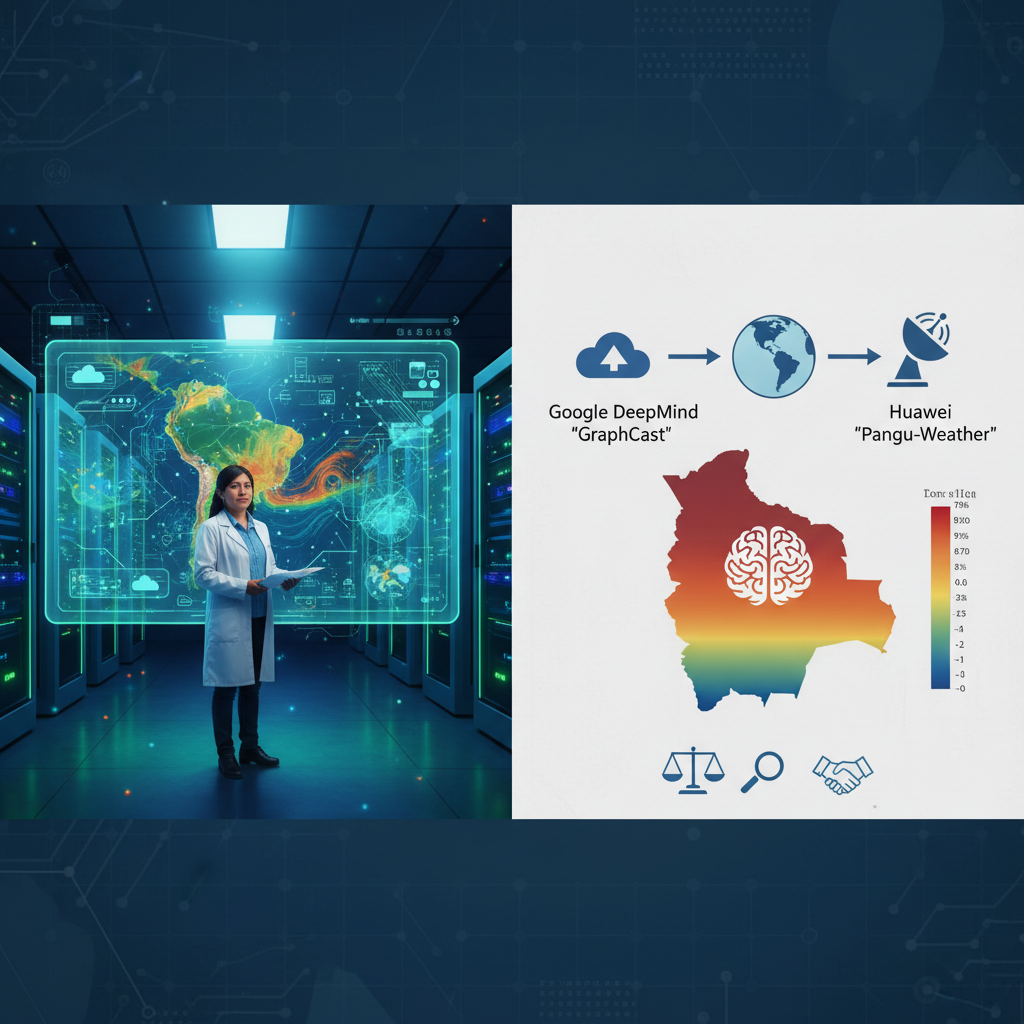
Take, for instance, Google DeepMind's GraphCast. This model, detailed in research published in Science, demonstrated superior accuracy over the European Centre for Medium Range Weather Forecasts, or Ecmwf, a global benchmark, in predicting hundreds of weather variables up to 10 days in advance. It achieved this in minutes on a single Google Tensor Processing Unit, or TPU, a fraction of the time and computational cost of traditional methods. Similarly, Huawei's Pangu Weather model has shown comparable prowess, rapidly generating global forecasts with high accuracy. These systems do not replace the fundamental physics but rather learn highly efficient approximations and correlations from data, making them incredibly fast and often more accurate for specific tasks.
Why It Matters: A Bolivian Imperative
For Bolivia, the implications are profound. Our agricultural sector, particularly in the altiplano and valleys, is highly vulnerable to unpredictable frosts, hailstorms, and droughts. Early and accurate warnings could mean the difference between a harvest and total crop loss, directly impacting food security and the livelihoods of thousands of families. Consider the annual rainy season, which often brings devastating floods and landslides. Improved forecasting could allow communities to prepare, evacuate, and mitigate damage more effectively. The altitude of innovation, as I often say, is not just about technological sophistication, but about its tangible impact on human lives and resilience.
Furthermore, Bolivia's unique position in the global lithium economy means that any disruption, whether from weather or other factors, has far reaching consequences. Reliable weather predictions can optimize mining operations, protect infrastructure, and ensure safer working conditions in challenging environments. "Bolivia's challenges require Bolivian solutions," a phrase often heard in our local development circles, applies here. We need tools that are not just theoretically powerful but practically adaptable to our specific geographic and socioeconomic realities.
The Technical Details, Made Accessible
At the core of these AI models are neural networks, specifically graph neural networks, or GNNs, and transformer architectures. GraphCast, for example, represents the Earth's atmosphere as a graph, with nodes representing grid points and edges representing connections between them. The GNN then processes information across this graph, learning how changes at one point influence others. This allows it to capture complex, non linear interactions across vast distances and different atmospheric layers.
Huawei's Pangu Weather, on the other hand, utilizes a 3D Earth Specific Transformer. This architecture is designed to handle the massive, high dimensional data of global weather, learning to extract features and predict future states with remarkable efficiency. Both models are trained on decades of reanalysis data, which combines historical observations with previous model outputs to create a comprehensive, consistent record of past weather. The sheer volume of this data, combined with advanced deep learning techniques, allows these AI systems to develop an intuitive understanding of atmospheric dynamics that surpasses traditional methods in certain predictive scenarios.
As Professor Bjorn Stevens, Director at the Max Planck Institute for Meteorology, noted in a recent publication, "The ability of these machine learning models to learn complex, non linear relationships from vast datasets is truly transformative. They offer a complementary, and in some cases superior, approach to traditional physical models, especially for short to medium range forecasting." This sentiment is echoed by many in the meteorological community, recognizing the paradigm shift underway. You can find more details on these advancements on platforms like MIT Technology Review and Nature Machine Intelligence.
Who Did the Research
The primary drivers of these specific breakthroughs are Google DeepMind and Huawei. Google DeepMind, known for its pioneering work in artificial intelligence, published its findings on GraphCast in December 2023. The team, led by Remi Lam, demonstrated the model's ability to forecast hundreds of atmospheric variables, including temperature, wind speed, and precipitation, with greater accuracy than the industry standard Ecmwf system. Their research highlighted the potential for AI to dramatically accelerate and improve weather prediction.
Similarly, Huawei's Cloud AI team, with researchers like Dr. Tianqi Chen, has been instrumental in developing Pangu Weather. Their work, also published in 2023, showcased a global AI weather forecasting system that can predict atmospheric states with high precision, significantly reducing the computational cost compared to traditional methods. These are not isolated academic exercises; they are the result of substantial investment and research by major technology companies seeking to apply AI to real world, large scale problems.
Implications and Next Steps
The immediate implication is clear: we are entering an era of more accurate and faster weather forecasts. This means better preparedness for extreme weather events, more efficient resource management, and potentially fewer lives lost. For Bolivia, this could translate into more resilient agricultural practices, improved infrastructure planning, and better public safety initiatives. However, the integration of these models into existing operational frameworks is not trivial. It requires significant investment in data infrastructure, training, and local expertise.
We must also consider the ethical dimension. Who owns these powerful forecasting models? How will their benefits be distributed, particularly to developing nations? Ensuring equitable access and building local capacity to utilize these tools will be crucial. It is not enough for a model to be accurate; it must also be accessible and actionable. "Let's talk about what actually works at 4,000 meters," is a question we must always ask, ensuring that these innovations are not just for the data centers of Silicon Valley but for the communities on the ground.
The future of weather forecasting is undoubtedly AI driven. The challenge now is to bridge the gap between cutting edge research and practical application, particularly in regions like ours where the stakes are highest. Collaborative efforts between international research institutions, local governments, and communities will be essential to harness this power for the betterment of all. The potential is immense, but the path forward requires careful navigation, grounded in reality and focused on tangible benefits for our people. For further insights into the broader AI landscape, consider exploring resources like TechCrunch's AI section.