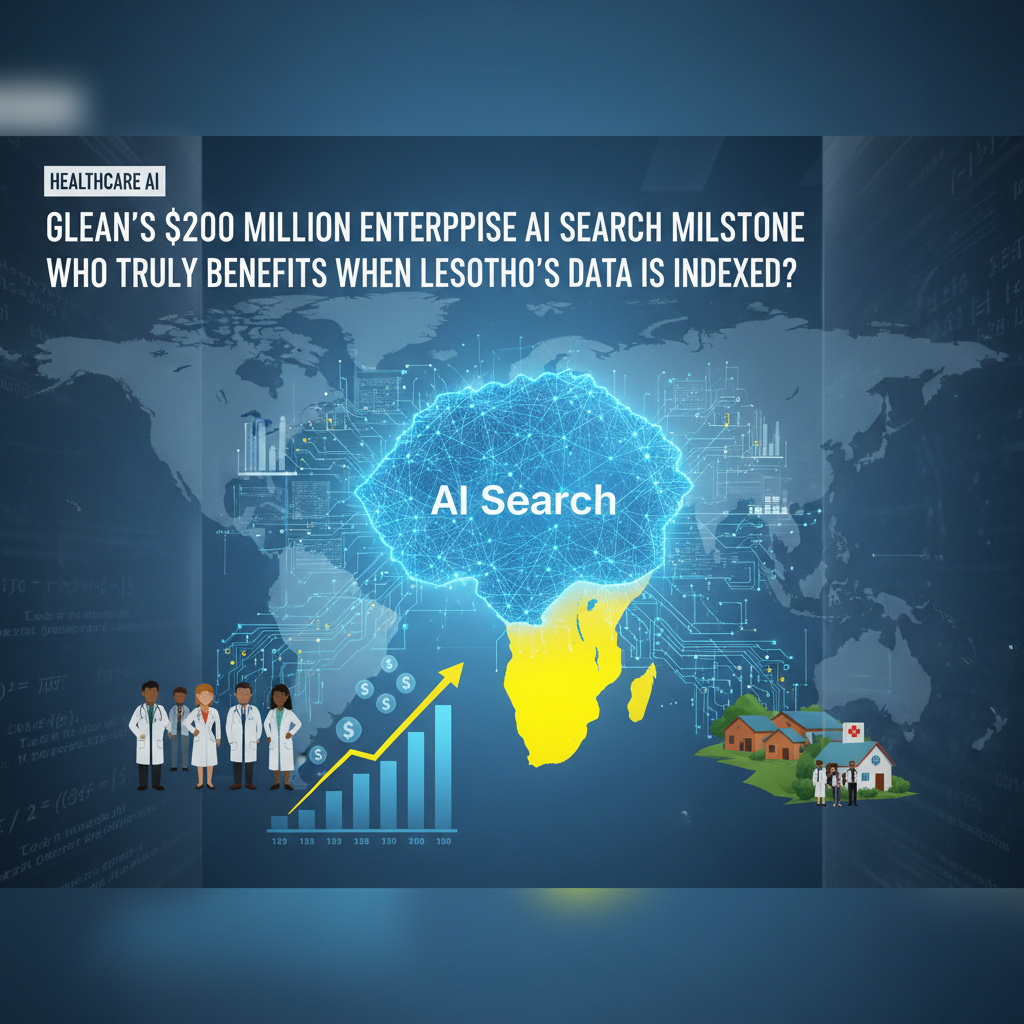

The digital landscape, much like the fertile valleys of Lesotho after a good rain, is constantly shifting and yielding new harvests. One such harvest, announced with considerable fanfare, is Glean's achievement of over $200 million in annual recurring revenue (ARR) for its enterprise AI search platform. This milestone, a testament to the surging demand for intelligent knowledge retrieval within corporations, marks Glean as a significant player in the competitive enterprise AI arena. However, from my vantage point in Maseru, such pronouncements always beg a deeper inquiry: who truly benefits from these technological triumphs, and what are the hidden costs, particularly for developing economies and their nascent digital infrastructures?
The breakthrough, in plain language, is about making corporate data universally accessible and searchable, regardless of where it resides. Imagine a large organization, perhaps a government ministry or a major bank in Maseru, with documents scattered across Google Drive, Microsoft SharePoint, Slack, Salesforce, and countless internal databases. Finding a specific piece of information, say, a policy document from five years ago or a client interaction record, can be a Sisyphean task. Glean's AI acts as a digital librarian, indexing and understanding the content across all these disparate sources, then allowing employees to find what they need with natural language queries. It is a powerful tool designed to eliminate information silos and boost productivity, promising to transform how knowledge workers operate.
Why this matters extends far beyond the boardrooms of Silicon Valley. As businesses and public institutions in Africa increasingly adopt cloud-based solutions and digital workflows, they too face the challenge of information fragmentation. The promise of Glean, and similar platforms from companies like Microsoft with its Copilot offerings or Google's enterprise search solutions, is to unlock latent value within an organization's collective knowledge. For a country like Lesotho, where institutional memory can be fragile and resources often scarce, efficient information retrieval could be transformative for sectors ranging from healthcare policy implementation to agricultural development strategies. The ability to quickly access historical data on crop yields, public health campaigns, or infrastructure projects could inform better decision-making and accelerate progress.
The technical details underpinning Glean's success involve a sophisticated blend of natural language processing (NLP), machine learning, and robust indexing architectures. At its core, the platform ingests vast quantities of unstructured and structured data from an enterprise's various applications. It then uses advanced language models, trained on general text and fine-tuned for enterprise-specific jargon, to understand the semantic meaning of documents and queries. When a user types a question, Glean's AI does not just match keywords; it comprehends the intent behind the query, retrieves relevant information, and often summarizes it or points to the most authoritative source. This involves techniques like vector embeddings, where documents and queries are converted into numerical representations in a high-dimensional space, allowing the system to find conceptually similar items even if they do not share exact keywords. Furthermore, Glean employs a personalization layer, learning from user behavior and organizational structure to deliver more relevant results over time, akin to a digital assistant that truly understands your role and context within the company. This is not merely a search engine; it is a knowledge graph builder, constantly mapping relationships between people, projects, and documents.
The research and development behind such platforms are often proprietary, but they draw heavily from decades of academic work in information retrieval and artificial intelligence. Companies like Glean leverage advancements made by institutions such as Stanford University, where many of its founders, including CEO Arvind Jain, have deep roots, and research labs like Google DeepMind and Meta AI. The evolution of transformer models, pioneered by Google researchers in 2017, and subsequent large language models (LLMs) have been instrumental in making semantic search a reality. These foundational breakthroughs, often published openly in venues like arXiv, are then refined and productized by companies like Glean to tackle specific enterprise challenges. The ecosystem of AI research is deeply interconnected, with academic insights frequently migrating into commercial applications at a rapid pace.
However, the implications and next steps for nations like Lesotho require careful scrutiny. While the efficiency gains are undeniable, the deployment of such powerful data-indexing tools raises critical questions about data sovereignty, privacy, and control. When a foreign entity indexes the entirety of a nation's institutional knowledge, even if it is for a private company or government department, where does that data truly reside? Who has access to the metadata, the search queries, and the usage patterns that can reveal sensitive insights into an organization's operations? What they're not telling you is that the power to search is also the power to surveil, to profile, and potentially, to control. For a small nation, entrusting core institutional memory to a platform whose servers and algorithms are largely opaque can be a precarious gamble.
Consider the healthcare sector in Lesotho. If the Ministry of Health were to adopt such a platform to manage patient records, research, and policy documents, the benefits in terms of accessibility and efficiency could be immense. However, the data, even if anonymized and encrypted, would still be processed by a third party. The terms of service, the data residency clauses, and the potential for foreign government access under differing legal frameworks become paramount. As I have often emphasized, we must always follow the money, and in this case, we must also follow the data. The value of this data, aggregated and analyzed, extends far beyond the immediate utility of a search result. It can be used to train future AI models, to identify trends, and to build profiles that could have geopolitical or economic ramifications.
Moreover, the cost of these sophisticated platforms, while justified by productivity gains in wealthier economies, can be prohibitive for many African institutions. This creates a digital divide, where those who can afford advanced AI tools gain a significant advantage, while others are left to grapple with outdated, inefficient systems. There is also the question of local capacity building. Are we merely consuming these technologies, or are we developing the expertise to understand, customize, and eventually build our own? Without indigenous capacity, we risk becoming perpetual consumers, dependent on foreign technology providers for our most critical information infrastructure.
As Glean celebrates its financial success, it is imperative for leaders in Lesotho and across Africa to engage in a robust dialogue about the governance of enterprise AI. We need clear policies on data sovereignty, stringent privacy regulations, and investment in local AI talent. The promise of AI to unlock knowledge is compelling, but the potential for unintended consequences, particularly in the realm of data control and privacy, cannot be ignored. The digital future of our continent depends not just on adopting new technologies, but on understanding their full implications and asserting our agency in shaping their deployment. The journey towards digital transformation must be navigated with both ambition and a healthy dose of skepticism, ensuring that the benefits truly accrue to our people and institutions, not just to the balance sheets of distant corporations. The lessons from the Basotho blanket, a symbol of protection and identity, remind us that what we cover and what we reveal are choices of profound consequence. We must choose wisely in this new digital era. For further insights into the complexities of AI in African contexts, one might consider the challenges faced in other sectors, such as those discussed in the article about Microsoft Copilot's Enterprise Mirage [blocked]. The underlying themes of dependency and local relevance remain constant. The conversation around AI's impact on global economies and societies is ongoing, with organizations like Reuters Technology frequently covering these developments, highlighting both the opportunities and the ethical dilemmas.