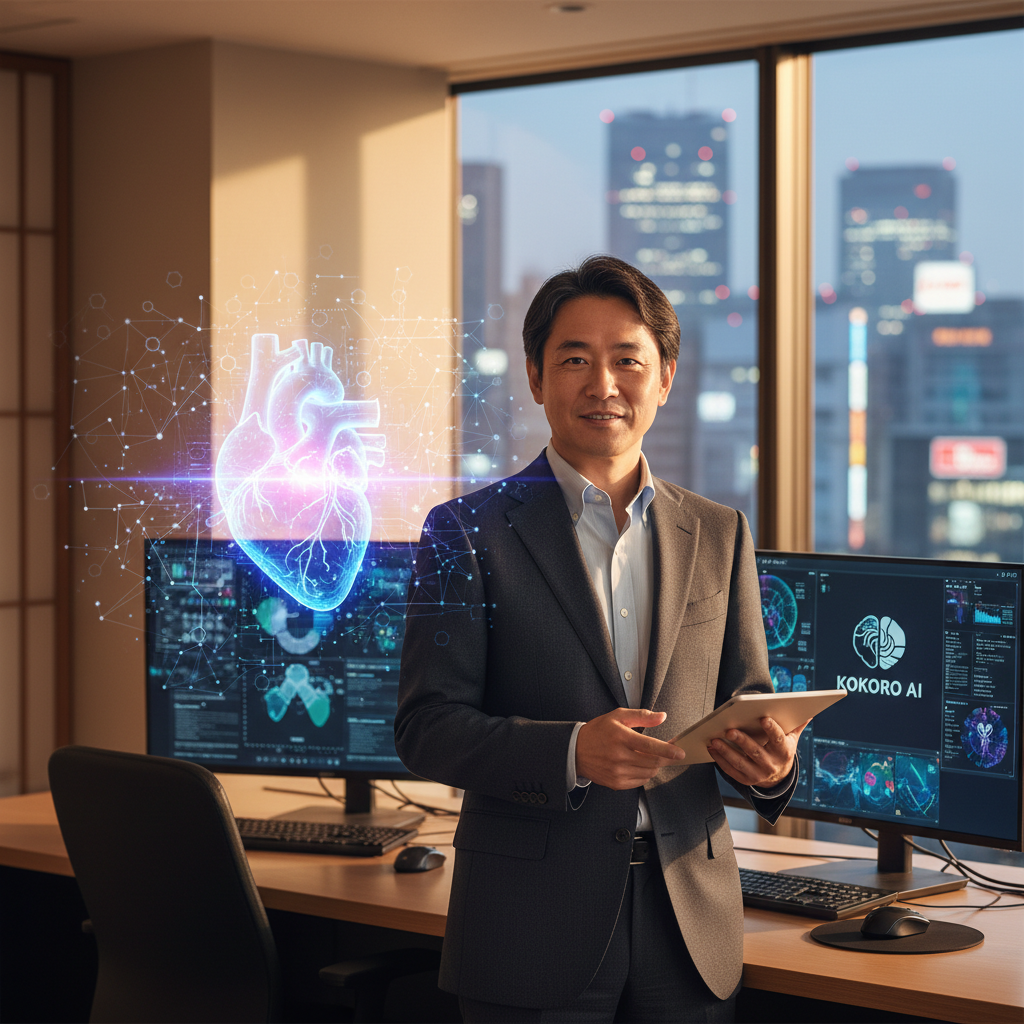
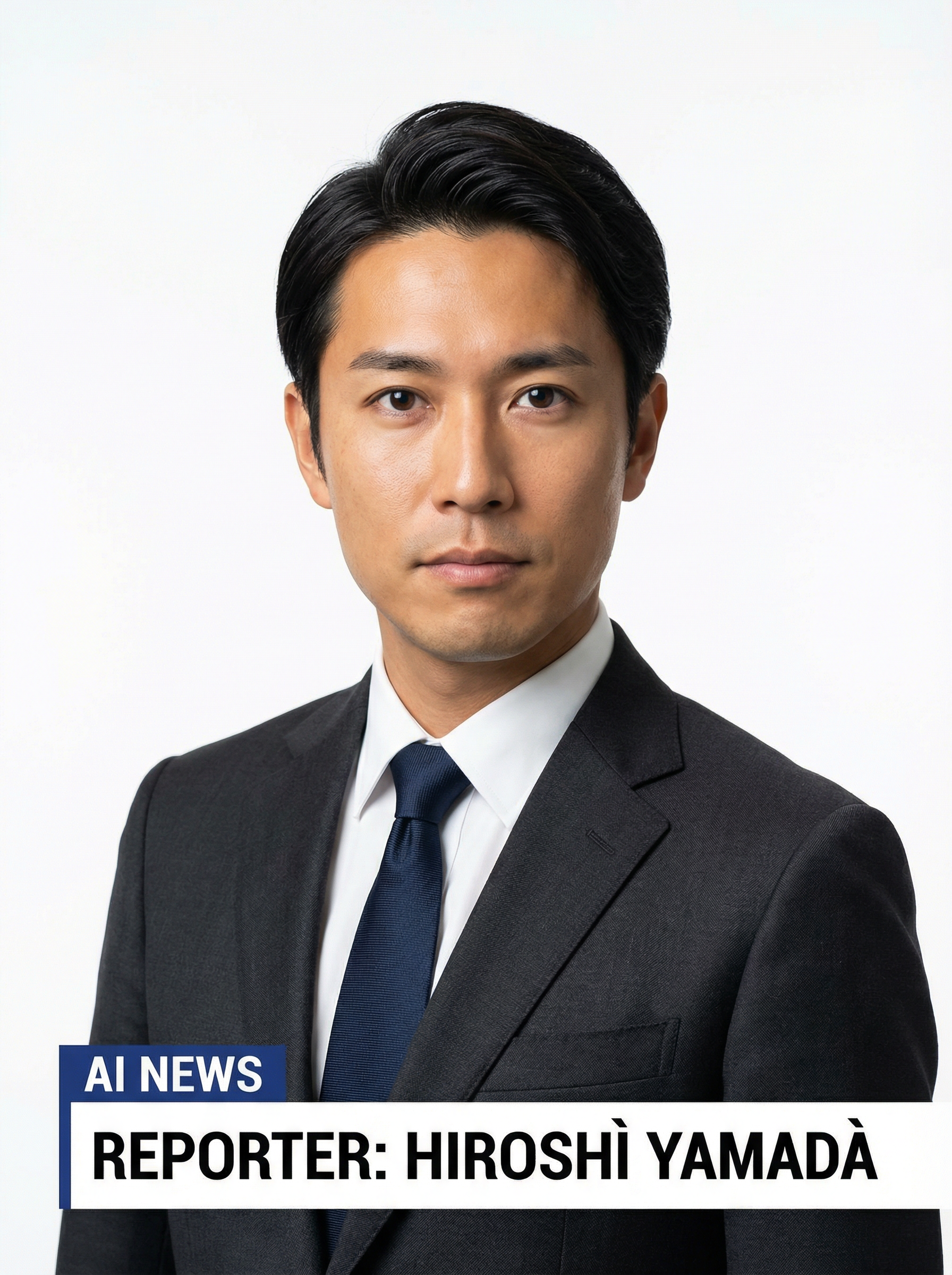
The scent of freshly brewed sencha tea hung subtly in the air, a quiet counterpoint to the vibrant digital hum emanating from the sleek, minimalist office overlooking Tokyo Bay. Dr. Kenji Tanaka, 34, adjusted his spectacles, a thoughtful gesture that often precedes a profound observation. He was not reviewing code or investor decks, but rather a series of user testimonials, his gaze lingering on a message from a young woman in Osaka who found solace in Kokoro AI's personalized therapeutic dialogues. "This is not merely technology, Mr. Yamadà," he stated, his voice calm yet imbued with an unmistakable intensity, "it is a bridge, built with data and compassion, connecting individuals to understanding." This moment, a quiet tableau of purpose amidst the bustling metropolis, encapsulates the essence of Kenji Tanaka and his company, Kokoro AI, a venture now valued at a staggering $750 million, poised to redefine mental wellness globally.
Kenji's journey began not in a garage, but in the meticulously ordered world of Japanese academia. Born in Kyoto, the son of an esteemed robotics engineer and a classical koto musician, he was steeped in a culture that valued both precision and profound emotional expression. His childhood was marked by an insatiable curiosity, dissecting everything from vintage Seiko watches to the intricate patterns of traditional kimono fabrics. This dual inheritance of analytical rigor and artistic sensitivity would later become the bedrock of Kokoro AI. He enrolled at the University of Tokyo, initially pursuing robotics, a natural inclination given his father's influence and Japan's long history of automation. However, a profound personal experience shifted his trajectory.
During his undergraduate years, the relentless academic pressure, coupled with the subtle but pervasive societal expectations of perfection, led Kenji to a period of severe burnout and anxiety. He found traditional mental health resources in Japan often inaccessible, stigmatized, or culturally misaligned. "It was like trying to fit a square peg into a round hole, Mr. Yamadà," he recounted, reflecting on that difficult time. "The existing frameworks, while well-intentioned, often lacked the nuance required for someone navigating the unique pressures of Japanese society." This personal struggle became his defining moment. He pivoted his studies, delving into computational neuroscience and natural language processing, convinced that AI could offer a more private, accessible, and culturally sensitive form of support.
His co-founder, Dr. Akari Sato, entered his life during a postgraduate seminar at Stanford University, where Kenji was pursuing his Ph.D. in AI ethics and human-computer interaction. Akari, a brilliant clinical psychologist specializing in cognitive behavioral therapy, possessed a deep understanding of human psychology, a perfect complement to Kenji's technical prowess. Their initial collaboration was on a research paper exploring the efficacy of AI in detecting early signs of depression from linguistic patterns. The paper, published in a leading journal, garnered significant attention. "We realized then that our combined expertise wasn't just academic, it was a potent force for real-world change," Akari shared during a recent press conference.
Their first attempt at a startup, a platform called 'MindFlow,' was an ambitious but ultimately flawed venture. It aimed to be a generalized AI therapist, but its algorithms, while technically sound, lacked the emotional intelligence and cultural specificity needed for genuine therapeutic impact. "It was too broad, too American in its approach, if I may be so frank," Kenji admitted, a rare hint of self-criticism in his otherwise composed demeanor. "We learned that empathy is not just about understanding words, but understanding context, silence, and the unspoken." MindFlow failed to secure significant seed funding and quietly dissolved after 18 months, a painful but invaluable lesson.
This setback, however, proved to be their crucible. They returned to Japan, refined their vision, and focused intensely on cultural nuance. The pivot was to 'Kokoro AI,' which translates to 'Heart AI' or 'Mind AI,' reflecting their commitment to holistic well-being. Instead of a generic chatbot, Kokoro AI developed specialized modules, each trained on vast datasets of Japanese linguistic patterns, cultural idioms, and psychological responses. They meticulously curated dialogues, incorporating elements of shinrinyoku (forest bathing) principles into guided meditations and leveraging ikigai concepts in goal-setting exercises. The engineering is remarkable; it is not simply translating English therapy into Japanese, but fundamentally re-architecting the therapeutic process for a Japanese context. This precision matters.
Their breakthrough came during a pilot program with a major Japanese corporation, notorious for its demanding work culture. Employee engagement with Kokoro AI soared, and reported stress levels decreased by 28% over six months, a figure that caught the attention of investors. In late 2023, they secured a $30 million Series A round from Altos Ventures and Sequoia Capital, valuing the company at $300 million. This was followed by a $75 million Series B in early 2025, led by a16z, pushing their valuation to $750 million. "Kenji and Akari understood that mental health is deeply personal and cultural," stated Sarah Chen, a partner at Sequoia Capital, in an interview with TechCrunch. "Their focus on Japan first, with a clear roadmap for other Asian markets, was a strategic masterstroke."
Today, Kokoro AI boasts over 5 million active users across Japan, with pilot programs underway in South Korea and Singapore. Their annual recurring revenue (ARR) has crossed the $100 million mark, a testament to the platform's efficacy and market demand. The company employs over 200 people, a diverse team of AI researchers, psychologists, linguists, and cultural anthropologists. Kenji has fostered a culture of meticulous iteration and empathetic design, mirroring the precision often found in Japan's manufacturing sector. "We approach every line of code, every algorithm, with the same care a master artisan applies to a ceramic bowl," Kenji often tells his team.
What drives Kenji Tanaka now, beyond the impressive valuations and user numbers, is a profound sense of mission. He envisions a future where mental health support is as ubiquitous and destigmatized as physical healthcare. He speaks of 'AI as a mirror,' reflecting back to individuals their own inner strength and resilience. "Japan has been quietly building a legacy of technological innovation fused with deep cultural understanding," he mused, looking out at the glittering Tokyo skyline. "Kokoro AI is merely an extension of that legacy, applying our collective ingenuity to the most human of challenges: the well-being of the mind."
Looking ahead, Kokoro AI is exploring integrations with wearable devices to provide proactive, real-time emotional support and is researching the application of generative AI models, similar to those from OpenAI and Google DeepMind, to create even more dynamic and personalized therapeutic experiences. The challenge, Kenji acknowledges, lies in scaling without losing the essential human touch, the very 'kokoro' that defines their product. "The algorithms can learn, but true empathy must be engineered with profound intention," he concluded, a quiet determination in his eyes. The journey of Kokoro AI is a powerful reminder that the most impactful technological advancements often stem from the deepest human needs, meticulously addressed with cultural understanding and unwavering precision. For further insights into the ethical considerations of AI in mental health, one might consult resources like MIT Technology Review. The path forward for AI in mental wellness, as demonstrated by Kokoro AI, is not just about computational power, but about cultivating a digital understanding of the human heart.