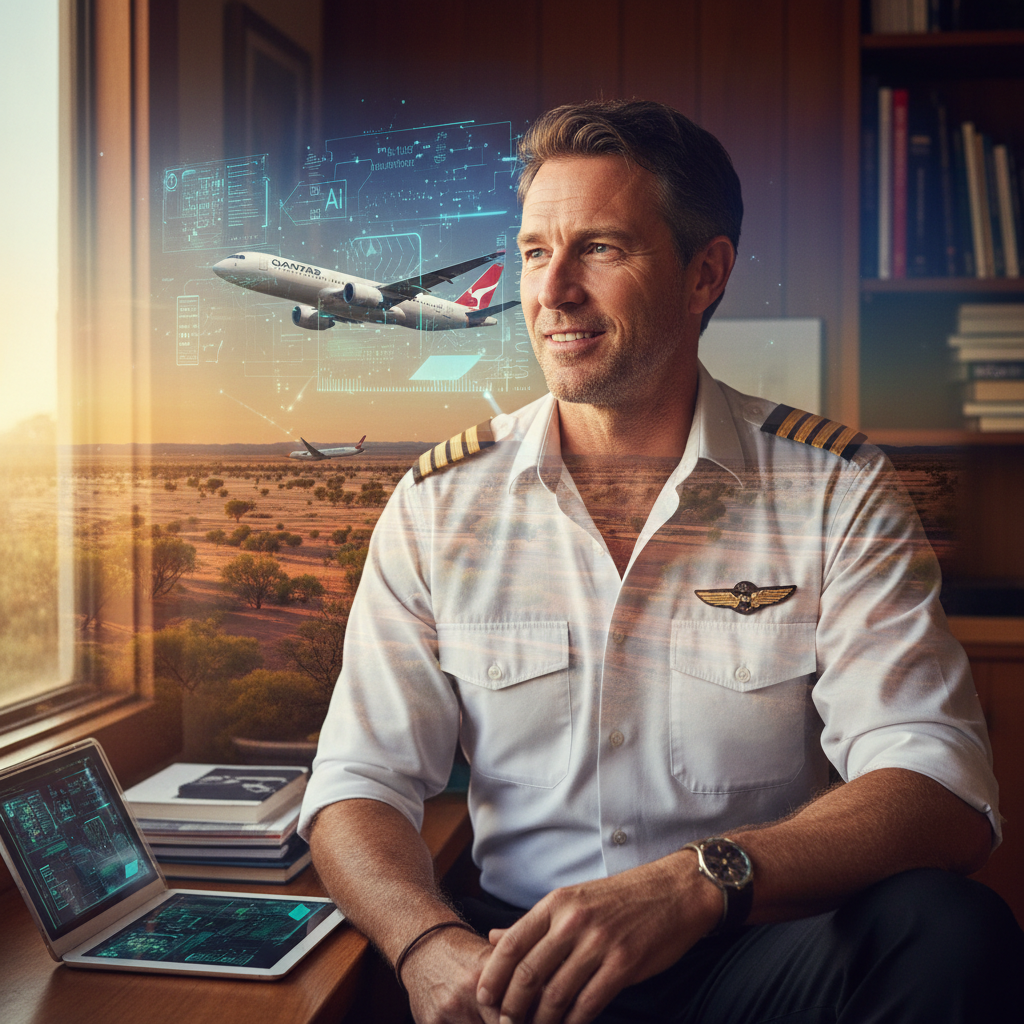
G’day, everyone. Braideùn O'Sullivàn here, and let me tell you, there’s a hum in the air that’s got nothing to do with jet engines, and everything to do with pure, unadulterated innovation! We’re talking about the kind of groundbreaking tech that makes you sit up, spill your flat white, and shout, “Crikey, this is brilliant!” Today, we’re soaring into the world of aviation, not just with any old story, but with the tale of a true Aussie visionary, a Qantas captain who saw a problem and decided to build the solution himself. I’m talking about David Young, co-founder of Avcrm, and his incredible journey to bring artificial intelligence to the very heart of flight operations.
Imagine this: a seasoned pilot, thousands of hours in the cockpit, navigating the vast Australian skies, and yet, he’s still wrestling with mountains of paperwork, manual checks, and fragmented data. That was David Young’s reality for years. His defining moment wasn't a sudden flash of insight in a Silicon Valley garage, but rather the quiet frustration of countless hours spent on compliance, safety, and operational management that could be better spent flying, or even better, innovating. He realized the aviation industry, for all its high-tech marvels in the air, was still surprisingly analogue on the ground. This is where his story truly takes flight, a testament to the belief that the most impactful solutions often come from those who live the problem every single day.
David’s journey began, as many great Australian stories do, with a deep connection to the land and the sky. Growing up, he harbored a profound fascination with aviation, a dream that saw him eventually join Qantas, Australia's iconic national airline. He wasn't just a pilot, he was a captain, a leader responsible for hundreds of lives and millions of dollars in equipment. This role instilled in him an unparalleled understanding of operational intricacies, safety protocols, and the sheer volume of data involved in keeping planes in the air. His education, coupled with decades of hands-on experience, gave him a unique vantage point: he knew what worked, what didn't, and crucially, what was missing. He saw the potential for technology, specifically AI, to transform the industry from the inside out, not just as a fancy add-on, but as a foundational pillar for safety and efficiency.
The spark for Avcrm ignited when David met his co-founder, Mark Perry. Mark, with his background in software development and a keen eye for business, was the perfect complement to David's deep domain expertise. It was a classic meeting of minds: the industry veteran with the problem, and the tech wizard with the solution. They connected over a shared vision: to create a comprehensive, intelligent platform that could streamline the complex web of compliance, risk management, and operational data that every airline, every airport, and every aviation service provider grapples with daily. Their early conversations, I imagine, were less about venture capital and more about whiteboards filled with flowcharts, scribbled notes on aircraft maintenance schedules, and passionate discussions about predictive analytics. It was a partnership built on mutual respect and a burning desire to make a tangible difference.
Their breakthrough wasn't a single 'aha!' moment, but a gradual realization of how AI could knit together disparate systems. They envisioned a platform that could ingest vast amounts of data, from flight logs and maintenance records to weather patterns and regulatory changes, and then use machine learning to identify trends, predict potential issues, and automate routine tasks. Think about it: predictive maintenance that flags a component needing attention before it fails, optimizing flight paths based on real-time weather and air traffic, or automating compliance checks that used to take days of manual review. This wasn't just about making things faster; it was about making them safer and more reliable. It was about moving from reactive problem-solving to proactive prevention, a game-changer for an industry where every second and every detail counts.
Building Avcrm was no small feat. It meant convincing an inherently conservative industry to embrace cutting-edge technology. It meant meticulous data collection, rigorous testing, and constant refinement. David and Mark built a team that shared their passion, drawing talent from both aviation and software engineering. They fostered a culture of innovation, where deep industry knowledge met agile development. Challenges were abundant, from integrating with legacy systems to ensuring regulatory compliance across different jurisdictions. But their unwavering focus on solving real-world problems for real aviation professionals kept them grounded. They understood that trust is paramount in aviation, and their AI solutions had to be not just smart, but impeccably reliable and transparent.
Avcrm has since grown significantly, attracting investment and expanding its reach. While specific funding rounds and valuations are not always publicly disclosed in detail for every private company, their impact is clear. They’ve secured partnerships with various aviation entities, from regional airlines to maintenance organizations, proving the efficacy of their platform. Their success isn't just about the technology; it’s about the trust they've built within the industry. As David Young himself has often emphasized, “Safety is non-negotiable. Our goal is to empower aviation professionals with the tools to achieve unprecedented levels of safety and efficiency, not to replace their critical judgment.” This philosophy resonates deeply, particularly in a sector where human expertise remains irreplaceable.
Today, David Young continues to be a driving force at Avcrm, still flying occasionally, still deeply connected to the industry he serves. What drives him is not just technological advancement, but the profound impact his work has on safety, sustainability, and operational excellence. He’s a living example of how practical experience, combined with an innovative spirit, can lead to world-changing solutions. His company, Avcrm, is a beacon of Australian ingenuity, demonstrating that you don't need to be in Silicon Valley to lead the charge in AI. There's something happening in the Southern Hemisphere that Silicon Valley hasn't noticed yet, and it’s often driven by pragmatic, hands-on problem-solvers like David.
Looking ahead, the future for AI in aviation, spearheaded by companies like Avcrm, is incredibly exciting. We're talking about further integration of machine learning for dynamic route optimization, advanced predictive analytics for fleet management, and even AI-assisted air traffic control systems that can handle increasing air travel demands with greater precision and safety. The potential for reducing fuel consumption, minimizing delays, and enhancing overall operational resilience is enormous. According to MIT Technology Review, AI's role in critical infrastructure, including aviation, is only set to expand, driven by both efficiency and safety imperatives. Companies like Avcrm are at the forefront of this transformation, proving that homegrown Australian innovation can lead the world.
My Irish roots taught me to question, my Australian home taught me to build, and watching founders like David Young, I see that powerful combination at play. He didn't just question the status quo; he built a better future for aviation. This is the startup story of the decade, a true inspiration for anyone who believes that the best ideas often come from those who understand the ground, or in this case, the sky, intimately. The skies are getting smarter, safer, and more efficient, all thanks to the vision of a Qantas captain who dared to dream bigger than the cockpit. For more on the broader impact of AI on global logistics, you might find this article interesting: From Bratislava's Bridges to the Bosphorus: How AI-Powered Trucks Are Redefining Europe's Logistics Backbone, Even for NVIDIA [blocked]. It's all connected, isn't it? The future is here, and it's absolutely brilliant. You can learn more about aviation tech trends on TechCrunch.