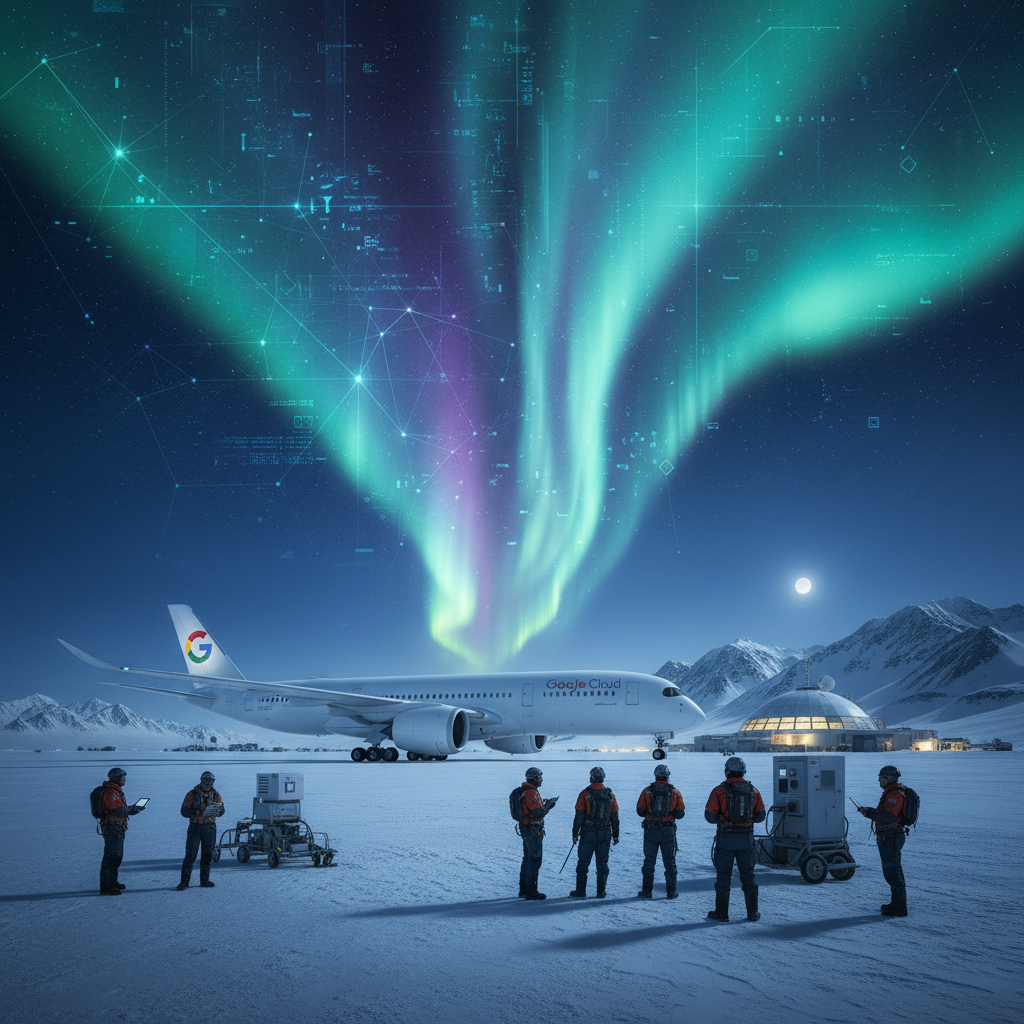

Last night, the aurora lit up our research station with a spectral dance of greens and purples, a reminder of the raw, untamed beauty that surrounds us here in Antarctica. It is a place of profound silence, where the vastness of nature dwarfs even the grandest human endeavors. Yet, even here, the echoes of Silicon Valley's biggest gambles reverberate, particularly the colossal $13 billion Microsoft poured into OpenAI. The question that hangs in the crisp, cold air, much like the ice crystals, is simple: is it paying off, not just for Redmond, but for the world, for science, for us?
From my vantage point, nestled between the frozen sea and the endless sky, I see technology not as a distant abstract, but as a lifeline, a tool for survival and discovery. The partnership between Microsoft and OpenAI, forged in the fires of ambition and innovation, was meant to accelerate AI's integration into everything, from everyday software to complex scientific modeling. For us, working on the front lines of climate change research, the promise of advanced AI is particularly poignant. We are drowning in data: satellite imagery of melting glaciers, sensor readings from beneath the ice sheets, acoustic data from the deep ocean. Manual analysis is a Sisyphean task. This is where AI looks like the end of the world, a beacon of hope in a sea of raw information.
Dr. Lena Karlsson, a glaciologist from the Swedish Polar Research Secretariat who often collaborates with our station, puts it plainly during one of our rare satellite calls. "The sheer volume of data we collect on ice dynamics is staggering. We need AI to identify patterns, predict changes, and ultimately, to understand the health of our planet. Microsoft's Azure AI infrastructure, powered by OpenAI's models, has made some inroads, yes, but the true 'holy grail' of predictive modeling is still just beyond our grasp." She speaks of the promise of GPT-4 and its successors, not as chatbots, but as intelligent agents capable of sifting through petabytes of unstructured environmental data, identifying anomalies that human eyes might miss.
Microsoft's investment, reportedly initiated with a $1 billion infusion in 2019, followed by further substantial commitments, has fundamentally reshaped the AI landscape. It has propelled OpenAI from a research lab to a global powerhouse, and in turn, cemented Microsoft's position as a leader in AI integration. Their strategy has been clear: infuse OpenAI's large language models and generative AI capabilities into their vast product ecosystem, from Office 365 Copilot to GitHub Copilot, and of course, Azure AI services. The financial results have been impressive, with Microsoft reporting significant growth in Azure revenue, often attributed to AI services demand. Satya Nadella, Microsoft's CEO, has frequently emphasized that AI is not just another feature, but a new way of working, a new operating model for the world. He stated in a recent earnings call, "We are seeing unprecedented demand for our AI services, and our partnership with OpenAI is at the core of delivering this next generation of AI to our customers." This sentiment is echoed across the industry, with many analysts at Bloomberg Technology highlighting the strategic brilliance of the early investment.
But what about the human element, the researchers like us who are trying to make sense of a changing world? In the silence of Antarctica, you hear things differently. You hear the creak of the ice, the whistle of the wind, and sometimes, the quiet hum of servers processing data. For a long time, accessing cutting-edge AI tools required a level of computational power and expertise that was simply out of reach for many smaller research groups, especially those operating in remote locations. The democratization of AI, through platforms like Azure AI and OpenAI's APIs, has been a significant positive outcome. Researchers can now leverage models that would have taken years and immense resources to train from scratch.
Consider the work being done on sea ice prediction. Accurate forecasts are vital for shipping, scientific expeditions, and understanding global climate patterns. Traditionally, this involved complex numerical models and expert human interpretation. Now, with the help of AI models, we can process vast datasets from satellites, buoys, and autonomous underwater vehicles with greater speed and accuracy. Dr. Ingrid Svensson, a Swedish oceanographer who once spent a season here, shared with me via a video call how her team is using OpenAI's models, accessed through Azure, to analyze historical sea ice data and identify subtle shifts that might indicate future trends. "It is not a magic bullet," she cautioned, "but it is like having an army of tireless assistants. It frees up our human intelligence for the truly complex interpretive work." This is a testament to the partnership's potential, moving beyond mere technological prowess to practical, impactful applications.
However, the journey has not been without its challenges. The rapid pace of AI development has raised ethical concerns, from bias in models to the potential for misuse. The energy consumption of training and running these massive models is also a significant environmental footprint, a paradox not lost on those of us studying climate change. There are also questions about the long-term sustainability of such a dominant partnership. While the collaboration has accelerated progress, some critics wonder if it stifles competition or centralizes too much power in the hands of a few tech giants. The discussions around AI safety and responsible development, often highlighted by organizations like MIT Technology Review, are more critical than ever.
From the perspective of our remote station, the investment's payoff is a mixed bag, much like the weather here. We see the immense potential, the tantalizing glimpses of a future where AI can truly augment human understanding of our planet's most delicate systems. We are leveraging these tools to analyze seismic data from icequakes, to track penguin populations through image recognition, and to predict extreme weather events with greater precision. The accessibility provided by Microsoft's cloud infrastructure, coupled with OpenAI's models, has undeniably advanced our capabilities. It is not just about the billions invested, but about the ripple effect, the empowerment of scientists and researchers globally.
Yet, the human element remains paramount. The AI models are powerful, but they are tools. They require human ingenuity to pose the right questions, human ethics to guide their development, and human empathy to interpret their findings for the benefit of all. The $13 billion investment has certainly paid off in terms of market dominance and technological advancement for Microsoft and OpenAI. For us, living and working at the edge of the world, its true value will be measured in the insights it helps us uncover, the warnings it helps us heed, and ultimately, the future it helps us protect. It is a powerful story, still unfolding, against the backdrop of the world's most magnificent and vulnerable continent. The next time the aurora paints the sky, I will be thinking of the silent algorithms working tirelessly, alongside dedicated humans, to understand its secrets. For more on the broader implications of AI in science, you might find this article on Apple Vision Pro's Neural Compass [blocked] interesting, as it touches on how AI is forging new realities in scientific exploration.