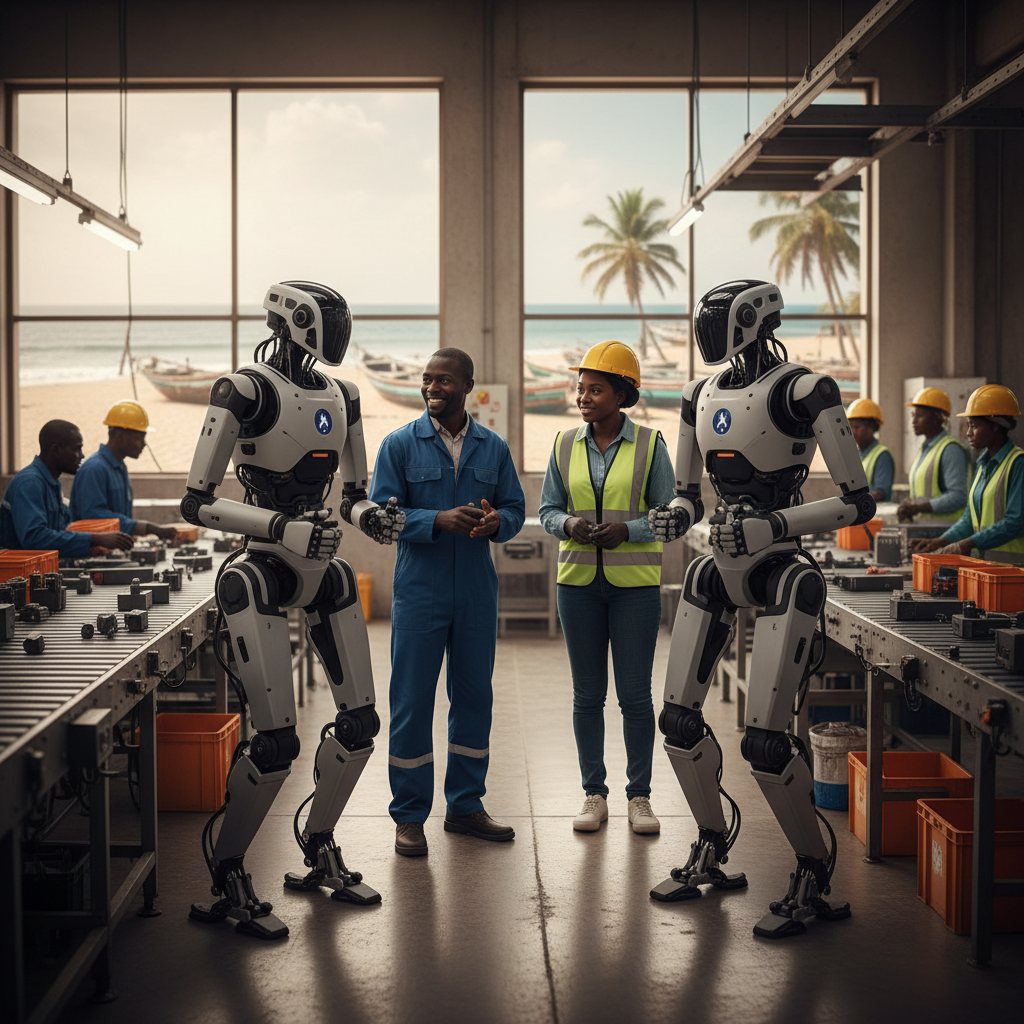

In Senegal, we have a saying: “Ku bëgg lu neex, na muñ lu metti.” It means, “Whoever wants pleasure must endure pain.” It speaks to the effort, the patience, and sometimes the struggle, required to achieve something truly remarkable. Today, I want to tell you a story about a different kind of effort, one where machines are learning to endure the repetitive, the strenuous, and sometimes the dangerous tasks, freeing up human hands for other work. This is a story about people, not algorithms, but it is also a story about the robots that are changing their lives, and the visionaries behind them.
I recently found myself thinking about the bustling markets of Dakar, the rhythm of daily life, and the constant hum of human activity. Then, I turned my attention to a different kind of hum, the whirring and clicking of humanoid robots, specifically those from a company called Agility Robotics. Their creation, Digit, is not some far off science fiction dream; it is a reality already working in warehouses and factories, making its way across continents. And for us in Africa, understanding these shifts is not just about technology, it is about our future, our jobs, and our place in a changing world.
The journey of Agility Robotics began not in a bustling factory, but in the quiet halls of Oregon State University. Jonathan Hurst, a professor of robotics, co-founded the company in 2015 with a clear vision: to build robots that could move like people, navigating human environments with ease. Their initial work focused on bipedal locomotion, understanding the complex physics of walking and balancing. It was a painstaking process, much like a child learning to walk, full of falls and restarts. But their perseverance paid off. Their early robot, Cassie, demonstrated incredible agility, and that laid the groundwork for Digit.
Their “aha moment,” as Dr. Hurst often describes it, came from realizing that existing industrial robots were great at fixed, repetitive tasks, but terrible at adapting to dynamic, human-centric spaces. Warehouses, for instance, are designed for people, with stairs, narrow aisles, and objects placed at human-friendly heights. Traditional wheeled robots struggle here. A bipedal robot, however, could theoretically navigate these spaces, pick up boxes, and even climb stairs, integrating seamlessly into existing infrastructure without requiring massive overhauls. This insight was the spark that ignited Agility Robotics’ commercial path.
So, what exactly is Digit? Imagine a robot that stands about 5 feet 7 inches tall, weighs around 140 pounds, and can lift and move packages weighing up to 35 pounds. It has two arms, two legs, and a torso, much like a human. But its true magic lies in its advanced control systems and sensors. Digit uses a combination of cameras, LiDAR, and other sensors to perceive its environment, build a 3D map, and plan its movements. Its bipedal locomotion allows it to walk forwards, backwards, and sideways, traverse uneven terrain, and even climb a few steps. It is powered by sophisticated AI algorithms that enable it to learn and adapt to new tasks, making it more than just a pre-programmed machine.
I sat down with a logistics expert, Madam Aminata Diop, who runs a freight forwarding company right here in Dakar. Her eyes lit up when she told me, “The idea of a robot that can work alongside my team, handling the heavy lifting and repetitive sorting, is incredibly appealing. We face challenges with labor shortages for certain tasks, and the physical strain on our workers is real. If Digit can truly integrate without demanding a complete redesign of our warehouses, it could revolutionize our efficiency and improve working conditions.” This sentiment echoes what Agility Robotics aims for: augmentation, not outright replacement, at least for now.
The market opportunity for humanoid robots like Digit is vast and growing. The global logistics and warehousing market alone is projected to reach trillions of dollars in the coming years, and labor costs are a significant component. Companies like Amazon, which has invested heavily in robotics, are constantly seeking ways to optimize their operations. Agility Robotics announced a significant milestone in 2023, raising over $150 million in funding, with investors including Dcvc and Playground Global. This capital injection is fueling their expansion, with plans to scale up manufacturing and deploy Digit to more customers. Ford Motor Company, for example, has been an early adopter, testing Digit for last-mile delivery and factory logistics, showcasing its potential beyond just warehouses.
When we look at the competitive landscape, Agility Robotics is certainly not alone. Companies like Boston Dynamics, with their famous Atlas and Spot robots, have demonstrated incredible mobility and dexterity, though their focus has been more on research and specialized applications. Tesla, under Elon Musk, has also unveiled its Optimus humanoid robot, aiming for mass production and broad utility, though it is still in earlier stages of development. Then there are companies like Sanctuary AI, focusing on general-purpose humanoids capable of a wider range of tasks. What sets Agility Robotics apart is its pragmatic approach to commercialization, targeting specific, high-value tasks in logistics and manufacturing where bipedal mobility offers a distinct advantage.
As we look ahead, the implications for places like Senegal are profound. While the initial deployments of Digit are happening in developed economies, the lessons learned, and the technology itself, will inevitably find their way to our shores. We must ask ourselves: how do we prepare our workforce for a future where robots handle some of the tasks traditionally done by humans? How do we ensure that this technological advancement leads to prosperity and not displacement? It is a question that resonates deeply with our proverb, “Nit ku baax du jàpp sa loxo rekk, day jàpp sa xol.” A good person does not just hold your hand, they hold your heart. We need to ensure that technology, too, holds the heart of humanity in its progress.
Dr. Ayodele Odusola, a prominent economist specializing in African development, shared his perspective with me. “The rise of humanoid robots presents both challenges and opportunities for African economies. While concerns about job displacement are valid, there is also the potential for these robots to fill critical labor gaps in sectors like agriculture, mining, and infrastructure, where human labor is often scarce or dangerous. The key will be investing in education and training programs that equip our youth with the skills to work alongside, manage, and even develop these advanced technologies.” His words remind us that adaptation is key.
Agility Robotics is currently focused on scaling production, aiming to produce thousands of Digit robots in the coming years. They are also continuously refining Digit’s AI, enhancing its ability to perceive, learn, and interact more naturally with its environment and human co-workers. The goal is not just a robot that walks, but one that understands its role and contributes meaningfully to a team. According to TechCrunch, the demand for automation solutions in logistics is skyrocketing, making Agility Robotics' timing quite opportune.
The journey of humanoid robots like Digit is just beginning. It is a testament to human ingenuity, a story of perseverance, and a glimpse into a future where the line between human and machine work becomes increasingly blurred. For us in Senegal, and across Africa, this is not just a distant technological trend; it is a call to action. A call to educate, to innovate, and to shape a future where these powerful tools serve our communities and uplift our people. The path ahead may have its challenges, but as we say, “Ndank ndank, mooy jàpp golo ci ñaay.” Slowly, slowly, one catches the monkey in the bush. Progress, like catching a clever monkey, requires patience and a steady hand. We must approach this new era with both.
For more insights into the broader impact of AI on the workforce, you might find this article on Amazon's Robot Army [blocked] interesting. The conversation around automation is global, and it is one we must all engage in thoughtfully. The future, after all, is built by the choices we make today, not just by the robots we build. It is a future where the human spirit, with its capacity for innovation and compassion, must always lead the way. You can also learn more about the broader implications of AI and robotics on society by visiting MIT Technology Review. The discussions there often touch on the ethical and societal questions that these advancements bring.