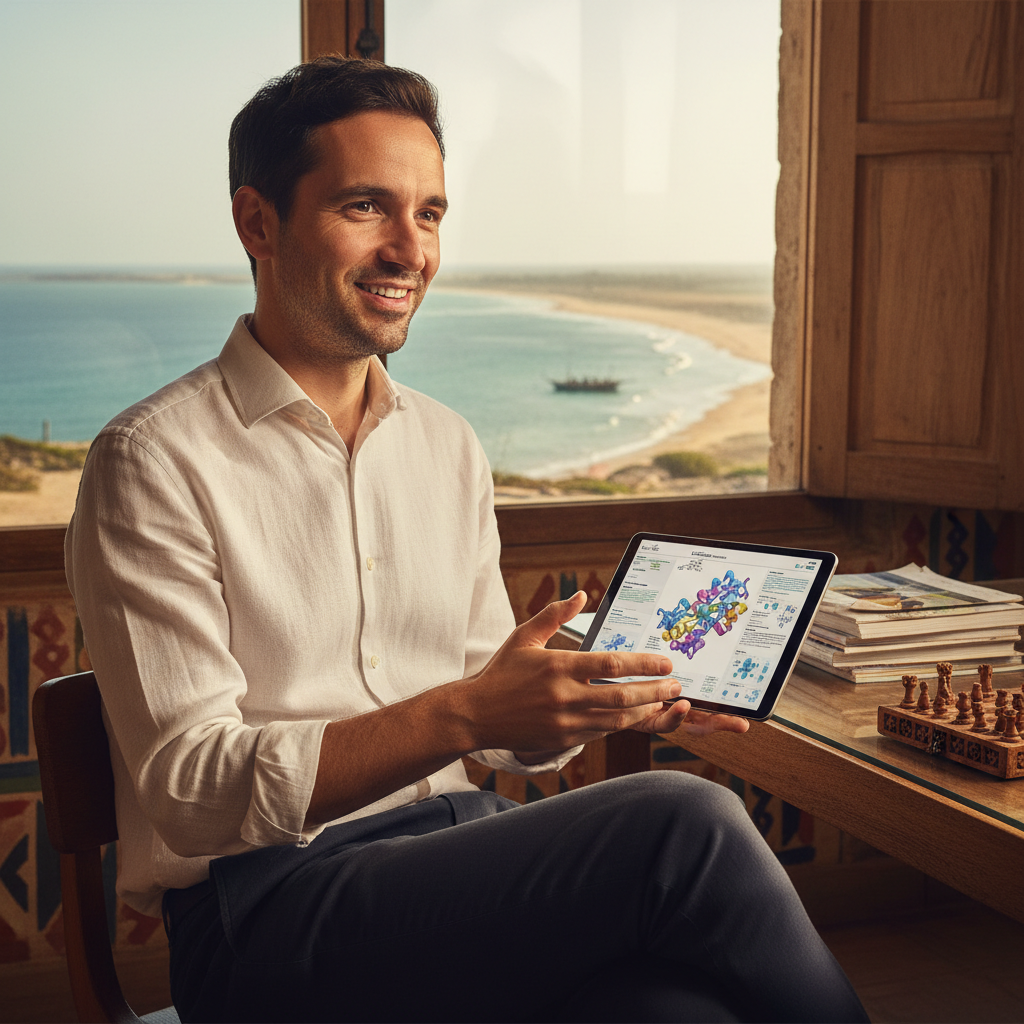
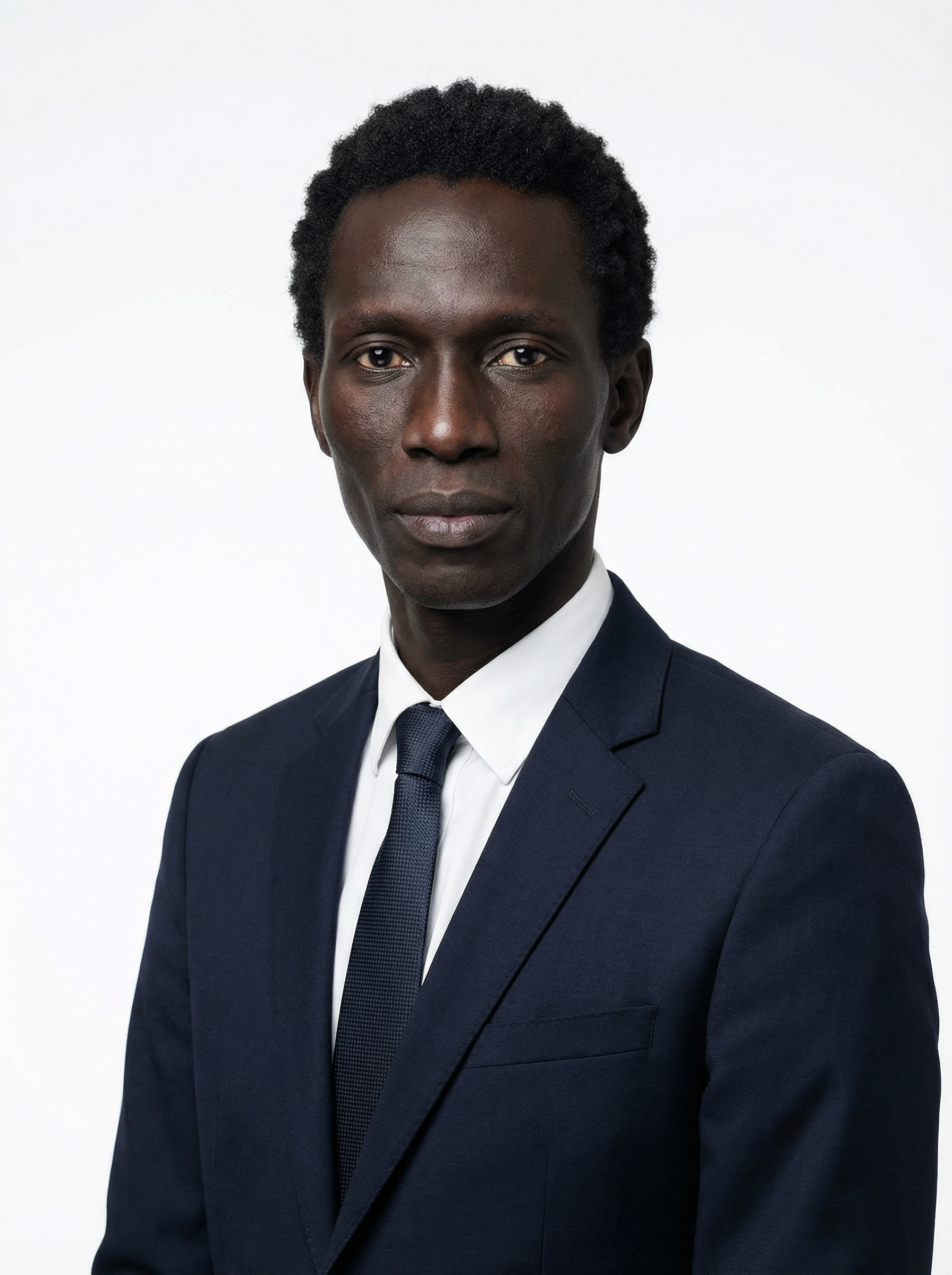
The humid air of Dakar, thick with the scent of spices and the murmur of conversation, feels a world away from the sterile laboratories of London or Silicon Valley. Yet, in the silent hum of advanced computing, the work of one man, Demis Hassabis, the visionary co-founder and CEO of Google DeepMind, casts a long, transformative shadow even here, across the continent of Africa. His creation, AlphaFold, a marvel of artificial intelligence, is not merely an academic triumph; it is a tool reshaping the very fabric of drug discovery and materials science, with implications that resonate deeply in regions grappling with endemic diseases and limited resources.
My sources tell me that the true impact of such breakthroughs often extends far beyond the immediate headlines. While the world celebrates AlphaFold's ability to predict protein structures with unprecedented accuracy, the quiet revolution it sparks in pharmaceutical research holds immense promise for nations like Senegal, where the fight against malaria, tuberculosis, and neglected tropical diseases is a daily reality. This is not just about abstract science; it is about access to life-saving treatments and the potential for a healthier future.
Demis Hassabis's journey to becoming one of the most influential figures in artificial intelligence is a narrative steeped in intellectual curiosity and a relentless pursuit of understanding. Born in London in 1976 to a Greek Cypriot father and a Singaporean Chinese mother, Hassabis was a child prodigy. His early life was marked by an extraordinary aptitude for chess, which he mastered to an international level by his teenage years, and a precocious talent for computer programming. At just 16, he joined the legendary game developer Bullfrog Productions, where he contributed to iconic titles like Theme Park. This early immersion in game design, a complex interplay of rules, strategy, and emergent behavior, would later prove foundational to his thinking about AI.
His academic path led him to Queen's College, Cambridge, where he studied Computer Science, graduating with a double first class honors degree. After a brief return to the gaming industry, founding Elixir Studios, Hassabis pivoted sharply towards neuroscience. He pursued a PhD in cognitive neuroscience at University College London, focusing on memory and imagination, a period that profoundly shaped his understanding of intelligence itself. He often speaks of the brain as the ultimate algorithm, a perspective that would guide his subsequent endeavors.
The pivotal moment came in 2010 when Hassabis co-founded DeepMind with Shane Legg and Mustafa Suleyman. Their shared ambition was audacious: to solve intelligence and use it to solve everything else. The early days were characterized by intense research, a small team, and a grand vision. They were not just building algorithms; they were building an entirely new approach to AI, one rooted in reinforcement learning and neural networks, inspired by the human brain. The documents reveal their early focus on general-purpose AI, aiming for systems that could learn and adapt across diverse tasks, not just specialized ones.
DeepMind's breakthrough came with AlphaGo, an AI program that defeated the world champion Go player, Lee Sedol, in 2016. This was a watershed moment, demonstrating AI's capacity for intuition and strategic thinking previously thought exclusive to humans. But for Hassabis, Go was merely a stepping stone. The real prize was biology. He saw the protein folding problem, a grand challenge in biology for over 50 years, as the perfect test for DeepMind's advanced AI systems.
Building AlphaFold was an immense undertaking, requiring years of dedicated research and vast computational resources. The team, comprising biologists, physicists, and AI researchers, had to bridge disciplinary divides. Their approach involved training a deep learning system on the known structures of tens of thousands of proteins. The breakthrough came in 2020, when AlphaFold 2, a refined version of their system, achieved accuracy comparable to experimental methods, effectively solving the protein folding problem. This was hailed as one of the most significant scientific advances of the decade.
The implications for drug discovery are staggering. Traditionally, determining a protein's 3D structure, crucial for understanding its function and designing drugs that interact with it, could take years and millions of dollars using experimental techniques like X-ray crystallography or cryo-electron microscopy. AlphaFold can predict these structures in minutes or hours. This acceleration means that researchers can now rapidly identify potential drug targets, design novel compounds, and understand disease mechanisms with unprecedented speed. As Hassabis himself stated in a Reuters interview,