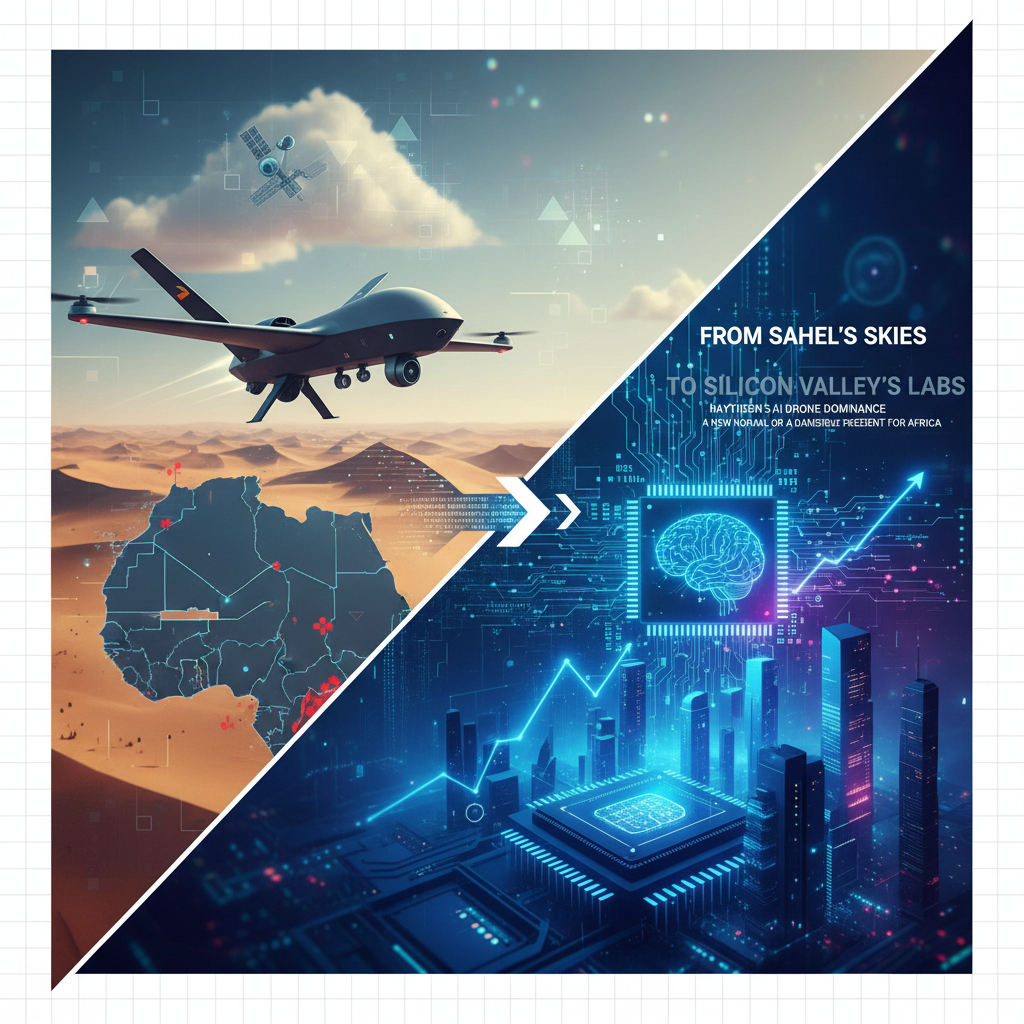
Is the future of conflict to be orchestrated by algorithms, with human oversight relegated to a mere formality? This is not a hypothetical question for defense strategists in Washington or Beijing alone. It is a pressing concern for nations like Senegal, grappling with evolving security challenges and the relentless march of technological advancement. The trend of artificial intelligence permeating military applications, from drone warfare to fully autonomous weapons, is accelerating at a pace that demands meticulous scrutiny.
Historically, the concept of machines making life or death decisions on the battlefield has been confined to the realm of science fiction. Yet, the seeds of this future were sown decades ago. Precision-guided munitions in the Gulf War, for instance, marked a significant step towards automated targeting. The advent of remotely piloted aircraft, or drones, fundamentally reshaped modern warfare in the early 21st century. These systems, while controlled by human operators, introduced a new layer of abstraction to combat, reducing the direct human cost for the aggressor and often increasing it for the targeted. The shift from human-in-the-loop to human-on-the-loop and now, increasingly, human-out-of-the-loop, represents a profound ethical and operational transformation.
Today, we are witnessing an unprecedented surge in investment and development in autonomous weapons systems. Major defense contractors, such as Raytheon, Lockheed Martin, and Northrop Grumman, are at the forefront, pouring billions into research and development. Raytheon, for example, has been aggressively acquiring AI startups specializing in computer vision and predictive analytics, integrating these capabilities into its advanced drone platforms and missile systems. My sources tell me that their 'Project Sentinel', a highly classified initiative, aims to develop AI-powered reconnaissance drones capable of independent target identification and engagement, dramatically reducing latency in critical decision cycles. This is not merely about faster reaction times; it is about delegating the decision to kill.
Data from the Stockholm International Peace Research Institute (sipri) indicates that global spending on military AI surged by an estimated 35% between 2023 and 2025, reaching nearly $40 billion annually. A significant portion of this is directed towards autonomous systems. The United States Department of Defense, through its Joint Artificial Intelligence Center (jaic), has outlined ambitious plans to deploy AI across all domains of warfare, from logistics to combat operations. China's military, the People's Liberation Army, is equally committed, with its 'Intelligentized Warfare' doctrine explicitly calling for AI integration to achieve battlefield superiority. The competition is fierce, and the stakes are existential.
For Africa, the implications are particularly acute. While many African nations, including Senegal, are not direct developers of these advanced systems, they are often the recipients or the battlegrounds where these technologies are tested and deployed. The proliferation of cheaper, AI-enabled drones, often from non-state actors or less scrupulous vendors, poses a significant threat to regional stability. "The ethical quandaries are immense," states Dr. Aïcha Diallo, a leading expert in international law and emerging technologies at Cheikh Anta Diop University in Dakar. "How do we hold an algorithm accountable for war crimes? Who bears the responsibility when an autonomous system makes a fatal error? These are not trivial questions; they demand international legal frameworks that simply do not yet exist." Dr. Diallo's concerns echo those of many across the continent, where the scars of conflict are still fresh and the pursuit of peace remains paramount.
Indeed, the ethical boundaries are being redrawn with alarming speed. The Campaign to Stop Killer Robots, a coalition of NGOs, has been vocal in its call for a pre-emptive ban on fully autonomous weapons. However, major military powers have resisted, citing national security interests and the perceived tactical advantages these systems offer. "The notion that these systems will reduce civilian casualties is a dangerous illusion," argues General Mamadou Konaté, a retired Senegalese Army Chief of Staff now advising the Economic Community of West African States (ecowas) on security matters. "Algorithms are trained on data, and that data inherently carries human biases. To trust them with life and death decisions, particularly in complex, asymmetric conflicts common in our region, is to invite catastrophic consequences. We must maintain meaningful human control over lethal force." His perspective underscores a widespread apprehension within African defense circles.
Beyond ethics, there is the undeniable economic and geopolitical dimension. The development of advanced military AI is incredibly resource-intensive, requiring cutting-edge research, vast computing power, and specialized talent. This creates a widening technological gap between the global North and South. African nations, often struggling with basic infrastructure, find themselves in a precarious position. They risk becoming reliant on foreign powers for defense technologies, potentially compromising their sovereignty and strategic autonomy. The documents reveal that several African militaries have recently acquired 'smart' surveillance drones from Chinese manufacturers, equipped with advanced AI for facial recognition and pattern analysis. While ostensibly for counter-terrorism, the dual-use nature of these technologies raises serious privacy and human rights concerns. This is just the tip of the iceberg, as these systems become more sophisticated and less reliant on human operators.
My verdict, after careful consideration of the evidence, is unequivocal: AI in the military, particularly autonomous weapons, is not a fad. It is the new normal, a paradigm shift that will redefine warfare for generations. The technological momentum is too great, and the geopolitical competition too intense, for this trend to be reversed. However, the critical question remains: what kind of normal will it be? Will it be a normal defined by unchecked algorithmic warfare, or one tempered by robust international governance and ethical safeguards? The current trajectory suggests the former, with devastating implications for global security and human rights. As a journalist from Senegal, I see the urgent need for African voices to be amplified in these crucial debates. Our continent, having often been a crucible for proxy conflicts, cannot afford to be a passive observer as the rules of engagement are rewritten by machines. The time for proactive engagement, for demanding accountability and ethical frameworks, is now. We must push for meaningful human control to remain at the core of all lethal decision-making, ensuring that the human element, with its capacity for empathy and moral judgment, is never fully outsourced to an algorithm. For further reading on the societal implications of AI, one might consult articles on Wired or the MIT Technology Review. The debate is far from over, and its outcome will shape our collective future. For a deeper dive into the technical aspects of AI development, Ars Technica provides extensive coverage.