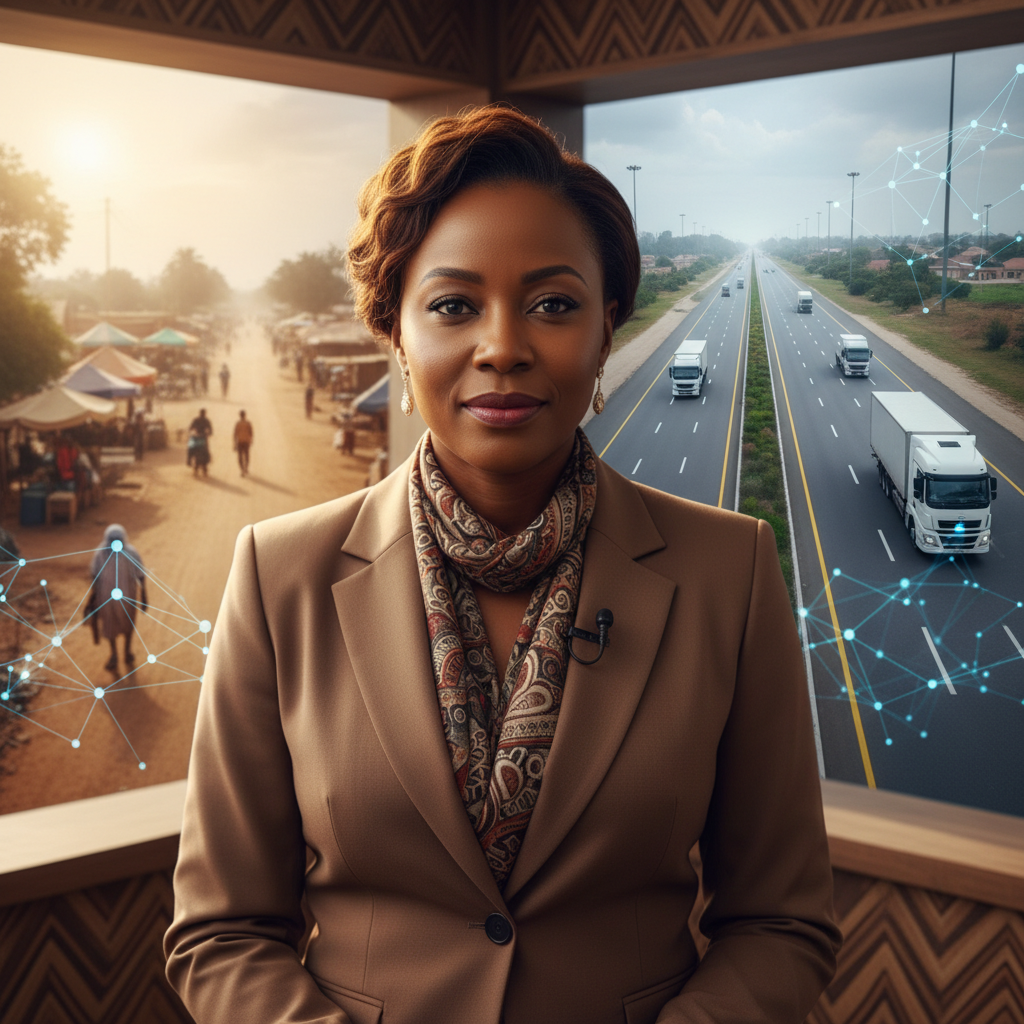

The sun was already high, painting the ochre walls of Ouagadougou with a golden glow, when I arrived at the bustling, yet surprisingly serene, co-working space. It was a hive of activity, a symphony of clicking keyboards and hushed conversations in a mix of Mooré, Dioula, and French. This isn't your typical Silicon Valley glass tower; this is the heart of Burkina Faso's tech scene, a place where dreams are built with grit and ingenuity. I was there to meet Safiatou Diallo, the visionary founder and CEO of WagaLogistics AI, a startup that is not just talking about the future of logistics, but actively building it right here, right now.
Safiatou greeted me with a warm smile, her eyes sparkling with an energy that could power a small village. She's a force of nature, a woman who embodies the spirit of innovation that is sweeping across our continent. We settled into a small, brightly colored office, the sounds of market life filtering in from outside. I had heard whispers, then shouts, about WagaLogistics AI and their audacious plan to bring autonomous delivery to West Africa, a region where infrastructure can be challenging and logistics a constant puzzle. The global logistics industry is an $800 billion giant, but Safiatou believes it is ripe for disruption, especially from the ground up.
"Youssoufaù, it's not just about self-driving trucks, is it?" she began, leaning forward, her voice a melodic blend of passion and pragmatism. "It's about efficiency, about reducing waste, about connecting our farmers to markets faster, about getting medicines to remote villages before they spoil. It's about empowering our people." She spoke of the current bottlenecks, the long waits at borders, the fuel costs, the wear and tear on vehicles, the sheer human effort involved in moving goods across vast distances. "We lose so much, both in time and resources, because our systems are not optimized. AI changes that equation completely."
I asked her about the genesis of WagaLogistics AI. "Well, you know how it is here," she chuckled, referring to the vibrant, often chaotic, rhythm of life in Ouaga. "I saw the trucks, the overloaded vehicles, the drivers working tirelessly, sometimes for days on end. I thought, 'There has to be a better way.' I studied computer science at the University of Ouagadougou, and then I spent some time in Europe, working with companies like NVIDIA on their autonomous vehicle platforms. But my heart was always here. I knew the real impact could be made in my home country." She returned with a burning desire to adapt cutting edge AI to local realities, not just import solutions.
"Many people think autonomous vehicles are only for perfect, pristine roads in developed countries," she continued, anticipating my next question. "They are wrong. Our roads, our weather, our unique challenges, these are not obstacles; they are opportunities for innovation. We are building systems that are resilient, that can learn from our specific environment. Our AI models are trained on data from actual Burkinabé roads, from the Sahel to the Cascades, not just simulations from California." This is the kind of grassroots innovation I love to see, truly solving local problems with global tech.
Her team, a mix of young Burkinabé engineers and data scientists, has developed a suite of AI powered tools. "Our initial focus is on optimizing routes, predictive maintenance for existing fleets, and smart warehousing," she explained. "But the grand vision, the one that truly excites me, is our fleet of 'WagaWheels' autonomous delivery pods for last mile logistics in urban areas, and eventually, our self-driving trucks for intercity transport. Imagine a future where a farmer in Bobo-Dioulasso can have their produce picked up by an autonomous vehicle and delivered to a market in Ouagadougou within hours, not days." This changes everything, I thought, picturing the impact on our economy.
"We're not talking about replacing every human driver overnight," Safiatou clarified, addressing a common concern. "This is about augmenting, about creating new types of jobs. We need technicians to maintain these vehicles, AI specialists to refine the algorithms, logistics managers to oversee the automated fleets. We're also working closely with the government and local transport unions to ensure a smooth transition, one that benefits everyone." She mentioned ongoing pilot programs with local businesses, showing a pragmatic approach to deployment.
I asked her about the technology behind WagaLogistics AI. "We leverage a combination of open source frameworks like TensorFlow and PyTorch, but our secret sauce is the custom datasets and reinforcement learning models we've built," she revealed. "We're collaborating with local universities to collect vast amounts of sensor data from our pilot vehicles. Think about it: a truck driving from Ouaga to Koudougou encounters unique road conditions, weather patterns, and even livestock crossings. Our AI learns from all of that, becoming more robust with every kilometer." It's an iterative process, a constant dance between data and deployment.
"We've achieved a 15% reduction in fuel consumption and a 20% improvement in delivery times in our pilot phase," she stated proudly, citing hard numbers that would make any logistics manager sit up and take notice. "These are real, tangible benefits for businesses and consumers alike." She sees a future where the cost of goods drops, and access to essential supplies improves dramatically across the region. "The revolution is being coded right now, right here in Ouagadougou."
Her vision extends beyond just Burkina Faso. "We see WagaLogistics AI as a blueprint for autonomous logistics across West Africa," she said, her gaze fixed on a map of the continent on her wall. "The challenges are similar, and the potential impact is immense. We're already in talks with partners in Côte d'Ivoire and Mali." The idea of a connected, efficient West African logistics network, powered by local AI, is truly inspiring.
Before I left, I asked her what keeps her motivated amidst the challenges of building a deep tech company in a developing economy. "The impact," she said without hesitation. "Seeing a small business owner smile because their goods arrived on time, knowing that a remote clinic received its supplies. That's what drives me. We are not just moving goods; we are moving our country forward." Her words resonated deeply. I've never seen anything like this level of homegrown innovation, tackling such a fundamental challenge with such advanced technology. It's a testament to the ingenuity and spirit of our people. The future of logistics, it seems, is being driven from the heart of Africa, one autonomous mile at a time. For more insights into how AI is transforming industries globally, you can always check out TechCrunch's AI section.
Safiatou Diallo and WagaLogistics AI are proving that the next wave of technological innovation isn't just coming from Silicon Valley or Shenzhen. It's emerging from places like Ouagadougou, powered by brilliant minds who understand their local context and are determined to build a better future for their communities. The global logistics industry better be ready; Africa is coming for it, with smart trucks and even smarter people at the helm. It's an exciting time to be alive, and even more exciting to be a journalist covering this incredible journey.