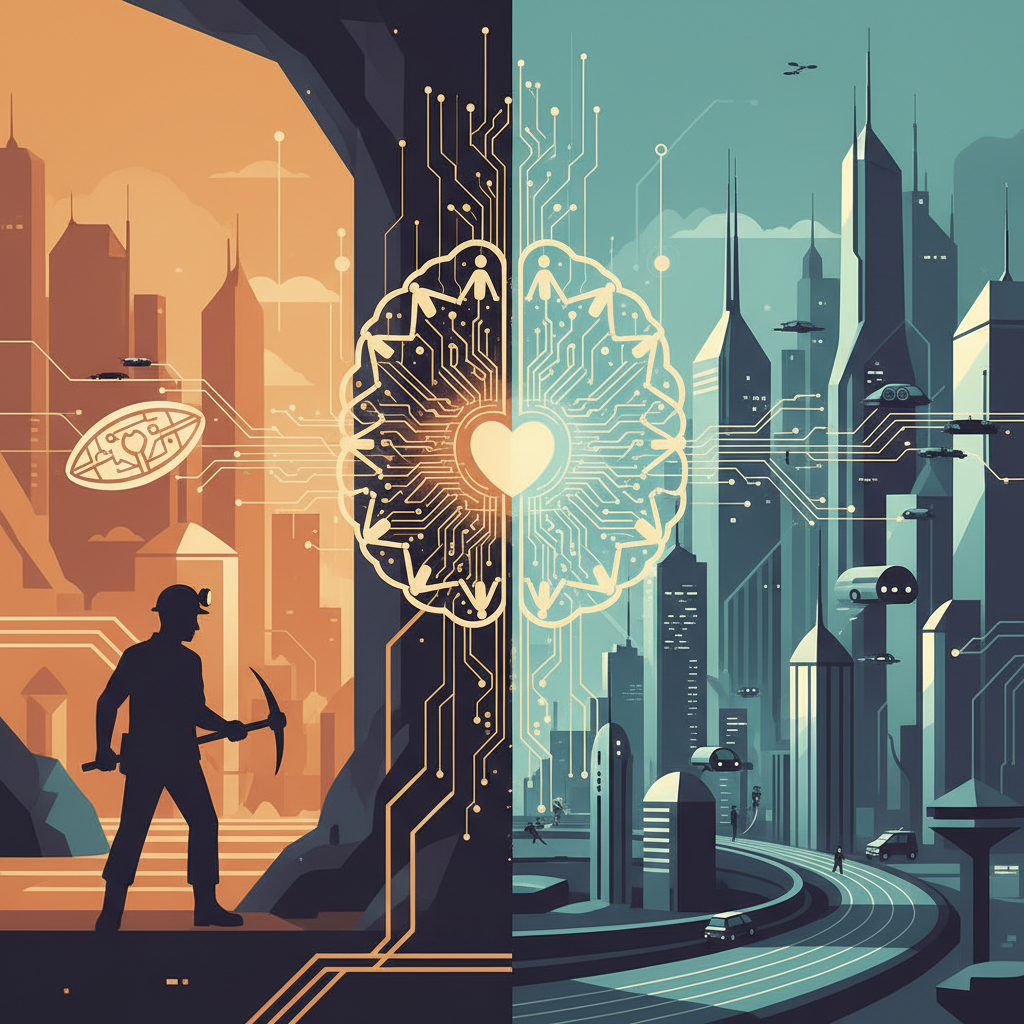

The morning sun, a familiar golden glow over the koppies of Johannesburg, often finds me on my way to a construction site. Not to build, mind you, but to observe. To see the human hands, the sweat, the grit that goes into shaping our skylines and our communities. From the bustling informal settlements to the gleaming high-rises of Sandton, construction is the heartbeat of development, a visible testament to progress, or sometimes, to persistent inequality. And lately, the whispers of AI are growing louder on these sites, promising a revolution.
They talk about AI in construction, don't they? Building design optimization, safety monitoring, project management. The big tech companies, the venture capitalists, they paint a picture of a future where drones survey sites, algorithms design more efficient structures, and AI-powered sensors keep workers safe. It sounds wonderful on paper, a symphony of efficiency and innovation. But here's the thing nobody's talking about, not really, not with the urgency it deserves: for us in South Africa, and indeed across much of the Global South, this isn't just a tech story because it's a justice story. The question is not if AI will transform construction, but how it will do so, and more importantly, for whom.
I recently read a report from a prominent global consulting firm, touting how AI could reduce construction costs by 20% and project timelines by 15%. They highlighted companies like Autodesk and Bentley Systems, who are already integrating AI into their design software, allowing for generative design that explores thousands of permutations to find the most optimal, sustainable, and cost-effective solutions. Imagine, for a moment, a skyscraper designed by an algorithm that considers local wind patterns, material availability, and even cultural aesthetics, all in a fraction of the time a human architect would take. It is a powerful vision, no doubt, and one that promises to make our infrastructure more resilient and affordable.
Then there's the safety aspect. Our construction sites, like many worldwide, are fraught with danger. According to the International Labour Organization, construction remains one of the most hazardous sectors globally, with thousands of fatalities annually. AI offers tantalizing solutions: computer vision systems from companies like SmartVid.io can monitor sites for safety violations, identify potential hazards, and even track worker compliance with safety protocols. Wearable sensors, often linked to AI platforms, can detect fatigue or vital sign abnormalities in real-time, alerting supervisors before an accident occurs. This could be a game-changer, saving countless lives and preventing injuries. "The potential for AI to enhance worker safety is immense, transforming reactive safety measures into proactive, predictive interventions," stated Dr. Nompumelelo Nkosi, a leading civil engineer and Head of Innovation at a major South African construction firm, in a recent industry panel. "We're moving from incident reporting to incident prevention, and that's a moral imperative."
Project management too, is ripe for disruption. AI can analyze vast datasets of past projects, predict delays, optimize resource allocation, and even manage supply chains with unprecedented accuracy. Companies like Procore and Oracle are leveraging machine learning to provide predictive analytics for project managers, helping them foresee bottlenecks and make data-driven decisions. This could mean fewer budget overruns, faster completion times, and a more streamlined process from groundbreaking to ribbon-cutting. The economic benefits, particularly for developing nations striving to build critical infrastructure, are undeniable.
But let's pause. Let that sink in. While these advancements are compelling, my concern, my deep concern, is that the current trajectory of AI in construction, driven primarily by companies in the Global North, risks exacerbating existing inequalities rather than alleviating them. When we talk about "optimization," are we optimizing for profit margins or for community well-being? When we talk about "efficiency," whose efficiency are we prioritizing?
Some might argue that these technologies are inherently neutral, tools that can be wielded for good or ill. They'll say, "Amahlé, you're being overly pessimistic. These tools will create new jobs, upskill workers, and lead to better infrastructure for everyone." And yes, there's a kernel of truth there. New roles for AI specialists, data scientists, and drone operators will emerge. But what about the vast majority of our construction workforce, many of whom are semi-skilled or unskilled, already struggling with precarious employment? Will they be upskilled, or will they be displaced? The digital divide is not just about internet access; it's about access to the skills and opportunities of the future. If we are not intentional, AI could become another barrier, another gatekeeper, rather than a bridge.
My rebuttal is rooted in Ubuntu, the philosophy that says "I am because we are." It's about interconnectedness, community, and shared humanity. True progress, for us, means lifting everyone up. If AI in construction leads to a handful of highly skilled engineers managing automated sites while thousands of labourers are left jobless, then we have failed. We've built smart buildings but broken communities. We need an approach that prioritizes human-centered design, not just building-centered design.
Consider the context of South Africa. We have a massive housing deficit, crumbling infrastructure in many areas, and high unemployment. We need to build, and we need to build affordably and sustainably. But we also need to create jobs. A report by the World Economic Forum in 2020 estimated that AI could displace 85 million jobs globally by 2025, while creating 97 million new ones. That net positive doesn't account for the regional disparities, the skills gap, or the social upheaval of transition. For us, the challenge is not just adopting AI, but adapting it to our unique socio-economic realities.
We need to push for AI solutions that are designed with our local contexts in mind. This means investing in local AI research and development, fostering startups that understand our specific challenges, and ensuring that our educational institutions are preparing our youth for the jobs of tomorrow, not just the jobs of yesterday. It means demanding transparency from global tech giants about how their algorithms are trained and what biases they might embed. It means advocating for policies that support reskilling programs and social safety nets for those whose livelihoods are impacted.
Take for example, the work being done by local innovators. I recently spoke with a team at the Council for Scientific and Industrial Research (csir) in Pretoria. They are exploring how AI can optimize the use of local, sustainable building materials, reducing reliance on expensive imports and creating value chains within our own communities. This is the kind of AI innovation we need: one that looks inwards, builds local capacity, and serves the broader community, not just the bottom line of foreign corporations. "Our focus is on leveraging AI to solve African problems, with African solutions," explained Dr. Thandiwe Mkhize, a senior researcher at the Csir. "That means developing models that understand our unique climate, our resource constraints, and our social needs. It's about self-determination in the digital age." Their work, though perhaps less flashy than the latest product from a Silicon Valley behemoth, holds the true promise for our future.
We must also ensure that the data fueling these AI systems is diverse and representative. If AI models are trained predominantly on data from developed nations, their solutions might not be optimal, or even appropriate, for our environments. A safety algorithm trained on European construction sites might miss critical nuances in a South African context, where informal practices or different material handling techniques are common. This is why local data collection and model training are paramount.
Ultimately, the promise of AI in construction is not just about faster, cheaper, safer buildings. It is about building a more just and equitable society. It is about ensuring that the benefits of this technological leap are shared widely, that our workforce is empowered, and that our communities thrive. We cannot afford to be passive recipients of technology developed elsewhere. We must be active participants, shaping its evolution to serve our collective good. This is our moment to infuse the cold logic of algorithms with the warm spirit of Ubuntu. Let us build, yes, but let us build together, for everyone. The future of our cities, and indeed our people, depends on it.
For more on how technology is shaping our world, visit DataGlobal Hub or explore the latest innovations in AI at MIT Technology Review. You can also find compelling discussions on the societal impact of AI on Wired.