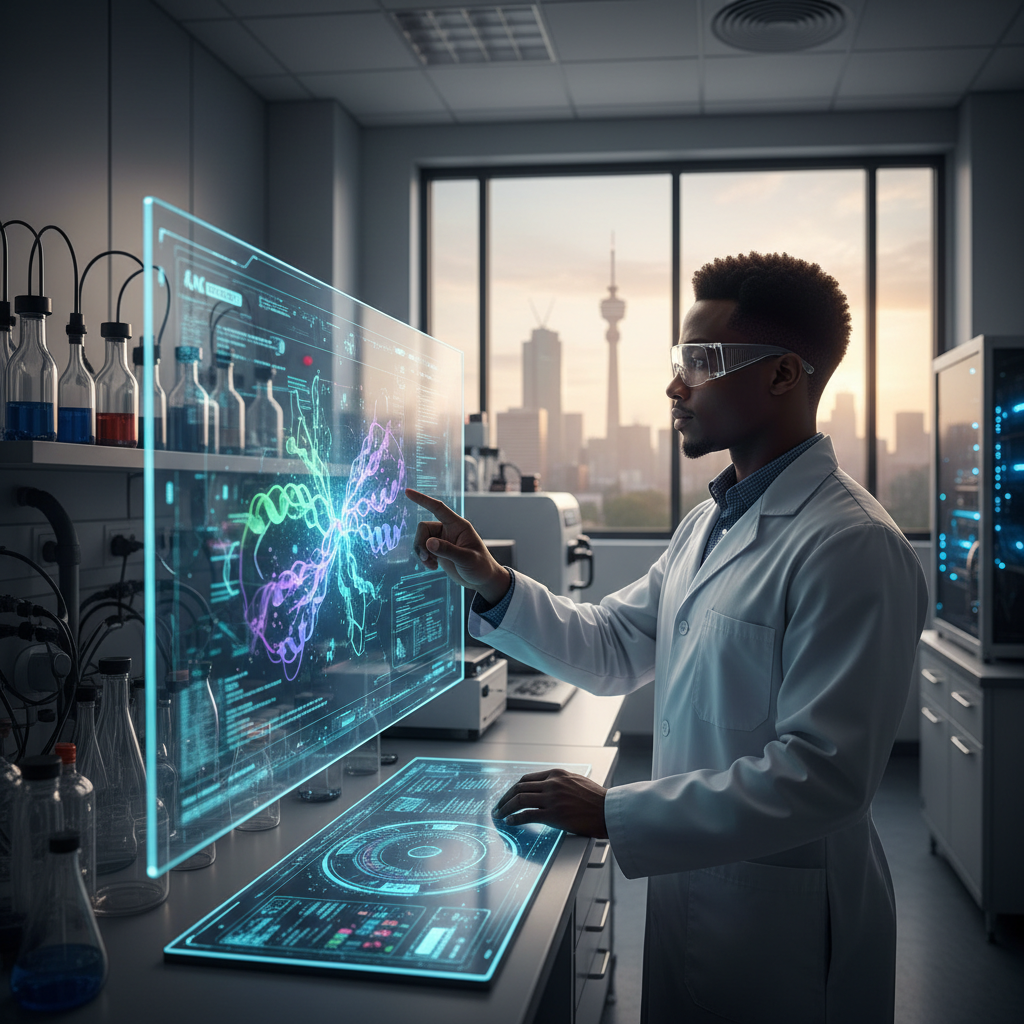

I remember sitting in a taxi, stuck in Joburg traffic, listening to the radio. The news was grim, another report on the rising cost of medication, another family struggling to afford treatment for a chronic illness. It always brings me back to a core truth: access to health, access to solutions, it's not just about money, it's about knowledge, about innovation. And here in South Africa, we know the cost of waiting for solutions to come from elsewhere.
But what if the solutions could be accelerated, made more accessible, right here at home? That's the question that lights up my spirit when I think about AI and protein folding. This isn't just a tech story because it's a justice story, a story about equity, about bringing cutting-edge science to the people who need it most.
The Big Picture: What Does This System Do?
Proteins are the workhorses of life. They build our bodies, fight infections, and carry out almost every biological process. The way a protein folds into its unique 3D shape dictates its function. Think of it like a key and a lock: the key's shape determines which lock it can open. For decades, scientists have struggled to predict these shapes, a monumental task that often took years of painstaking lab work. If you know a protein's shape, you can design drugs that specifically target it, or create new materials with tailored properties.
This is where AI steps in, like a brilliant, tireless detective. AI protein folding systems predict these intricate 3D structures from a simple sequence of amino acids, the building blocks of proteins. It's like giving the AI a string of letters and asking it to build the entire engine, perfectly. This capability is revolutionizing drug discovery, vaccine development, and even the creation of advanced materials, all at a speed that was once unimaginable. For us in Africa, where diseases like tuberculosis and malaria still claim too many lives, this acceleration is not just academic, it's life-saving.
The Building Blocks: Key Components Explained Simply
To understand how this magic happens, let's break it down into its core ingredients:
- The Amino Acid Sequence (Input): This is the raw data, a long chain of amino acids, like a genetic code. Each amino acid is a specific chemical compound, and their order is crucial.
- Massive Datasets of Known Protein Structures: The AI doesn't learn in a vacuum. It's trained on vast libraries of protein structures that have already been experimentally determined. Think of it as a student learning from millions of solved puzzles.
- Neural Networks (The Brain): This is the AI's core engine, a complex computational model inspired by the human brain. Specifically, these are often deep learning models, capable of identifying subtle patterns and relationships within the data. Companies like Google DeepMind, with its AlphaFold system, have pioneered this approach, using sophisticated architectures like transformers and attention mechanisms.
- Computational Power (The Muscle): Predicting protein structures requires immense computing power, often relying on powerful GPUs from companies like NVIDIA. This is why access to infrastructure is so critical, especially for startups in emerging markets.
Step by Step: How It Works From Input to Output
Imagine you have a new protein, perhaps from a pathogen, and you want to know its shape to design a drug. Here's how the AI system typically works:
Step 1: Inputting the Sequence. You feed the AI the linear sequence of amino acids that make up your protein. It's just a string of letters, each representing a different amino acid.
Step 2: Initial Feature Extraction. The neural network first processes this sequence, looking for local patterns, evolutionary relationships, and potential interactions between amino acids. It tries to understand which parts of the chain are likely to be close to each other in the final 3D structure.
Step 3: Iterative Prediction and Refinement. This is where the real intelligence comes in. The AI makes an initial guess at the protein's 3D shape. Then, it evaluates this guess against what it knows about protein physics and the patterns it learned from the training data. It iteratively refines its prediction, adjusting angles and distances between atoms, until it arrives at the most probable and energetically stable 3D structure. It's like a sculptor constantly adjusting their clay until the form is perfect.
Step 4: Outputting the 3D Model. The final output is a highly accurate 3D model of the protein's structure, often presented as a digital file that scientists can visualize and analyze. This model can then be used for further research, drug design, or material engineering.
A Worked Example: Tackling Malaria in Africa
Let's bring this home. Malaria remains a devastating disease across Africa. Imagine a research team at the University of Cape Town discovers a new protein in the Plasmodium falciparum parasite, the one responsible for the most severe form of malaria. They suspect this protein is crucial for the parasite's survival, making it an ideal drug target.
Traditionally, determining the 3D structure of this new protein could take years using techniques like X-ray crystallography or NMR spectroscopy, both expensive and time-consuming. With an AI protein folding system, they could input the protein's amino acid sequence. Within hours, or even minutes, the AI could provide a highly accurate 3D model of the protein. This model immediately reveals potential binding sites, pockets where a drug molecule could attach and disable the protein.
Armed with this structural information, medicinal chemists can then use computational methods to design and screen thousands of potential drug compounds in silico, meaning on a computer, before ever synthesizing a single molecule in the lab. This drastically reduces the time and cost of drug development, allowing promising candidates to move to experimental testing much faster. This isn't just theory, it's happening. Dr. Janet Mphahlele, a leading South African virologist, recently noted, "The speed at which AI can generate these structures means we can pivot our research focus much faster, responding to new variants or emerging pathogens with unprecedented agility. It's a game changer for public health in our region."
Why It Sometimes Fails: Limitations and Edge Cases
While incredibly powerful, AI protein folding isn't a magic bullet. Here's the thing nobody's talking about enough: it has its limitations.
- Novel Protein Folds: For proteins with entirely new, never-before-seen folding patterns, the AI might struggle. It relies on patterns learned from existing data, so truly novel structures can be challenging. It's like asking a student to solve a puzzle unlike any they've ever seen.
- Dynamic Proteins: Many proteins are not static; they change shape as they perform their functions. Predicting these dynamic movements, rather than just a single static structure, is still a significant challenge for current AI models.
- Computational Resources: While the AI speeds up the process, the training and execution of these models still demand substantial computational power and expertise, which can be a barrier for smaller labs or those in resource-constrained environments. This is a critical point for ensuring equitable access to this technology.
- Accuracy for Specific Applications: While overall accuracy is high, sometimes the fine details of a predicted structure might not be precise enough for certain highly sensitive drug design applications, requiring experimental validation.
Where This Is Heading: Future Improvements
The future is bright, and the pace of innovation is relentless. We're seeing continuous improvements in model accuracy and speed. Researchers are working on:
- Predicting Protein Interactions: Moving beyond single proteins to predict how multiple proteins interact with each other, which is crucial for understanding complex biological pathways and designing multi-target drugs.
- Designing Novel Proteins: Instead of just predicting existing structures, AI is starting to design entirely new proteins with desired functions, opening up possibilities for bespoke enzymes or advanced biomaterials. Imagine creating a protein that can break down plastic waste, engineered by AI.
- Accessibility and Democratization: Efforts are underway to make these powerful tools more accessible, perhaps through cloud-based platforms or more efficient models that require less computational muscle. This is vital for African startups and researchers. As Professor Thandiwe Nkosi, an AI ethics researcher at Wits University, often says, "Technology is only truly transformative when it serves all of humanity, not just the privileged few. We must ensure these tools are not just for Silicon Valley, but for Soweto too." Let that sink in.
From the bustling research labs in Stellenbosch to the innovative startups in Nairobi, African scientists are not just consumers of this technology, they are active contributors, adapting it to local challenges and pushing its boundaries. The potential for AI protein folding to address our most pressing health and environmental issues, right here from our continent, is immense. It's a future I'm deeply invested in, a future where technology truly serves Ubuntu, where the well-being of the community is paramount. This is our moment to shape that future, not just observe it. For more on how AI is transforming scientific discovery, you can explore resources like MIT Technology Review or Nature Machine Intelligence. For a broader look at AI startups, TechCrunch is always a good read. And for understanding the ethical implications of such powerful technologies, especially in developing regions, I often look to articles like Google DeepMind's AlphaFold 3: A Beacon for Drug Discovery, But Will Mali See the Light? [blocked].