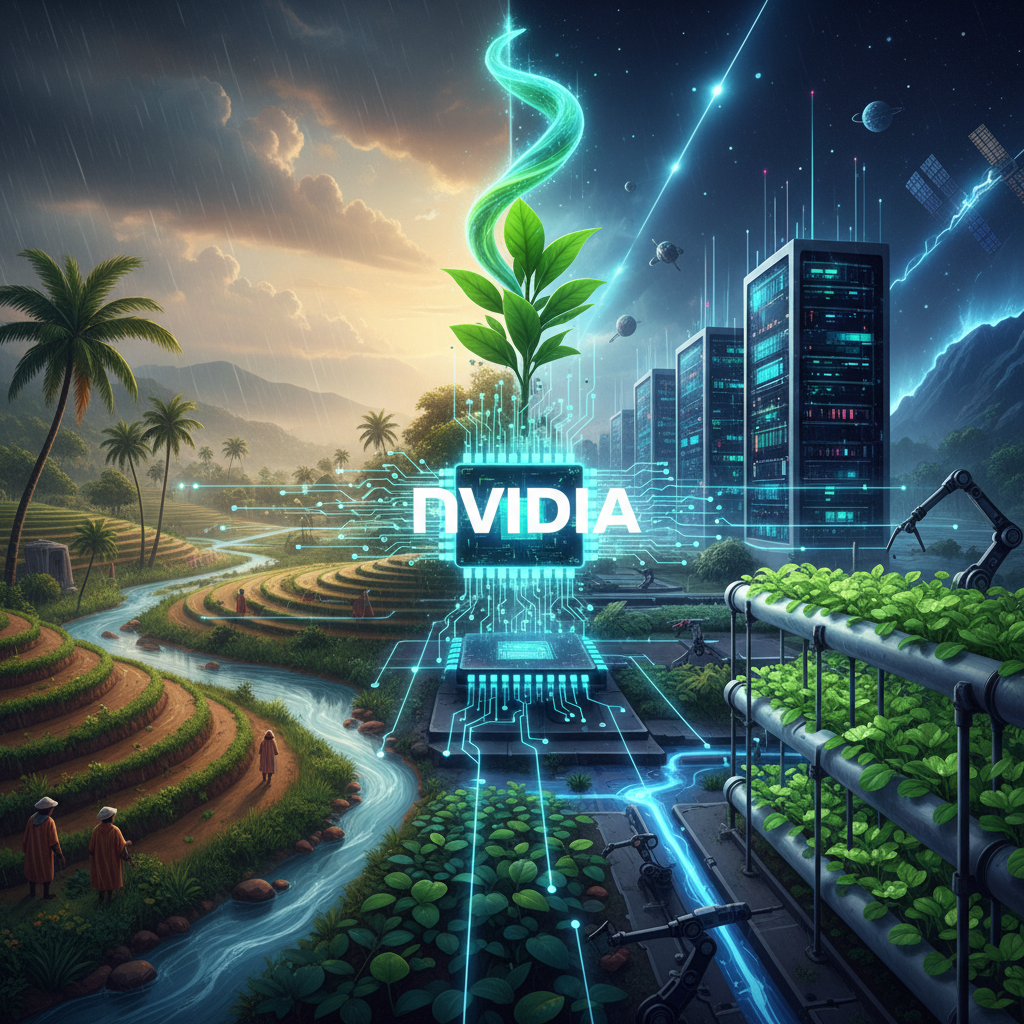

The scent of wet earth after the first monsoon rains, it is etched into the soul of every Indian. For generations, our farmers have looked to the skies, their livelihoods tied to the whims of nature. But what if I told you that in the next five to ten years, those farmers will be looking not just at the clouds, but at data dashboards, at drone footage, and at AI models predicting yields with uncanny accuracy? This is not a distant dream, my friends, this is the very near future, and it is being sown right here, in the fertile plains and bustling tech hubs of India.
We are on the cusp of an agricultural revolution, one that will make the Green Revolution of the 1960s look like a mere prelude. This time, the seeds are not just high-yielding varieties, but algorithms, sensors, and the raw computational power of companies like NVIDIA. Imagine a farmer in Punjab, not just guessing when to irrigate, but receiving real-time recommendations from an AI system that has analyzed soil moisture, weather patterns, and crop health down to the square meter. Imagine a farmer in Maharashtra, using a smartphone app powered by Google's Gemini to identify a pest infestation before it decimates his entire chili crop. This is the inflection point, a moment where ancient wisdom meets cutting-edge technology, and the outcome will be nothing short of miraculous for our nation and the world.
A Vision of Abundance: The AI-Powered Farm of 2030
Picture this: it is 2030. The sun rises over a sprawling farm in Telangana. Instead of a lone farmer trudging through rows, a fleet of autonomous drones, equipped with hyperspectral cameras and AI-powered vision systems, conducts daily surveillance. These drones, perhaps running on NVIDIA's Jetson platforms, collect terabytes of data on plant health, nutrient deficiencies, and early signs of disease. This data is fed into a central AI platform, let's call it 'KrishiGPT', a localized large language model developed by an Indian startup, trained on decades of regional agricultural data, satellite imagery, and soil maps.
KrishiGPT, running on cloud infrastructure provided by Amazon Web Services or Microsoft Azure, then generates hyper-localized prescriptions: exact amounts of water for each irrigation zone, precise fertilizer blends tailored to specific soil patches, and targeted pesticide application only where needed. Human decision-making shifts from manual labor to strategic oversight, managing the AI systems and interpreting their high-level recommendations. Yields soar, water usage plummets by 30 percent, and pesticide application is reduced by half, leading to healthier produce and a cleaner environment. This is not science fiction, this is the logical progression of current AI capabilities, scaled and adapted for India's unique agricultural landscape.
How We Get There: The Milestones on the Horizon
The journey to this AI-powered agricultural utopia involves several key milestones. First, data infrastructure. We need ubiquitous, affordable internet connectivity in rural areas, something the Indian government's 'Digital India' initiative is already pushing. We also need a robust network of IoT sensors and drone operators. Companies like Skye Air Mobility, an Indian drone startup, are already making significant strides here.
Second, AI model development and localization. Generic global AI models simply will not cut it. India's agricultural diversity, with its myriad crop varieties, soil types, and microclimates, demands highly specialized, localized AI. This is where Indian talent shines. Our engineers and data scientists, often working for startups or research institutions like the Indian Agricultural Research Institute, are building these bespoke models. "The real challenge is not just collecting data, but making sense of it in a way that is actionable for a farmer who may not have a PhD in data science," says Dr. Priya Sharma, lead AI researcher at AgriSense Innovations, a Bengaluru-based AI agriculture firm. "Our models need to be intuitive, robust, and culturally relevant." Her team is leveraging open-source frameworks and fine-tuning models like Meta's Llama for specific regional crops and languages.
Third, farmer adoption and education. This is perhaps the biggest hurdle. Trust needs to be built. Training programs, perhaps delivered through state agricultural universities or NGOs, will be crucial. The government's push for farmer producer organizations (FPOs) can be a powerful vehicle for disseminating these technologies and providing collective access to expensive AI services. Imagine a village FPO pooling resources to subscribe to a precision farming AI service, much like they pool resources for tractors today.
Who Wins and Who Loses
Clearly, the biggest winners will be the farmers themselves, seeing increased yields, reduced costs, and a better quality of life. Consumers will benefit from more affordable and healthier food. India, as a nation, will achieve unprecedented food security, potentially becoming a global agricultural powerhouse. "India's potential in AI agriculture is immense, not just for feeding our own 1.4 billion people, but for innovating solutions that can be exported globally," notes Rajesh Kumar, a senior analyst at Niti Aayog, India's policy think tank. "Forget Silicon Valley, look at Hyderabad, look at Pune, look at Bengaluru. This is where the real agricultural AI innovation is happening." TechCrunch has been tracking some of these emerging startups, and the investment flow is undeniable.
But there will be losers too. Traditional middlemen, whose value proposition often lies in information asymmetry and inefficient supply chains, will face disruption. Farmers who are unwilling or unable to adapt to new technologies might be left behind. There is a critical need for policy frameworks that support equitable access to these technologies and provide safety nets for those whose livelihoods are impacted by this shift. We cannot allow this revolution to create a new digital divide in our villages.
The Global Impact: India as an AI Agriculture Leader
India's scale and diversity make it a living laboratory for AI in agriculture. The solutions developed here, from drought-resistant crop management algorithms to pest detection systems for diverse climates, will have direct applicability across the developing world. Our experience in integrating technology with a vast, disparate farming community will provide invaluable lessons for Africa, Southeast Asia, and beyond. This is not just about India's food security, it is about global food security. The world is watching how we harness AI to feed our people, and I believe we are poised to show them the way.
Companies like Microsoft, with their 'AI for Earth' initiatives, and Google, with their advanced satellite imagery analysis, are already collaborating with Indian partners. NVIDIA's GPU technology, essential for training and deploying complex AI models, will be the backbone of many of these solutions. The sheer volume of data generated by Indian farms will be a goldmine for AI development, pushing the boundaries of what is possible in precision agriculture. Wired has highlighted the transformative power of data in agriculture, and India is set to become a prime example.
What Readers Should Do Now
For investors, look beyond the usual tech darlings. The next wave of unicorns will emerge from the intersection of AI and agriculture, particularly in India. Seek out startups working on localized AI models, drone services, and IoT solutions for farms. For policymakers, prioritize rural digital infrastructure, farmer training, and regulatory frameworks that encourage innovation while ensuring equity. For technologists, this is your calling. The problems are immense, but the impact you can have on human lives is even greater. The future of food is being written today, and AI is the pen. Let us ensure it writes a story of abundance for all. The time for action is now, before the next monsoon season arrives. This is not just about technology, it is about dignity, sustenance, and the very future of our civilization. It is about feeding the world, one smart farm at a time.