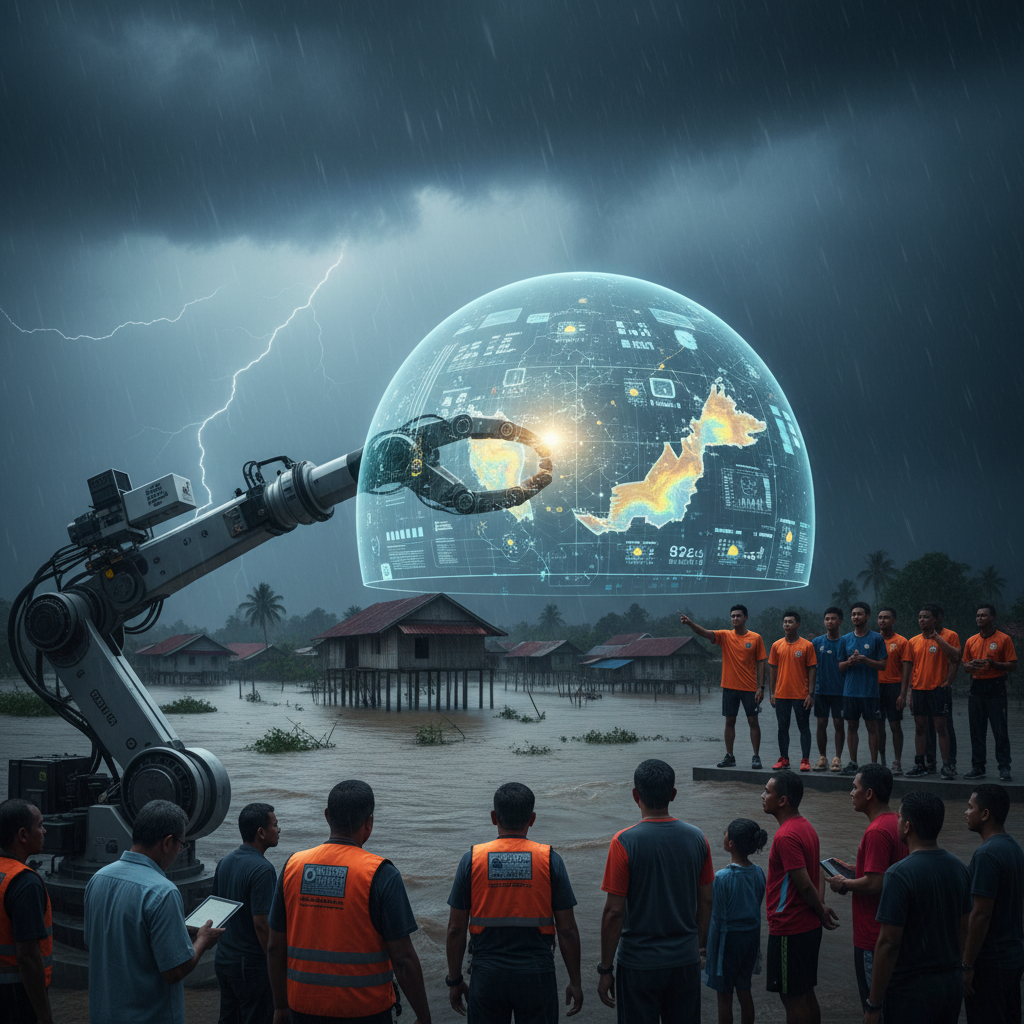

Living in Malaysia, we understand the rhythm of the monsoon. We know the sudden downpours, the rising rivers, and the quiet dread that accompanies news of distant tremors. For generations, our resilience has been tested by floods, landslides, and the occasional seismic rumble from our Indonesian neighbors. But as climate change intensifies these natural phenomena, our traditional methods of coping are being stretched thin. This is where artificial intelligence, with its insatiable appetite for data and its uncanny ability to spot patterns, steps in as a potential game-changer.
Globally, the conversation around AI's role in disaster response, earthquake prediction, and climate adaptation has shifted from theoretical musings to urgent, practical applications. Here in Southeast Asia, where we are disproportionately affected by climate disasters, the stakes could not be higher. Let me explain why this matters for Southeast Asia, and particularly for our beloved Malaysia.
Consider the annual flood season, a familiar narrative in states like Kelantan and Terengganu. Historically, warnings often came too late, leaving communities scrambling. Today, AI models are transforming this. Dr. Amirul Hafiz, Head of Hydrological Forecasting at the Malaysian Meteorological Department (MetMalaysia), shared his insights with me recently. "We are now integrating satellite imagery, real-time sensor data from rivers, and historical rainfall patterns into deep learning models," he explained. "These models, powered by NVIDIA's advanced GPUs, can predict flood levels with an accuracy of 85% up to 72 hours in advance, a significant leap from the 50% accuracy we saw just five years ago. This allows for earlier evacuation orders and better resource deployment." This is not just technology; it's about saving lives and livelihoods.
The architecture is fascinating. Imagine a digital 'kampung' where every river gauge is a watchful elder, every weather station a gossiping neighbor, and AI is the village head, synthesizing all this information to foresee danger. Companies like Google DeepMind are developing advanced climate models that integrate atmospheric, oceanic, and land data to predict extreme weather events with unprecedented precision. Their latest model, WeatherBench 2.0, has shown a 15% improvement in medium-range weather forecasting accuracy compared to traditional numerical models, according to a recent report on MIT Technology Review. This kind of global research directly impacts our local ability to prepare.
Earthquake prediction, long considered the holy grail of seismology, is also seeing breakthroughs thanks to AI. While perfect prediction remains elusive, AI is significantly improving early warning systems. In Indonesia, a country frequently rocked by seismic activity, researchers are using machine learning to analyze micro-seismic data, identifying subtle precursory signals that human analysis might miss. A startup based in Bandung, for instance, has deployed a network of low-cost seismic sensors across Java, feeding data into AI algorithms that can detect unusual patterns in ground motion. "We've seen promising results in identifying seismic anomalies that precede larger events by several hours, sometimes even a day," said Dr. Intan Sari, a lead seismologist at the Indonesian Institute of Sciences. "This isn't a crystal ball, but it's a vital head start for communities in vulnerable areas." While Malaysia is less prone to major earthquakes, we are certainly not immune, and these regional advancements are crucial for our collective safety.
Beyond prediction, AI is proving invaluable in climate adaptation. Think about our agricultural sector, a cornerstone of Malaysia's economy. Palm oil, rubber, rice, these crops are sensitive to changing weather patterns. AI-powered precision agriculture platforms are helping farmers optimize irrigation, predict pest outbreaks, and even select crop varieties more resilient to drought or excessive rainfall. For example, a local Malaysian agritech firm, AgroAI Solutions, has developed a platform that uses satellite imagery and AI to monitor soil moisture and crop health across thousands of acres of oil palm plantations. "Our system has helped reduce water usage by 20% and increase yields by 10% in pilot projects," stated Encik Razali Kassim, CEO of AgroAI Solutions. "This isn't just about efficiency; it's about ensuring food security and economic stability for our farmers in the face of unpredictable climate shifts." This blend of traditional agriculture with cutting-edge technology is a testament to our adaptability.
The challenges, of course, are substantial. Data scarcity, particularly in remote areas, remains a hurdle. The cost of deploying and maintaining extensive sensor networks and high-performance computing infrastructure is another. Furthermore, ensuring that these advanced technologies are accessible and understandable to the communities they are meant to serve is paramount. It is not enough to have a brilliant algorithm if the village head cannot interpret its warning.
However, Malaysia is positioning itself perfectly to overcome these challenges. Our government, through initiatives like MyDIGITAL, is investing heavily in digital infrastructure and AI research. We are fostering a vibrant startup ecosystem, and our universities are producing talented data scientists and engineers. Collaboration with regional partners, such as through Asean frameworks, is also crucial. Sharing data, best practices, and technological advancements across borders amplifies our collective impact. This collaborative spirit, much like the gotong-royong tradition in our villages, is essential for tackling a global problem.
"The integration of AI into disaster management isn't just a technological upgrade, it's a paradigm shift in how we interact with our environment," observed Puan Sri Dr. Elena Tan, a prominent environmental policy expert and advisor to the Ministry of Natural Resources and Environmental Sustainability. "We are moving from reactive responses to proactive resilience, and AI is the engine driving this transformation. But we must ensure ethical deployment, data privacy, and equitable access for all communities, particularly those most vulnerable." Her words resonate deeply, reminding us that technology must always serve humanity.
The future is not about preventing every natural disaster; that is beyond our grasp. Instead, it is about building a society that is smarter, more informed, and more resilient in the face of nature's power. AI offers us a powerful toolkit, a digital keris, if you will, to navigate these turbulent times. By combining cutting-edge algorithms with local wisdom and a strong community spirit, Malaysia, and indeed all of Southeast Asia, can forge a path towards a safer, more sustainable future. The journey is long, but with every predictive model and every early warning, we take another step towards mastering the monsoon, not just enduring it. For more on how AI is shaping global responses, you can follow developments on Reuters Technology.
Read more about AI's role in climate tech [blocked]