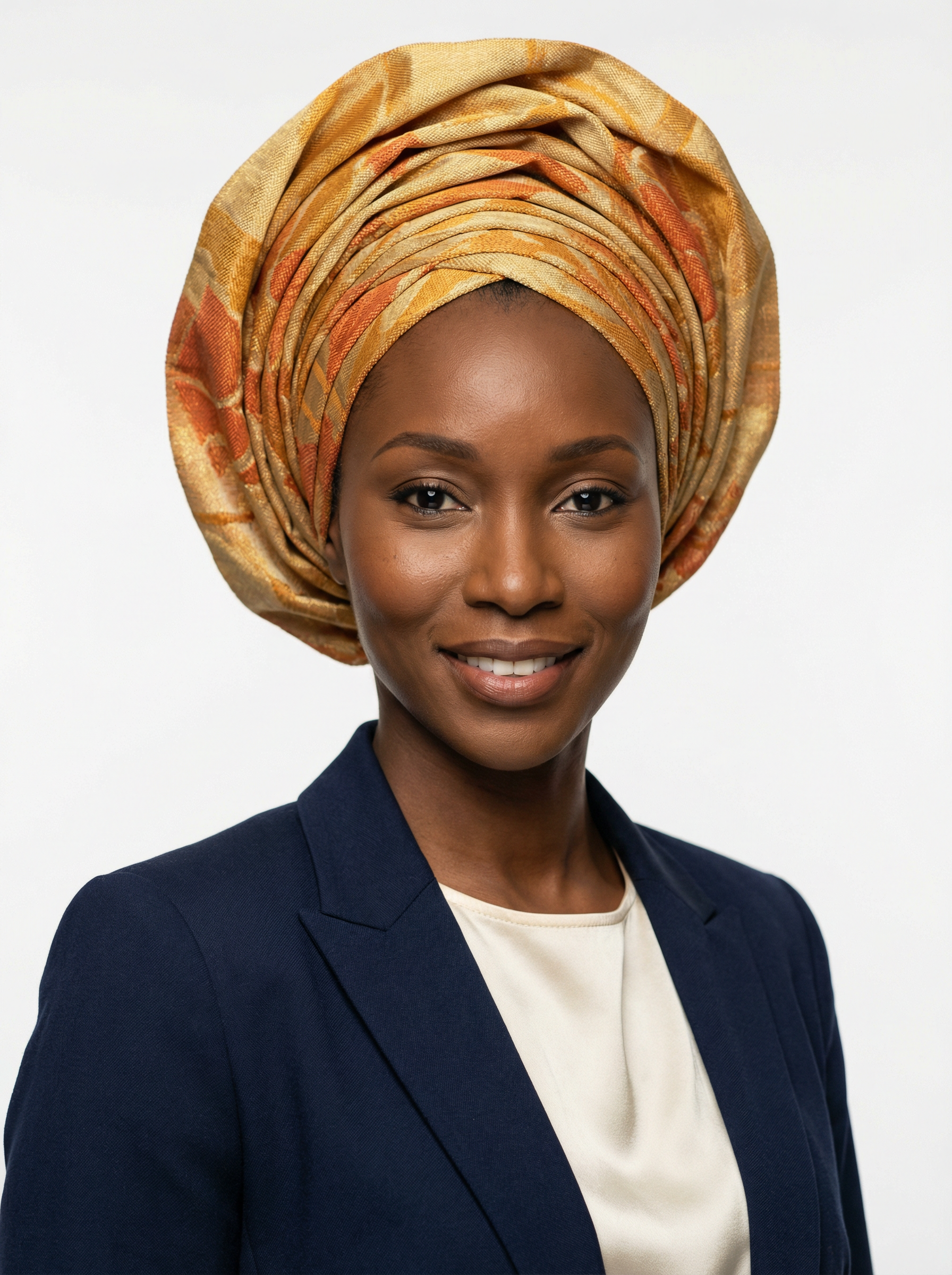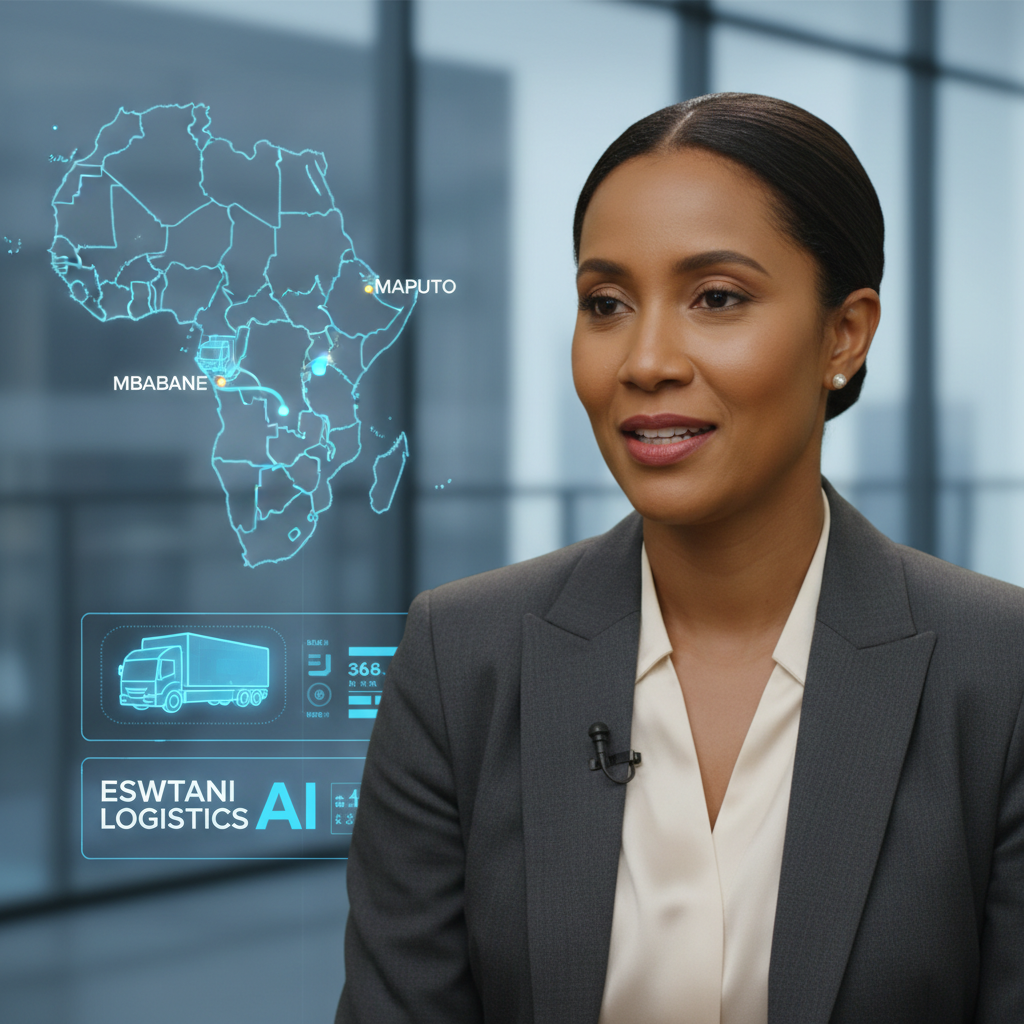
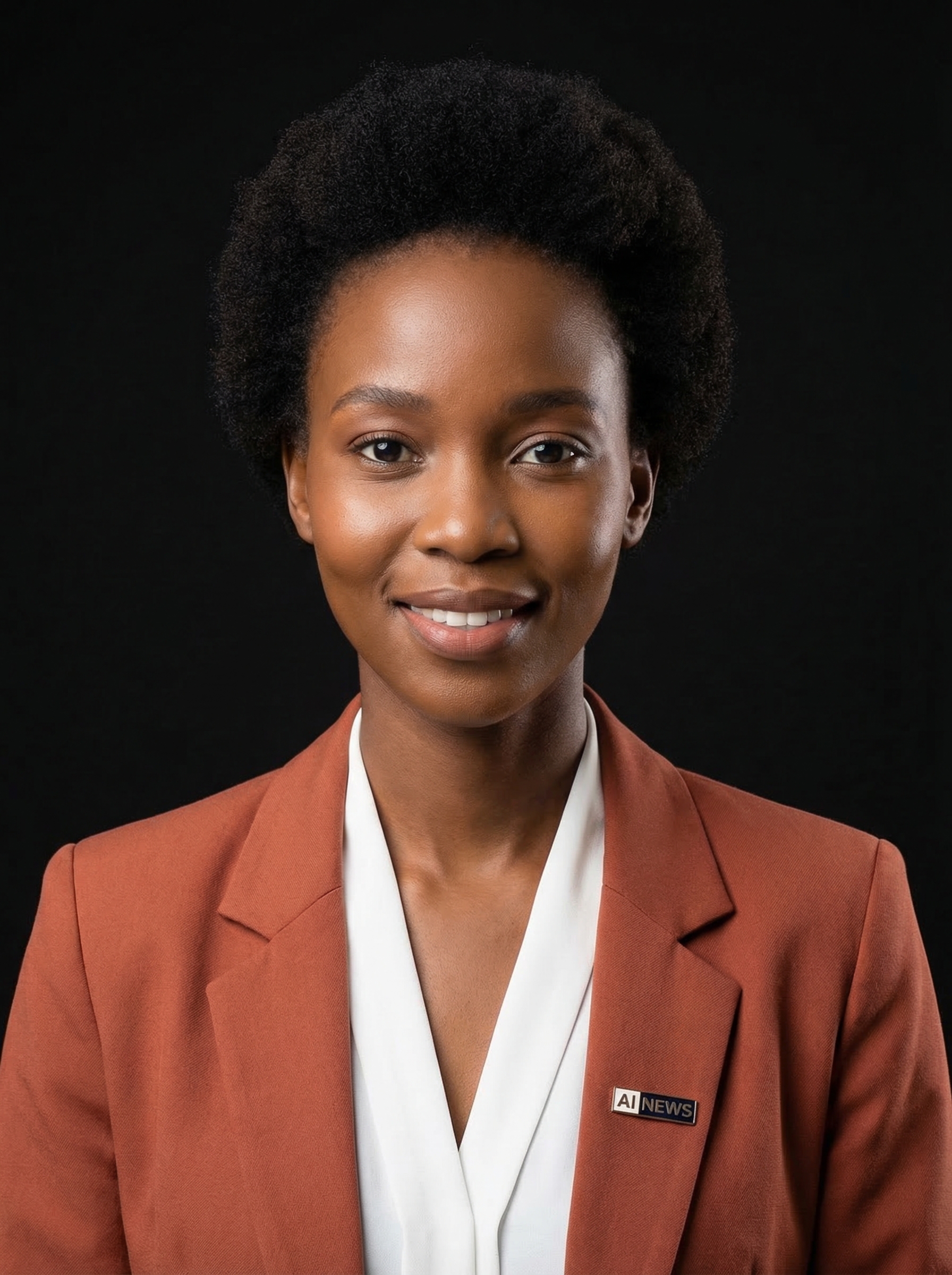
The morning sun was already warm on my face as I drove through the winding roads leading to the Eswatini Logistics AI headquarters, just outside Mbabane. The air, crisp and clean, carried the scent of acacia trees and distant woodsmoke. It’s a familiar comfort, a reminder of home, even as I was heading to interview someone at the forefront of a technological shift that feels global in its scope. I was here to meet Nomusa Dlamini, the CEO of a company making waves in autonomous logistics, right here in our tiny kingdom.
The office itself was a blend of modern efficiency and traditional Swati warmth. Bright, open spaces were adorned with local art, and the hum of servers was punctuated by the gentle rhythm of siSwati conversations. Nomusa greeted me with a smile that reached her eyes, a firm handshake, and an offer of emasi, fermented milk, a gesture of hospitality that immediately put me at ease. She’s not what you might expect from a tech CEO; her demeanor is grounded, her voice calm, yet there’s an undeniable spark of innovation in her gaze.
“Thandiwè, welcome. It’s good to have you,” she said, gesturing to a comfortable seating area overlooking a meticulously kept garden. “We’re doing something a little different here, aren’t we?”
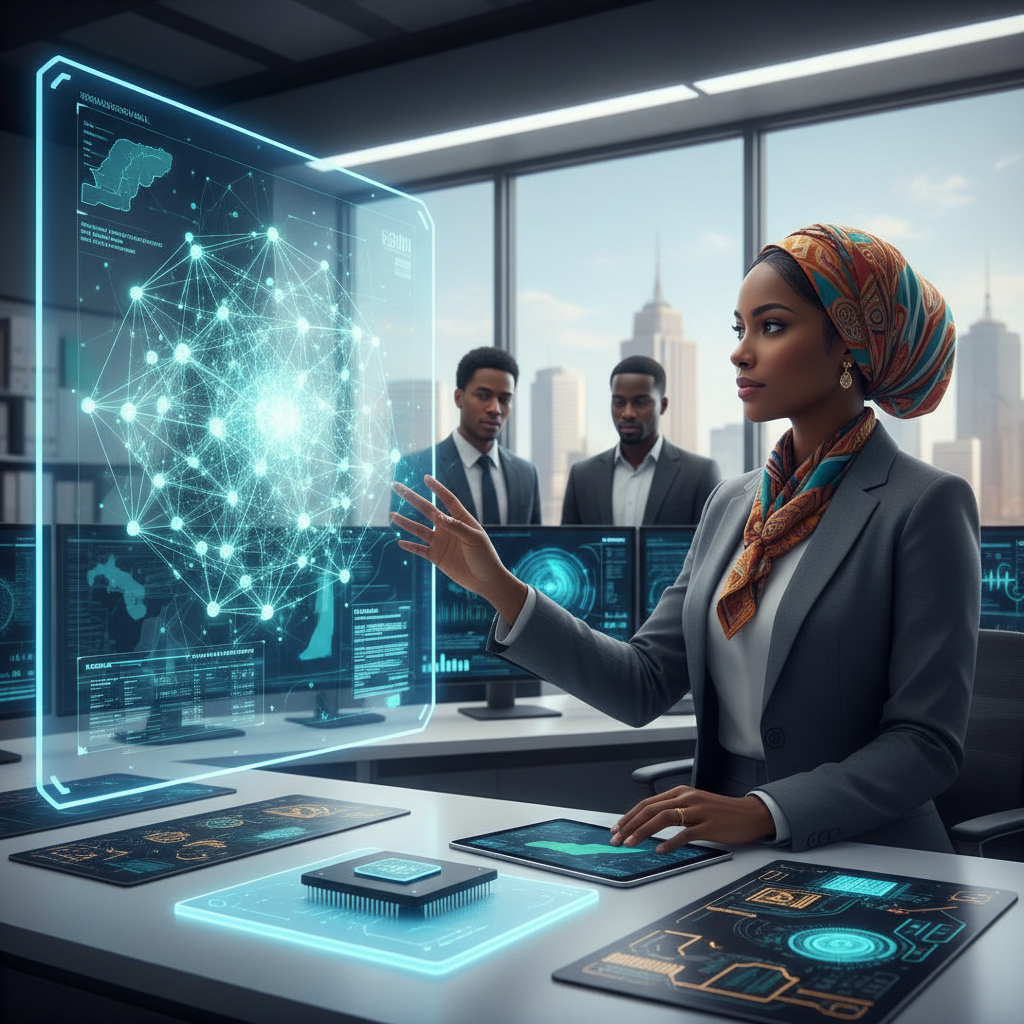
Indeed, they are. Eswatini Logistics AI, a homegrown startup, has been quietly deploying a fleet of semi-autonomous trucks for cross-border routes, primarily between Eswatini, South Africa, and Mozambique. This isn't just about moving goods; it's about reimagining the very arteries of trade in a region where logistics costs can be crippling, often accounting for as much as 20% of a product's final price. The global logistics industry is valued at over $800 billion, and Nomusa believes Africa’s slice of that pie can grow significantly with smart technology.
“People often think of autonomous vehicles as something for the big cities, the Teslas and Waymos of the world,” Nomusa began, sipping her emasi. “But the real impact, I believe, is in places like ours, where infrastructure can be challenging, and the need for efficiency is paramount. Imagine reducing transit times by 15% and fuel consumption by 10% on a route from Durban to Maputo. That’s not just a number; that’s fresh produce reaching markets sooner, medicines arriving where they are needed, and local businesses competing on a global scale.”
Her company isn't building the trucks from scratch. Instead, they’re integrating advanced AI systems, developed in-house, with existing heavy-duty vehicles. “We work closely with manufacturers like Volvo and Mercedes-Benz, adapting their platforms for our unique regional conditions,” she explained. “Our AI, which we’ve affectionately named ‘Sihle’ meaning ‘beautiful’ in siSwati, learns from every kilometer driven, every weather pattern encountered, and every traffic situation. It’s a continuous learning loop.”
I asked her about the challenges, particularly given the varied road conditions and regulatory landscapes across borders. “Oh, the challenges are immense, Thandiwè, but that’s where the innovation truly blossoms,” she chuckled. “For instance, our trucks operate with a ‘human-in-the-loop’ system. A trained driver is always present, ready to take over if Sihle encounters something outside its learned parameters. This isn’t about replacing people entirely, but about augmenting their capabilities and making their jobs safer and more efficient. In Eswatini, we say 'a person is a person through other people', AI should learn this lesson, and ours is designed with that philosophy at its core.”
This approach, she elaborated, has been crucial for regulatory acceptance. “We’ve spent countless hours with government officials, transport ministries, and trade bodies in all three countries,” Nomusa stated. “It’s about building trust, demonstrating safety, and proving the economic benefits. Our pilot programs have shown a 30% reduction in accidents related to driver fatigue, a significant win for everyone.” She mentioned that their success has even caught the attention of global players, with a recent partnership announced with Google's DeepMind for further AI optimization, particularly in predictive maintenance and route planning. “Their expertise in complex algorithms is invaluable,” she added, “and it allows us to scale faster.”
The conversation shifted to the human element. What about the drivers? Are they worried about losing their jobs? “It’s a valid concern, and one we address head-on,” Nomusa said, her voice softening. “We’re not firing drivers; we’re retraining them. Many of our former long-haul drivers are now ‘safety operators’ or ‘fleet managers’ in our control centers, monitoring multiple autonomous trucks. Others are being trained as AI technicians, learning to maintain and troubleshoot these sophisticated systems. We’ve partnered with the Eswatini College of Technology to develop new curricula for these roles.” This commitment to local workforce development is something I’ve seen before in other Eswatini initiatives, a testament to our community-first approach.
“The transition isn’t without its bumps, of course,” she admitted, “but the long-term vision is about creating higher-skilled, better-paying jobs. It’s about making our logistics sector a leader, not just a follower. This tiny kingdom has big ideas about technology, and we are proving them.”
Nomusa’s vision extends beyond just trucks. She sees a future where autonomous drones handle last-mile delivery in rural areas, bringing essential supplies to remote villages that are currently difficult to reach. “Imagine a drone delivering medical supplies to a clinic in Lubombo within hours, not days, especially during the rainy season,” she mused. “That’s the kind of impact that truly excites me.” She pointed to recent advancements by companies like Amazon and their drone delivery programs as inspiration, but stressed the need for localized solutions. “What works in Seattle might not work in the Lebombo Mountains, and our AI is learning those nuances.”
Her passion was infectious. She spoke of the potential for Eswatini to become a regional hub for autonomous logistics research and development, attracting talent and investment. “We have the talent, the drive, and the unique geographical position,” she asserted. “We can be a living laboratory for these technologies, proving their viability in diverse, real-world conditions.”
As our interview concluded, Nomusa walked me to the door, past a large, vibrant mural depicting a traditional Swati village alongside sleek, futuristic vehicles. It was a powerful image, symbolizing the bridge her company is building between tradition and innovation. Her work is a testament to the idea that technological advancement doesn't have to erase cultural identity; it can, in fact, empower it. The road ahead for Eswatini Logistics AI will undoubtedly have its challenges, but with leaders like Nomusa Dlamini at the helm, the journey promises to be as transformative as it is exciting. The world watches as this small nation makes its mark on the global logistics map, powered by local ingenuity and a deep understanding of community needs. For more insights into the evolving landscape of AI in industry, you can explore reports from MIT Technology Review or follow the latest developments on TechCrunch. The future, it seems, is being driven by more than just algorithms; it's being driven by people, for people. Our conversation reminded me of the importance of human-centered design in all technological endeavors, a principle that Eswatini Logistics AI seems to embody beautifully.