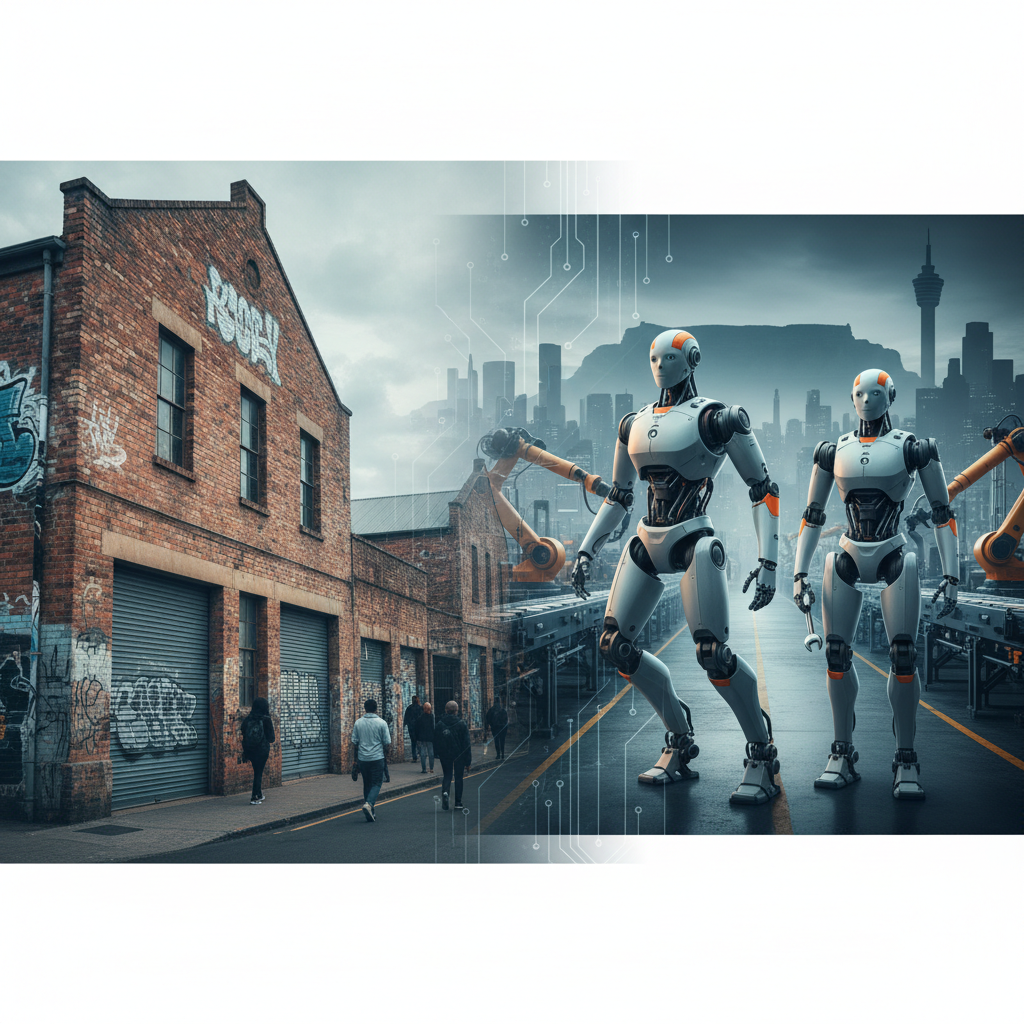

The morning sun, a familiar Johannesburg gold, spills over the bustling streets of Maboneng. Taxis hoot, vendors call out, and the scent of freshly brewed coffee mixes with the exhaust fumes. It is a symphony of human endeavor, a vibrant testament to the spirit of ubuntu, where each person plays their part in the collective. But as I sip my rooibos, I cannot help but wonder: what happens when some of those parts are played by machines, by humanoid robots with nimble fingers and tireless frames?
This is not a distant sci-fi fantasy, my friends. This is April 2026, and the future of work is knocking on our door, not with a gentle tap, but with the clanking of gears and the whirring of servos. Companies like Boston Dynamics, known for their agile Atlas robot, and newer players like Figure AI, with their Figure 01, are pushing humanoid robotics from experimental labs into the very fabric of our economies: factories, restaurants, and retail stores. For South Africa, a nation grappling with both immense potential and pressing unemployment, this technological wave presents a complex challenge and an urgent opportunity.
The Technical Challenge: Bridging the Human-Robot Divide
The core problem humanoid robots aim to solve is the automation of tasks in unstructured, human-centric environments. Unlike industrial robots confined to cages and repetitive motions, humanoids are designed to operate alongside people, use human tools, and navigate spaces built for us. This demands an unprecedented level of perception, manipulation, and cognitive intelligence. Think about a restaurant kitchen: a chef needs to identify ingredients, grasp delicate items, operate complex machinery, and adapt to unexpected spills or changes in orders. A robot needs to do all this and more, safely and efficiently.
Architecture Overview: A Symphony of Sensors and Actuators
The typical humanoid robot architecture is a marvel of engineering, integrating multiple subsystems that mirror human capabilities. At its heart is a robust perception system, often comprising high-resolution cameras (rgb-d for depth perception), LiDAR for precise mapping and localization, and tactile sensors in grippers for delicate manipulation. These sensors feed data into a central computation unit, usually a powerful embedded system equipped with NVIDIA GPUs for parallel processing of complex AI models.
Then there is the actuation system, the muscles and joints of the robot. This involves high-torque servomotors, often with force feedback, controlling dozens of degrees of freedom. For instance, a robot like Figure 01 boasts 40 degrees of freedom, allowing for human-like dexterity. The power system, typically high-density lithium-ion batteries, needs to balance energy capacity with weight and heat dissipation, a constant engineering trade-off. Finally, a sophisticated communication layer handles data flow between internal components and external systems, like factory management software or restaurant POS systems, often relying on robust wireless protocols and real-time operating systems such as ROS (Robot Operating System).