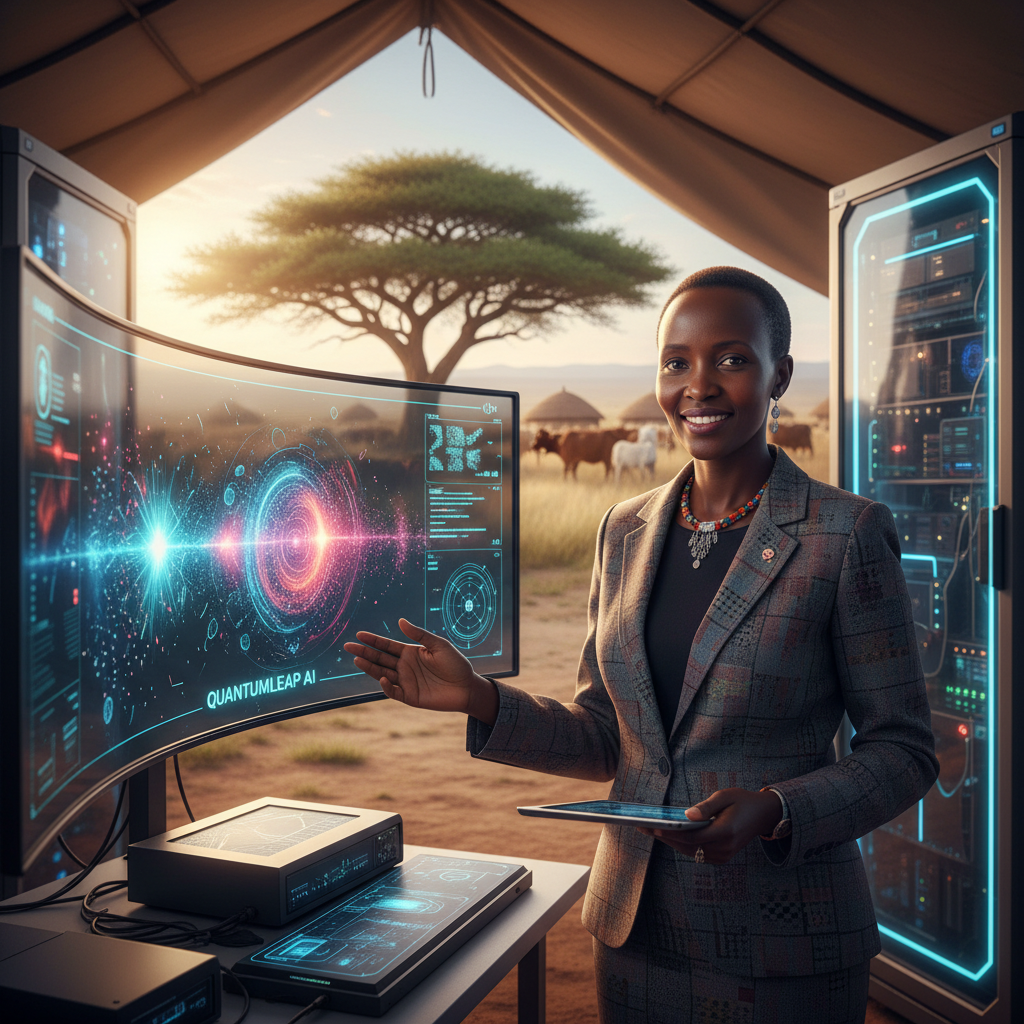
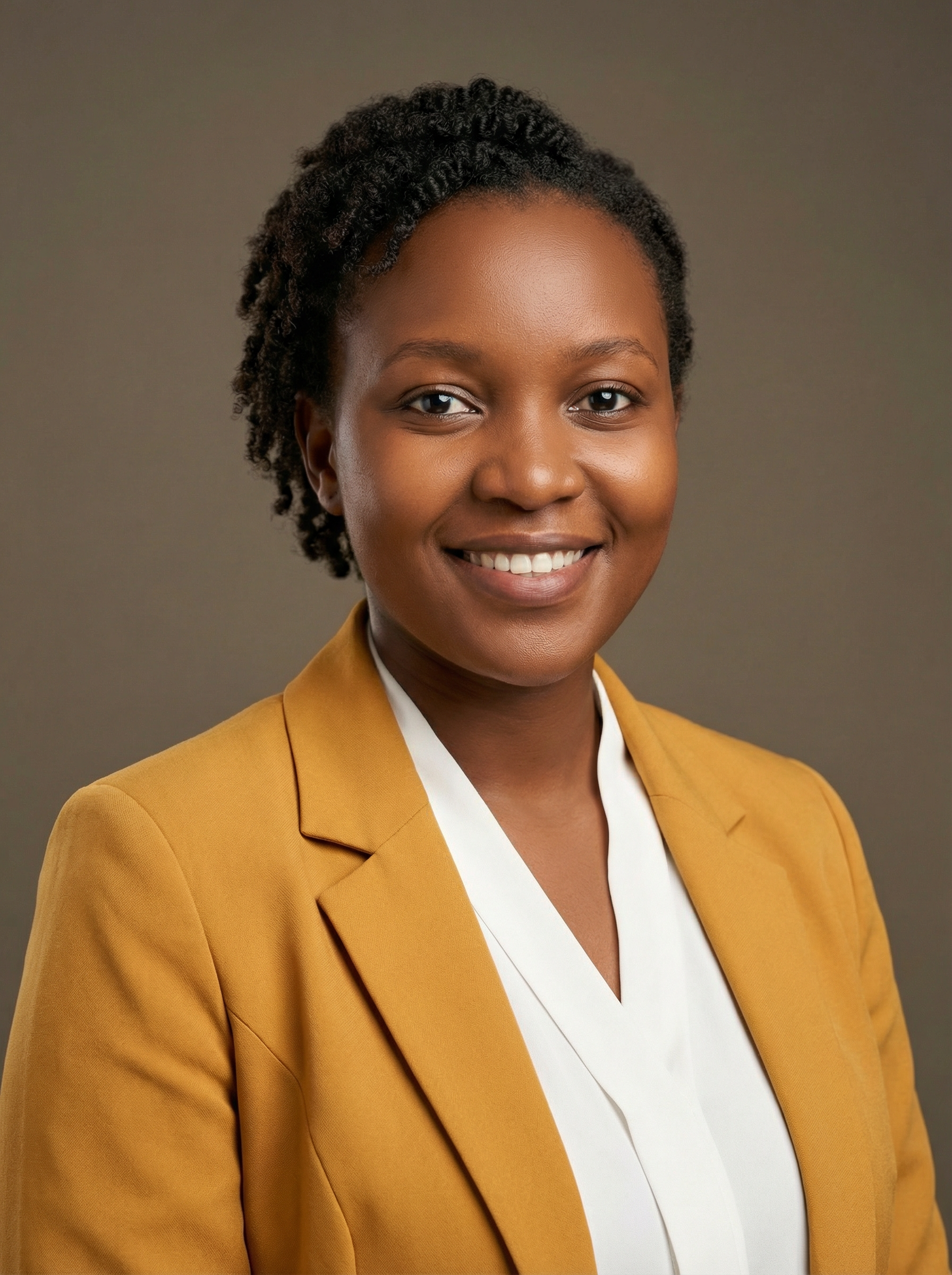
The air in Arusha, Tanzania, often hums with the distant lowing of cattle and the chatter of market traders. It is a symphony of life, ancient and vibrant. But for a young Elara Mchunga, growing up in the shadow of Mount Meru, her mind was often miles away, lost in the silent, thunderous collisions of subatomic particles. She was not dreaming of cattle or markets, but of quarks and leptons, of the universe’s most fundamental secrets. Now, at 34, Dr. Elara Mchunga is not just dreaming, she is actively dismantling the barriers to those secrets with her company, QuantumLeap AI, a firm that has just closed a $50 million Series B at a staggering $500 million valuation.
Her story is not your typical Silicon Valley garage tale, nor is it a simple academic ascent. It is a narrative woven with the grit of East Africa and the relentless pursuit of knowledge that defines true innovation. When I met her recently via a rather glitchy video call, she was in Geneva, the crisp European air doing little to dampen her infectious, almost mischievous, smile. “Zawadì, the universe is a puzzle, no?” she began, her voice carrying the melodic lilt of Swahili spoken with a scientist's precision. “And for too long, we have been trying to solve it with a hammer and chisel. QuantumLeap, we are building the laser drill.”
Elara’s fascination with physics began early. Her father, a secondary school teacher in Arusha, nurtured her curiosity, often pointing out the constellations in the clear Tanzanian night sky. “He taught me that the biggest questions are often hidden in the smallest details,” she recalled. This philosophy would become the bedrock of her life’s work. After excelling in her local schools, she earned a scholarship to the University of British Columbia in Canada, a world away from the familiar warmth of home. It was there, amidst the grey skies and towering evergreens, that she truly found her calling in theoretical physics.
“UBC was a culture shock, of course,” she admitted, a wry chuckle escaping. “Suddenly, I was the girl from Tanzania, trying to explain why the Higgs boson mattered to people who thought physics was just about dropping apples.” She completed her undergraduate degree with honors, then pursued a PhD in particle physics at MIT, diving headfirst into the arcane world of quantum chromodynamics and electroweak interactions. Her doctoral research focused on developing novel computational methods to analyze high-energy collision data, a field ripe for disruption.
The 'aha' moment, as she describes it, came during a summer internship at Cern, the European Organization for Nuclear Research, home to the Large Hadron Collider. She was tasked with sifting through mountains of data, looking for anomalies that could signal new physics. It was tedious, slow work, even with the best existing algorithms. “I remember thinking, ‘This is insane. We have the most powerful machine on Earth smashing particles, and we are analyzing the results like it is 1999,’” she said, shaking her head. “The sheer volume of data, petabytes upon petabytes, was overwhelming the human capacity to interpret it. The patterns were there, but we just couldn't see them fast enough.”
That summer, she met Dr. Kenji Tanaka, a brilliant but equally frustrated Japanese computer scientist who was working on machine learning applications for astrophysics. They bonded over late-night coffee and shared complaints about the limitations of current data analysis techniques. “Kenji understood the algorithms, I understood the physics. It was like two halves of a very complicated equation finally finding each other,” Elara explained. Their initial attempts to merge their expertise were, to put it mildly, a glorious mess. “We tried everything, from neural networks to Bayesian inference, and for months, it felt like we were just teaching the computer to make more sophisticated mistakes,” she laughed. “There was a moment I thought, maybe this is just too big for AI.”
The pivot came after a particularly grueling hackathon at Cern. Instead of trying to build one monolithic AI to solve everything, they focused on a modular approach. They developed specialized AI agents, each trained on specific types of particle interactions and decay signatures. These agents would then collaborate, sharing insights and flagging anomalies for human physicists. It was a paradigm shift. “We realized the problem wasn't the AI itself, but how we were asking it to learn,” Kenji Tanaka, now QuantumLeap AI’s CTO, told me in a separate interview. “By breaking down the problem into smaller, manageable chunks, the AI could achieve superhuman speed and accuracy in pattern recognition. It was like giving Sherlock Holmes a thousand Watson assistants, each an expert in a different field.”
Their prototype, initially dubbed 'HadronHound,' quickly caught the attention of senior researchers at Cern. It could identify rare particle events several orders of magnitude faster than traditional methods, significantly reducing the analysis bottleneck. This was the genesis of QuantumLeap AI. They incorporated in 2023, securing a modest $1.5 million seed round from local Swiss investors and a small grant from the European Innovation Council. The early days were a blur of coding, pitching, and living on instant noodles. “We were two nerds with a big idea and even bigger electricity bills,” Elara quipped. “But we knew we were onto something.”
Their big break came when they were accepted into Y Combinator’s Winter 2024 batch. The intense accelerator program forced them to refine their business model, focusing not just on Cern, but on other large-scale scientific facilities and even industries dealing with complex data, such as materials science and medical imaging. “Y Combinator taught us that even if you are saving the universe, you still need a solid revenue model,” Elara said. They emerged from YC with a $30 million Series A led by Altos Ventures, at a $300 million valuation, a clear signal that the market believed in their vision.
Today, QuantumLeap AI employs over 70 people, a diverse team of physicists, AI engineers, and data scientists from across the globe. Their flagship product, 'CosmicSight,' is now deployed at Cern, Fermilab, and several other leading research institutions. It is not just accelerating discoveries, but also making the process more efficient and cost-effective. “We are seeing a 40% reduction in data processing time and a 15% increase in the identification of novel particle interactions,” stated Dr. Anya Sharma, Head of Data Analytics at Fermilab, praising QuantumLeap’s impact. “Their technology is truly transformative for experimental physics.”
Elara’s leadership style is a blend of academic rigor and Tanzanian warmth. She fosters a culture of open inquiry, encouraging her team to challenge assumptions and think boldly. “My team, they are not just employees, they are explorers,” she said, her eyes gleaming. “We are pushing the boundaries of what is possible, and that requires courage and a bit of madness.” The company is on track to hit $10 million in annual recurring revenue (ARR) by the end of 2026, a testament to the growing demand for their specialized AI solutions.
What drives her? Beyond the scientific breakthroughs and the impressive valuations, Elara is driven by a profound belief in the power of knowledge to uplift humanity. “Imagine what we can achieve when we truly understand the fundamental laws of the universe,” she mused. “It is not just about finding new particles, it is about unlocking new energy sources, new materials, new ways of thinking about reality itself.” She often speaks at conferences, not just about AI and physics, but about inspiring young Africans, especially girls, to pursue Stem fields. “If a girl from Arusha can help unravel the universe’s secrets, what can’t she do?” she challenged, a direct nod to her roots.
Looking ahead, QuantumLeap AI is exploring applications in quantum computing, aiming to develop AI that can design and optimize quantum algorithms. They are also eyeing partnerships with space agencies, to help analyze astronomical data from telescopes like the James Webb Space Telescope. “The cosmos is calling, Zawadì. And our AI is ready to answer,” she said, her smile broadening. It is a future that feels both impossibly grand and utterly inevitable. You can't make this stuff up, can you? From a small town in Tanzania to the cutting edge of particle physics, Elara Mchunga is proving that the universe, and human ingenuity, are truly boundless. Welcome to the future, because it's weird, and it's being built by people like Elara. For more on the intersection of AI and scientific discovery, check out MIT Technology Review. The pace of innovation, especially in specialized AI applications, is truly remarkable, as highlighted by recent articles on TechCrunch.
Her journey is a powerful reminder that the next great leap in technology or science might not come from the usual suspects in Silicon Valley, but from anywhere on this planet where curiosity meets opportunity. Only in East Africa, perhaps, could such a unique blend of grounded humility and cosmic ambition truly flourish.