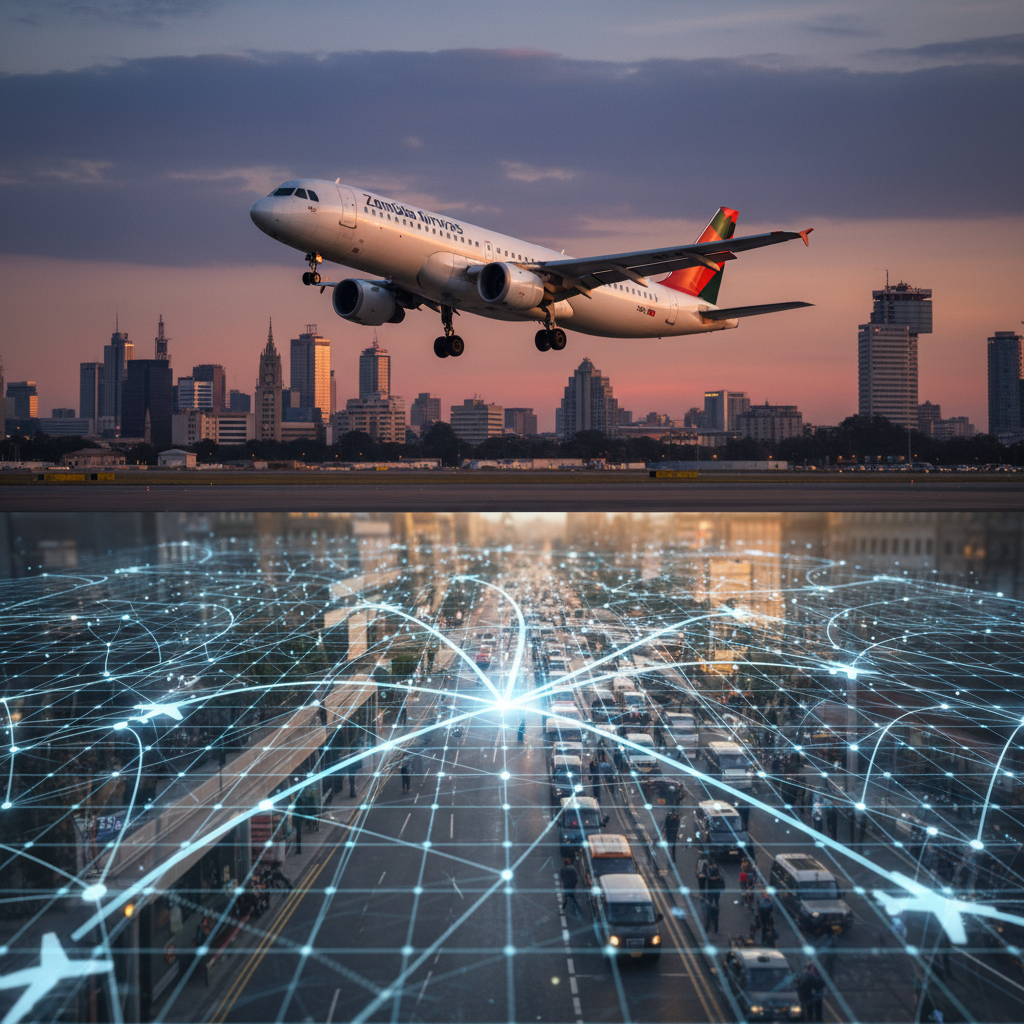

You're going to want to sit down for this, especially if you have ever found yourself stuck on a tarmac, wondering if the pilot was consulting a map drawn by a particularly confused chicken. The world of aviation, that grand ballet of metal birds and human ingenuity, is increasingly looking to artificial intelligence to solve its most persistent headaches. We are talking about everything from making sure your flight from Kenneth Kaunda International Airport to Dubai doesn't take an unnecessarily scenic route, to predicting when a critical engine part might decide to throw a tantrum, and even orchestrating the intricate dance of planes in the sky. It sounds like science fiction, but it is very much our April 2026 reality. And the question for us here in Zambia, and indeed across Africa, is whether we are merely passengers on this AI-powered flight, or if we can actually take the controls.
For decades, aviation has been a poster child for precision engineering and rigorous safety protocols. But even the best human minds and the most robust systems have their limits. Enter AI, promising to squeeze efficiencies out of every drop of jet fuel and every minute of air time. Companies like Google and Microsoft are not just building chatbots and cloud services anymore, they are deeply embedded in the backend of industries you would least expect, including the very air we breathe, or rather, the air our planes fly through. The global aviation industry, according to various reports, is projected to invest billions into AI solutions over the next decade, with some analysts estimating the market could reach over $20 billion by 2030. That is a lot of zeroes, even for those of us who count in kwacha.
Let us start with flight optimization. Imagine a world where every flight path is not just about getting from A to B, but about finding the absolute sweet spot between fuel consumption, weather patterns, air traffic congestion, and even geopolitical no-fly zones, all in real time. This is where AI truly shines. Algorithms can process vast amounts of data, far more than any human air traffic controller or pilot could, to suggest the most efficient routes. This means less fuel burnt, fewer emissions, and hopefully, fewer delays for impatient passengers. For airlines, the financial savings are immense. For the planet, the environmental benefits are crucial. And for us, it means potentially getting to our destination before our children finish their snacks.
"AI's ability to dynamically adjust flight paths based on live data is a game-changer for operational efficiency and environmental sustainability," stated Willie Walsh, Director General of the International Air Transport Association (iata), in a recent industry briefing. "We are seeing early adopters report significant reductions in fuel burn, sometimes upwards of 5 percent on long-haul routes. This is not just theoretical, it is happening now." And if you know anything about airline margins, 5 percent is not just pocket change, it is enough to make a CEO smile, perhaps even genuinely.
Then there is predictive maintenance, a concept that sounds less exciting than optimizing flight paths, but is arguably even more critical for safety. Instead of fixing things when they break, or on a rigid schedule, AI can analyze sensor data from aircraft engines, landing gear, and other vital components to predict when a part is likely to fail before it actually does. This is like having a mechanic who can tell you your car battery will die next Tuesday, giving you ample time to replace it, rather than leaving you stranded on the Great East Road. Companies like GE Aviation, for instance, are using AI and machine learning to analyze terabytes of flight data, allowing airlines to perform maintenance proactively, reducing costly unplanned downtime and, more importantly, enhancing safety. This technology is already being implemented by major carriers globally, and the results are promising, with some reports indicating a reduction in maintenance-related delays by up to 20 percent.
Now, let us talk about air traffic control, the grand conductor of the aerial orchestra. Here in Zambia, like many places, air traffic controllers are highly skilled individuals, but they operate within human limitations. They can only track so many planes, process so much information, and make so many decisions in a given timeframe. As air travel continues to grow, particularly in rapidly developing regions like Africa, the skies are getting more crowded. AI can act as a super-assistant, monitoring every aircraft, predicting potential conflicts, and suggesting optimal trajectories to controllers. This does not mean replacing humans, at least not yet, but augmenting their capabilities, making the skies safer and more efficient. The irony is almost too perfect, that the very technology that sometimes feels like it is taking over our lives might be the one keeping our planes from colliding.
However, and this is where my Zambian perspective kicks in, while the global north is busy implementing these sophisticated AI systems, what about us? Our aviation sector, while growing, often struggles with infrastructure, funding, and access to cutting-edge technology. Are we destined to be consumers of these AI solutions, or can we be contributors? The cost of implementing these systems is not insignificant. A small airline or a national aviation authority in a developing country might look at the price tag for a state-of-the-art AI-powered air traffic control system and decide that a few more human controllers and a prayer are more within budget. And who can blame them?
Consider the startup landscape. While Silicon Valley and European tech hubs are churning out aviation AI startups like hot cakes, the African continent is still playing catch-up. We have brilliant minds, innovative spirits, and unique challenges that could foster bespoke AI solutions. But the investment, the data infrastructure, and the regulatory frameworks often lag. "The digital divide extends to the skies," noted Dr. Naledi Pandor, South Africa's Minister of International Relations and Cooperation, during a recent panel discussion on technology in Africa. "We must ensure that as AI reshapes global industries, Africa is not left behind, merely importing solutions. We need to build our own capacity, our own data scientists, our own engineers, who can adapt and innovate for our specific contexts." Her words echo a sentiment often heard across the continent, a desire to move beyond being a market and become a hub of innovation.
There are glimmers of hope. Initiatives like the African Union's Digital Transformation Strategy for Africa are pushing for greater digital literacy and infrastructure development. Perhaps with increased investment in local tech ecosystems, we could see Zambian startups emerging to tackle these challenges with AI. Imagine a startup in Lusaka developing an AI system specifically trained on Zambian weather patterns, or on the unique maintenance challenges faced by aircraft operating in our regional climate. That is the kind of localized innovation we need. It is not just about buying the latest shiny gadget from abroad, it is about understanding our own problems and building solutions that fit.
The path forward for Zambia, and for many African nations, involves strategic partnerships, investment in education, and fostering a startup culture that can leverage AI. We need to train our youth, the next generation of engineers and data scientists, right here at home. We need to create an environment where a brilliant idea born in Matero can get the funding and support it needs to take flight, literally. Because if we do not, we risk a future where our skies are managed by algorithms designed thousands of kilometers away, with little understanding of the local nuances. And while those algorithms might be efficient, they might not always be ours.
The global aviation industry is undeniably soaring into an AI-powered future. The benefits in terms of safety, efficiency, and environmental impact are too significant to ignore. But as the world gets smarter, we must ensure that our participation is not just as passive recipients, but as active shapers of this new reality. The challenge is immense, but so is the potential. And for a country that prides itself on its resilience and ingenuity, I believe we are more than capable of rising to the occasion. After all, we have always found a way to fly, even when the winds were against us. For more insights into how AI is shaping industries globally, you might want to check out articles on TechCrunch or MIT Technology Review. The conversation is just beginning, and we need every voice at the table.