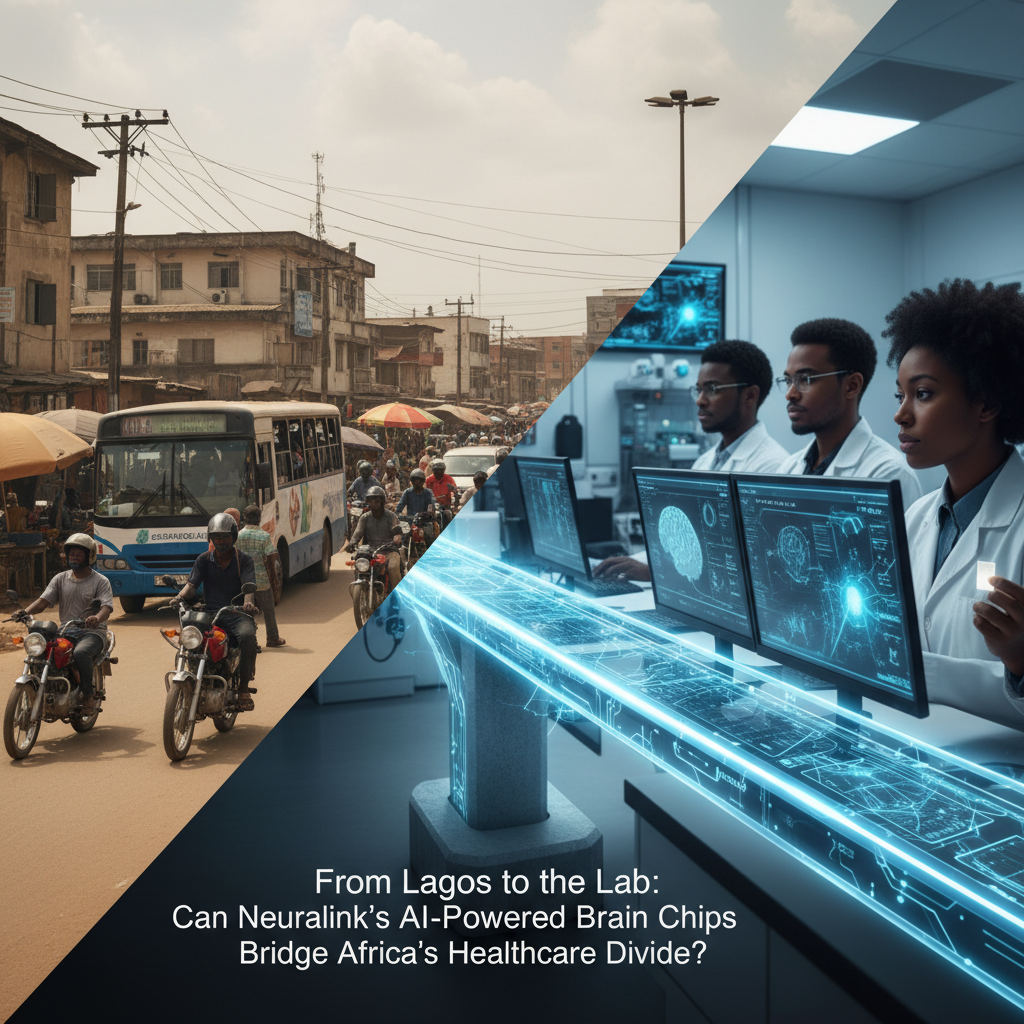

Let me tell you something, my people. Every time I see a new headline about brain-computer interfaces, or BCIs as the tech bros call them, my mind doesn't just go to the Silicon Valley labs. It zooms straight to the bustling streets of Lagos, to the quiet villages in the Niger Delta, to the millions across our continent who face daily struggles with disabilities that these technologies promise to erase. We are talking about restoring sight, giving voice back to the voiceless, and movement to those who have been still. This isn't just science fiction anymore; it is happening, and it is powered by artificial intelligence.
Elon Musk's Neuralink, always a headline grabber, recently showed us a patient, Noland Arbaugh, playing chess and controlling a computer cursor with his mind. It was a spectacle, a demonstration of what many once thought impossible. Arbaugh, paralyzed from the neck down, can now interact with the digital world using only his thoughts, thanks to a chip implanted in his brain that communicates with a computer. This is not just a gadget; it is a profound step towards redefining human capability. But as I watched, a question burned in my mind: for whom is this future being built?
Mark my words, the future is already here because it is just not evenly distributed. While the West celebrates these breakthroughs, Africa often finds itself on the periphery, waiting for the trickle-down effect. We have a continent with an estimated 80 million people living with disabilities, according to the World Health Organization. Many of these conditions, from spinal cord injuries to neurological disorders, could potentially be addressed by sophisticated BCIs. Imagine the impact: a child born blind in Kano seeing their mother's face for the first time, a stroke survivor in Accra speaking again, a veteran in Nairobi walking with renewed purpose. The possibilities are not just exciting; they are revolutionary.
The core of these advancements lies in AI. It is the AI algorithms that decode the complex electrical signals from the brain, translating intent into action. Without advanced machine learning, these BCIs would be mere electrodes in the skull. Companies like Neuralink, Synchron, and Blackrock Neurotech are pouring billions into research and development, pushing the boundaries of what these neural networks can achieve. Synchron, for instance, has focused on a less invasive approach, implanting its Stentrode BCI into a blood vessel in the brain, allowing patients to control devices. Blackrock Neurotech has been a pioneer in brain array technology for decades, enabling individuals with paralysis to move robotic limbs and control computers. These are not small feats; they are monumental.
But here is the catch, the bitter kola in the sweet drink: accessibility and affordability. The cost of these procedures, the specialized medical infrastructure required, and the ongoing support for these devices are astronomical. A single Neuralink procedure, if we are to speculate based on similar cutting-edge medical interventions, could easily run into hundreds of thousands of dollars. How many Nigerians, how many Africans, can afford such a price tag? It is a question that keeps me up at night.
Dr. Ifeanyi Nsofor, a Senior New Voices Fellow at the Aspen Institute and a public health expert based in Abuja, often speaks about the need for equitable access to healthcare innovations. He once said,