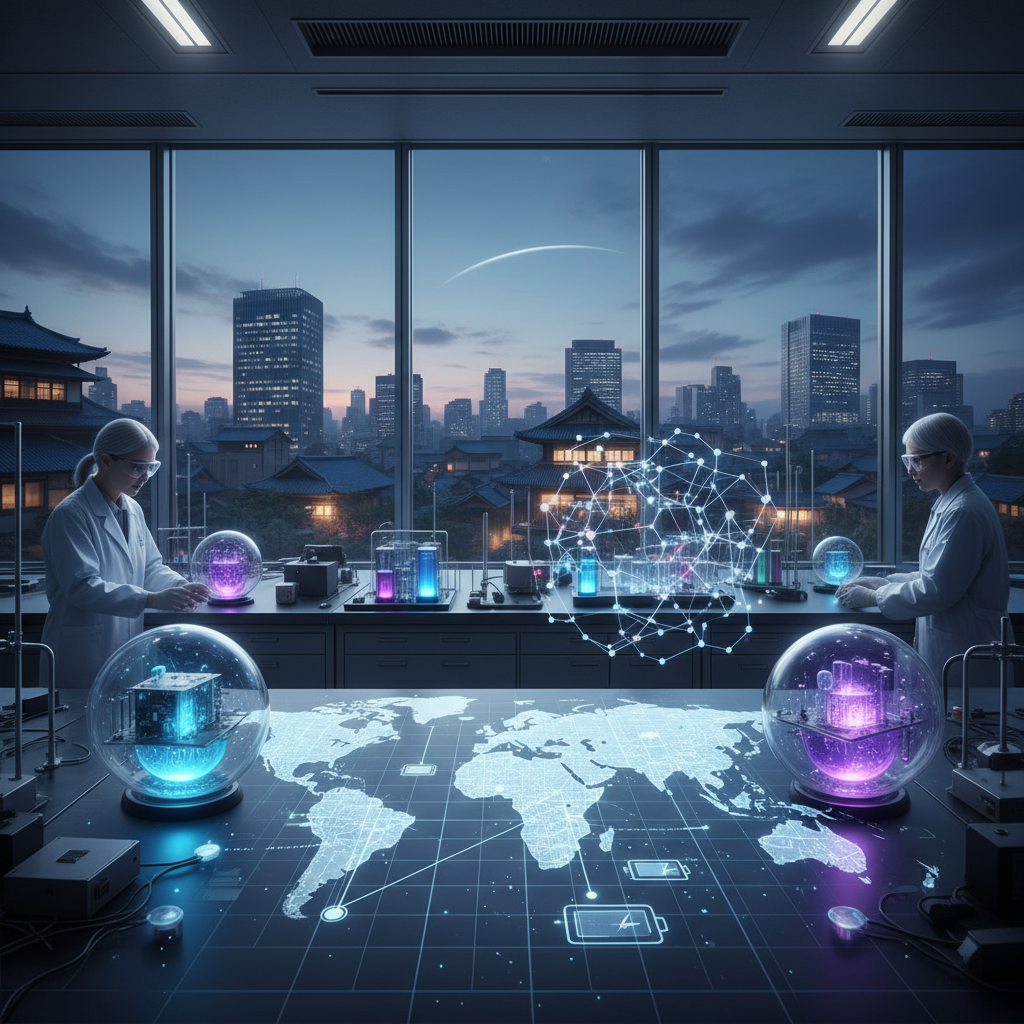
For centuries, humanity's progress has been inextricably linked to its mastery over materials. From the Bronze Age to the Silicon Age, each epoch is defined by the substances we learn to harness. Today, in the crucible of the 21st century, the quest for next-generation superconductors and advanced battery materials has become a modern-day alchemical pursuit, one now profoundly reshaped by the transformative power of artificial intelligence. Here in Japan, a nation synonymous with meticulous craftsmanship and technological foresight, this convergence is not merely an academic exercise, it is a national imperative.
The challenge is immense. Discovering a new material with desired properties, such as high-temperature superconductivity or vastly improved energy density for batteries, has traditionally been a laborious, trial-and-error process. It is akin to searching for a specific grain of sand on all the beaches of the world, often taking decades and billions of dollars. However, AI is changing this paradigm, acting as a sophisticated divining rod in the vast landscape of chemical compounds.
Consider the sheer combinatorial complexity involved. If we were to synthesize and test every possible combination of elements for a novel material, the universe's age would not suffice. This is where AI, particularly machine learning algorithms, enters the stage. These systems can analyze vast datasets of existing materials, identifying subtle patterns and correlations that human researchers might overlook. They can predict the properties of hypothetical compounds with remarkable accuracy, drastically narrowing the search space and accelerating the discovery cycle.
Japan has been quietly building its capabilities in this domain for years, leveraging its robust infrastructure in materials science and its pioneering spirit in robotics and automation. Institutions like the National Institute for Materials Science, or Nims, have been at the forefront, integrating AI into their research pipelines. Dr. Kenji Tanaka, Head of the AI Materials Informatics Group at Nims, elaborated on this shift. "Our traditional methods, while precise, were inherently sequential. AI allows us to explore the materials genome in parallel, predicting optimal compositions and structures before a single atom is synthesized. This is not just an incremental improvement, it is a complete re-engineering of discovery," he stated during a recent symposium in Tsukuba.
The engineering is remarkable. Imagine an AI system, fed with crystallographic data, quantum mechanical simulations, and experimental results, learning the fundamental rules governing material behavior. It then proposes a new compound, perhaps a complex oxide or an intermetallic alloy, with a predicted critical temperature for superconductivity far exceeding current limits. This prediction is then validated through automated synthesis and characterization, often carried out by robotic systems, further accelerating the feedback loop. This synergistic approach, where AI guides experimentation and experiments refine AI, is the engine of rapid progress.
One of the most pressing applications lies in energy storage. The global transition to electric vehicles and renewable energy sources hinges on the development of batteries that are cheaper, safer, lighter, and more energy-dense. Companies like Panasonic, a titan in battery manufacturing, are heavily investing in AI for materials discovery. Their research, often in collaboration with academic institutions, focuses on identifying new cathode and anode materials, as well as solid-state electrolytes, to push the boundaries of lithium-ion and beyond. The competition is fierce, with giants like Samsung also pouring resources into AI-driven materials innovation, particularly for their burgeoning EV battery divisions. The stakes are immense, potentially billions in market share.
For superconductors, the dream remains room-temperature superconductivity, which would revolutionize power transmission, medical imaging, and even transportation. While still a distant goal, AI is bringing us closer. Researchers are using AI to sift through millions of hypothetical compounds, searching for the elusive combination of elements and structures that could exhibit this phenomenon. A recent paper published in Nature Machine Intelligence highlighted an AI model that predicted over 500 new potential high-temperature superconducting materials, a feat impossible through manual exploration.
The data-driven approach is not without its challenges. The quality and quantity of training data are paramount. "Garbage in, garbage out" remains a fundamental truth, even for the most sophisticated algorithms. Ensuring the integrity and comprehensiveness of materials databases is a continuous effort. Furthermore, the interpretability of AI models, understanding why an AI predicts certain properties, is crucial for guiding human intuition and developing new theories. This is where the meticulous nature of Japanese research truly shines, focusing on both the 'what' and the 'why' behind AI's recommendations.
Globally, major players are recognizing this paradigm shift. Google DeepMind, known for its AlphaFold breakthroughs in protein folding, is also exploring materials science applications. NVIDIA's powerful GPUs, originally designed for graphics, are now indispensable tools for running the complex simulations and training the large AI models required for materials discovery. The confluence of computational power, advanced algorithms, and deep domain expertise is creating a fertile ground for innovation.
The implications for Japan, and indeed for the global economy, are profound. A breakthrough in battery technology could solidify Japan's position as a leader in electric vehicles and grid storage. A novel superconductor could dramatically reduce energy waste, impacting everything from data centers to bullet trains, areas where Japan already excels. Precision matters, and AI is providing an unprecedented level of precision in predicting material behavior.
As we look ahead to the next decade, the synergy between AI and materials science promises to unlock a new era of technological advancement. The quiet hum of servers in Kyoto's research labs, running complex AI algorithms, is perhaps as significant as the clang of hammers in ancient forges. These digital alchemists are not just discovering new materials, they are forging the very foundations of our future. For more insights into how AI is reshaping various industries, consider reading about Japan's Digital Agency Mandates AI Transparency [blocked], which touches upon the regulatory landscape surrounding these powerful technologies. The race is on, and Japan is demonstrating its unwavering commitment to leading from the front, not just in AI development, but in its tangible applications that promise to reshape our world. For further global perspectives on this rapidly evolving field, I often consult Reuters' technology section for the latest business and research developments.
The future, it seems, will be built on materials discovered by machines, guided by human ingenuity. It is a testament to the enduring spirit of innovation that continues to define our age.