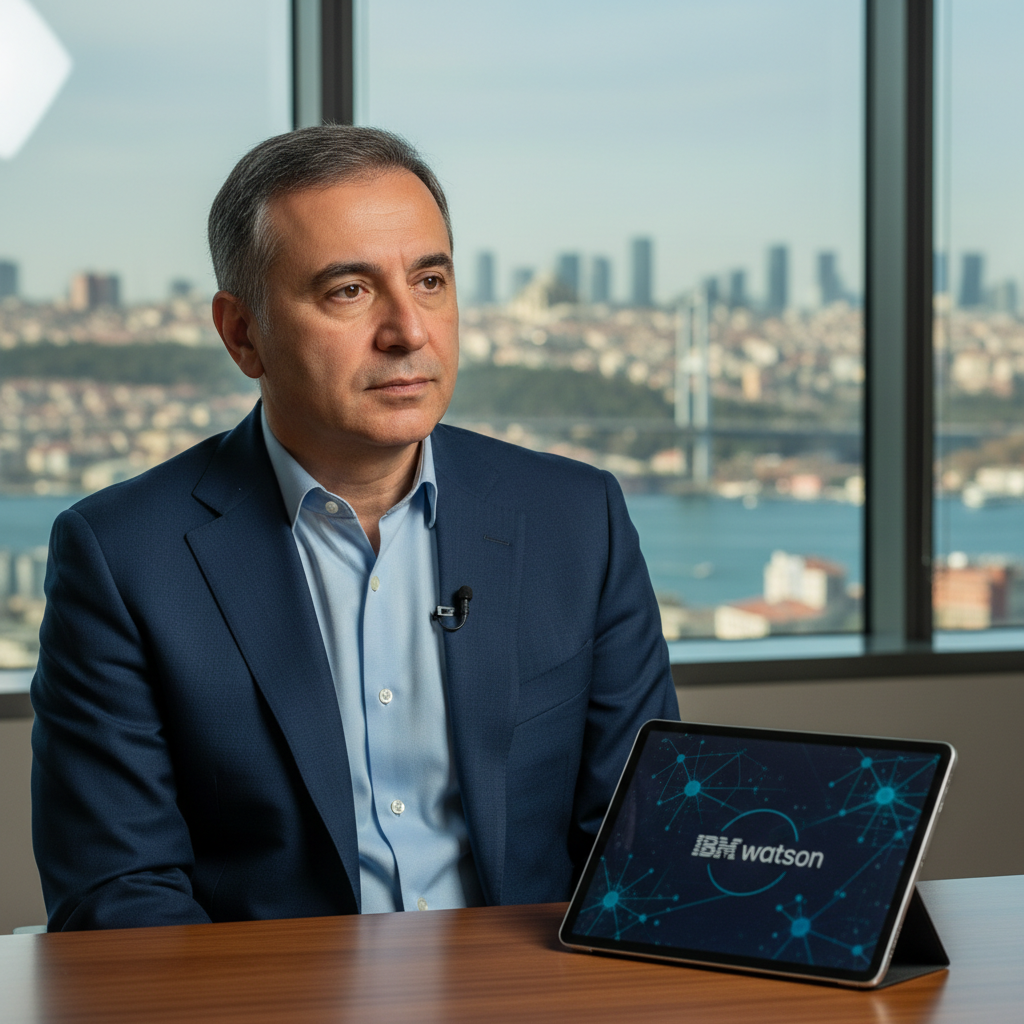

The Bosphorus, a timeless ribbon of blue, always reminds me of how Istanbul bridges two worlds and so does its AI scene. From my window overlooking the shimmering waters, I often ponder the currents of technology that flow between continents, shaping our lives in ways both grand and subtle. Today, one such current is the quiet, yet profound, reinvention of IBM Watson, a name that once promised a revolution in every home, now finding its true calling in the complex corridors of enterprise AI.
I met Dr. Arda Batu, a man whose insights are as sharp as the morning light on the Golden Horn, at a small cafe in Karaköy. He is a familiar face in Turkish technology circles, known for his thoughtful analyses and his ability to connect global trends to local realities. Over Turkish tea, strong and dark, he shared his perspective on how IBM, with its storied past and ambitious future, is navigating the choppy waters of the AI consulting market, particularly here in Europe.
Dr. Batu, with his background in international relations and his current role at the intersection of technology and policy, offers a unique lens. He has observed the evolution of AI from its early, often overhyped, days to its current, more pragmatic, application in business. "IBM Watson's initial foray into the public consciousness was perhaps too ambitious, too broad," he began, stirring his tea thoughtfully. "It promised a general intelligence that the technology simply wasn't ready to deliver at scale. But what they have done now, focusing on specific industry solutions and leveraging their deep enterprise relationships, is a much more strategic and sustainable path."
Indeed, IBM's journey with Watson has been a fascinating one. From its triumph on Jeopardy! in 2011, capturing the world's imagination, to its subsequent struggles in healthcare, the brand has seen its share of peaks and valleys. Yet, the company has steadfastly continued to invest, shifting its focus from a general-purpose AI to a suite of targeted tools designed for specific business challenges. This pivot, as Dr. Batu highlighted, is crucial for its relevance in a market now dominated by agile startups and tech giants like Google and Microsoft, all vying for a piece of the enterprise AI pie.
"The enterprise AI consulting market is not about flashy consumer applications," Dr. Batu explained. "It's about deep integration, data security, regulatory compliance, and demonstrable return on investment. This is where IBM's legacy, its decades of experience working with large corporations and governments, becomes an undeniable asset." He pointed out that while companies like OpenAI and Anthropic are pushing the boundaries of foundational models, the real work of deploying AI in complex, regulated environments often requires a different kind of expertise, one that IBM has cultivated over many years.
IBM has been strategically acquiring companies and developing platforms to bolster its enterprise AI offerings. Their focus on hybrid cloud environments, for instance, allows businesses to deploy AI models where their data resides, whether on-premises or across multiple cloud providers. This flexibility is particularly appealing to large organizations with stringent data governance requirements. "For a bank in Frankfurt or a manufacturing giant in Bursa, the ability to keep sensitive data within their own infrastructure while still leveraging advanced AI capabilities is paramount," Dr. Batu noted. "IBM understands this deeply."
One of the key areas where IBM Watson is making inroads is in automation and intelligent workflows. By applying AI to streamline processes, from customer service to IT operations, businesses can achieve significant efficiencies. Dr. Batu mentioned a public statement by Arvind Krishna, IBM's Chairman and CEO, who has consistently emphasized the transformative power of AI in business. Krishna has been quoted saying, "AI will fundamentally change every business process. It is the defining technology of our time." This sentiment resonates with IBM's strategy to embed AI into the very fabric of enterprise operations, making it an indispensable tool rather than a standalone novelty.
The consulting aspect is equally vital. Implementing AI is rarely a plug-and-play affair. It requires understanding a client's unique business processes, identifying the right use cases, preparing data, training models, and integrating them into existing systems. This is where IBM Consulting, with its vast network of experts, comes into play. They are not just selling software; they are selling solutions, tailored to specific needs. "It's a bespoke tailoring service for the digital age," Dr. Batu mused, a smile playing on his lips. "And that's a service many large enterprises are willing to pay a premium for."
He cited the example of AI in financial services, an area where accuracy and compliance are non-negotiable. IBM Watson's capabilities in fraud detection, risk assessment, and personalized customer interactions are being deployed by major institutions globally. Similarly, in telecommunications, AI is optimizing network performance and predicting maintenance needs, leading to better service and reduced operational costs. These are not headline-grabbing consumer products, but they represent billions of dollars in value for businesses.
For Turkey, a country at the crossroads of innovation and tradition, the implications are significant. "Our businesses, particularly in manufacturing, finance, and logistics, are increasingly looking to AI for competitive advantage," Dr. Batu explained. "They need partners who can deliver robust, secure, and scalable solutions. While local startups are vibrant and innovative, the complexity of enterprise-level AI often demands the kind of comprehensive support that a company like IBM can provide." He added that the transfer of knowledge and the development of local expertise through such partnerships are invaluable for Turkey's burgeoning tech ecosystem.
The conversation shifted to the future. What does the next chapter hold for IBM Watson and the enterprise AI market? Dr. Batu believes that specialization will be key. "We will see more vertical-specific AI solutions, deeply trained on industry data, offering hyper-personalized insights. The generalist AI will give way to the specialist AI in the enterprise space." He also anticipates a greater emphasis on explainable AI, where businesses need to understand how AI models arrive at their conclusions, especially in regulated industries.
He also touched upon the competitive landscape. While IBM has a strong footing, it faces formidable competition. Microsoft, with its Copilot offerings and strategic investments in OpenAI, is a major player. Google Cloud is also aggressively pursuing enterprise clients with its Gemini models and extensive AI services. Yet, IBM's unique selling proposition lies in its holistic approach, combining hardware, software, and consulting services under one roof.
As our tea glasses were emptied, Dr. Batu concluded with a thought that resonated deeply with my own observations. "The story of AI is not just about algorithms and data; it's about people. It's about how these tools empower individuals and organizations to achieve more. IBM Watson's reinvention is a testament to resilience and adaptation, a reminder that even established giants can redefine their purpose in a rapidly changing world." His words echoed the very essence of what we try to capture at DataGlobal Hub: the human element behind every technological leap.
From our vantage point in Istanbul, we see this evolution not as a distant phenomenon, but as a tangible force shaping our economy and our future. The enterprise AI market, with players like IBM Watson, is quietly building the infrastructure for the next generation of business, one intelligent process at a time. For more on the evolving landscape of enterprise AI, you can explore resources like TechCrunch's AI section or MIT Technology Review for deeper analysis. The journey of AI, much like the Bosphorus, continues to flow, connecting distant shores and bringing new possibilities to light. The enterprise AI market is a complex ecosystem, and understanding its nuances requires a keen eye on both technological advancements and strategic business decisions, as discussed in various reports from Reuters Technology.