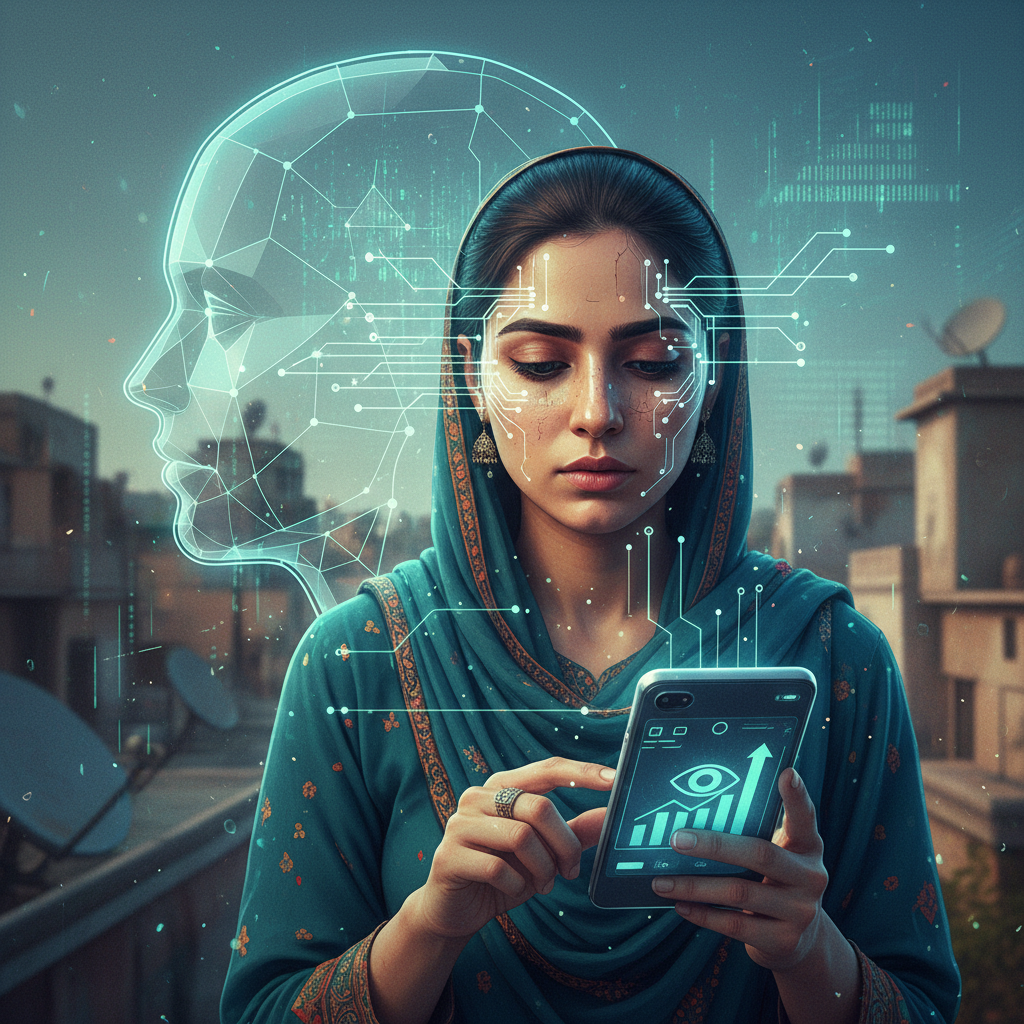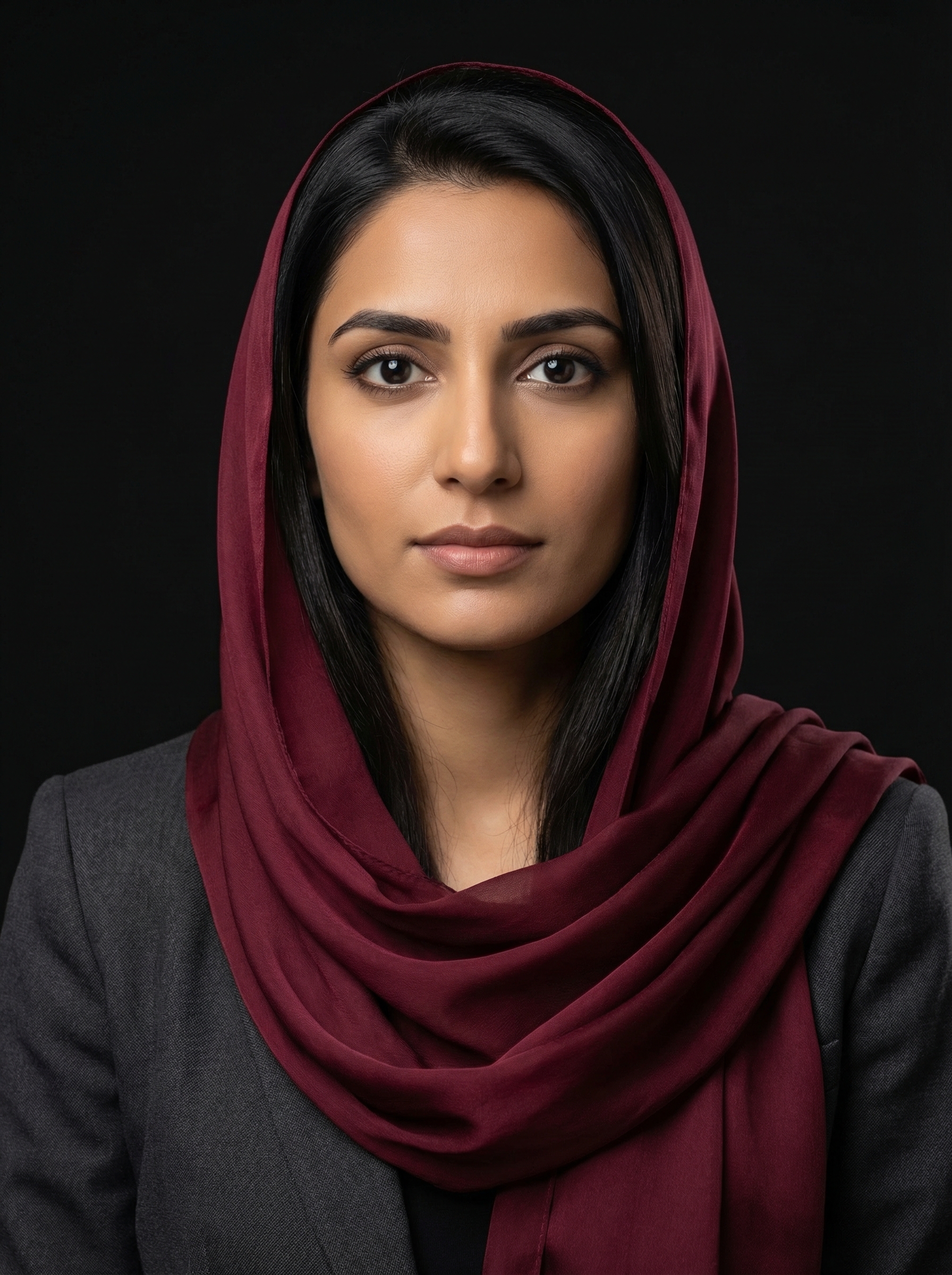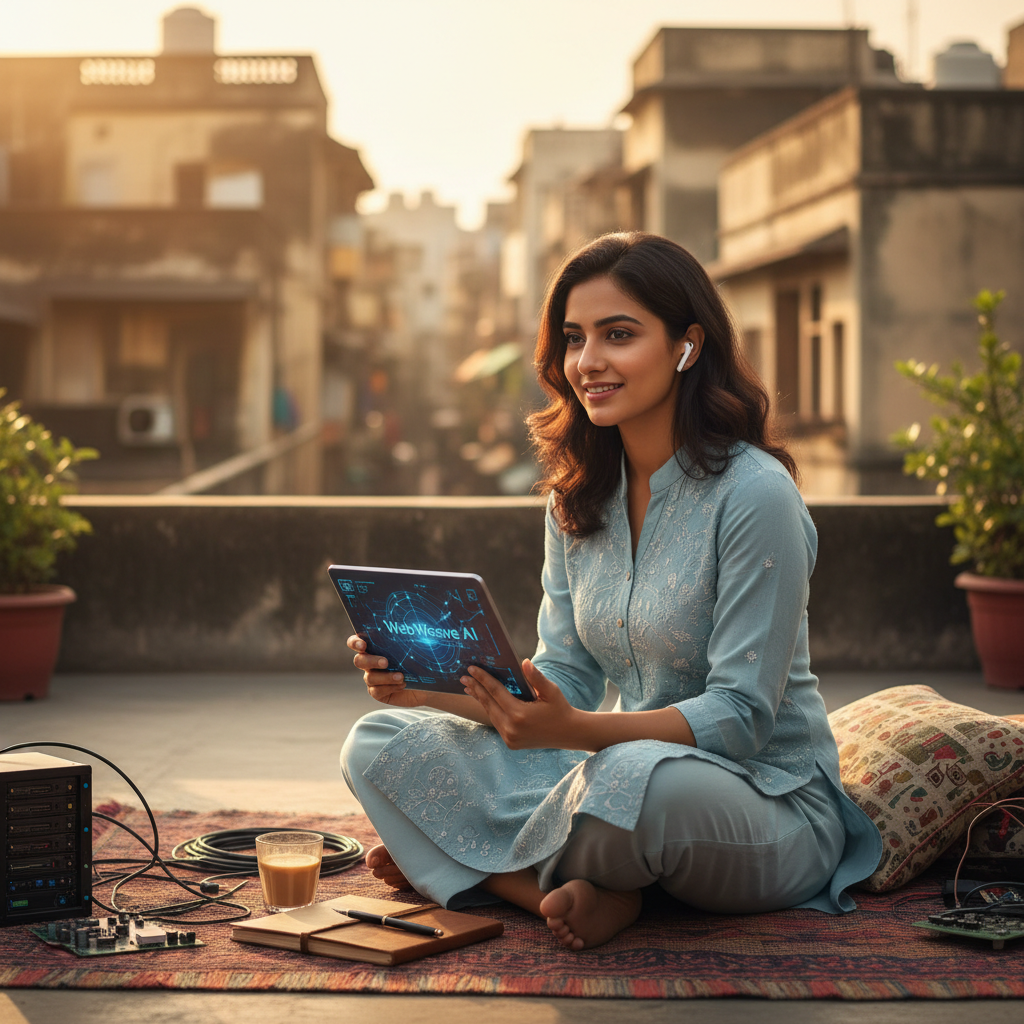

The air in Hyderabad, even in April 2026, still hums with that familiar, chaotic energy. But step into the glass-and-steel edifice of WebWeave AI's headquarters in Gachibowli, and you feel a different kind of current, one that promises to reshape the very fabric of the internet. Here, amidst the whirring of servers and the quiet intensity of young engineers, sits Anya Sharma, the 28-year-old CEO and co-founder, a woman who embodies the audacious spirit of India's tech revolution.
I first met Anya at a small, bustling chai stall near her old IIT Hyderabad campus, long before WebWeave AI was a whispered name in venture capital circles. She was sketching diagrams on a crumpled napkin, her eyes alight with an idea so grand it sounded almost delusional. "Arjùn," she'd said, pushing a steaming cup of masala chai towards me, "imagine if every website, every single one, had a brain. Not just a chatbot, but an intelligent layer that understands context, anticipates needs, and personalizes everything. That's the future." She wasn't just talking about Vercel's AI SDK, she was talking about making it ubiquitous, a fundamental utility.
Anya's journey, like many of India's brightest, began with a relentless pursuit of academic excellence. Born and raised in a modest household in Bengaluru, the daughter of a government school teacher and a small business owner, she was a child prodigy. She devoured books on mathematics and computer science, often staying up late under the dim glow of a single bulb, coding on an ancient desktop her father had salvaged. Her acceptance into IIT Hyderabad for Computer Science was less a surprise and more an inevitability. "My parents always told me, education is your greatest wealth," she recalled, a faint smile playing on her lips. "They mortgaged our small home for my coaching. I couldn't fail them."
After graduating top of her class, the golden gates of Silicon Valley beckoned. Google offered her a coveted position in their AI research division in Mountain View. For two years, she worked on cutting-edge projects, rubbing shoulders with some of the brightest minds in the world. But something gnawed at her. "It was incredible, the resources, the talent," she told me, gesturing with her hands as if still wrestling with the memory. "But I felt like a cog in a giant machine. The impact felt distant, abstract. I wanted to build something that touched everyone, immediately."
The 'garage moment' for WebWeave AI didn't happen in a garage, but in a cramped, humid apartment in Hyderabad. Anya had returned to India, much to the bewilderment of her Google colleagues and family. She reconnected with Rohan Gupta, a former IIT classmate and a brilliant backend engineer, over a plate of biryani. Rohan, equally disillusioned with corporate life, shared Anya's hunger for radical innovation. "We spent months just talking, brainstorming, arguing," Rohan recounted to me during a recent interview. "Our first idea was a personalized AI tutor, then an AI-powered legal assistant. They were good, but not it."
The pivot came during a late-night coding session, fueled by endless cups of filter coffee. They were struggling to integrate a simple AI chatbot into a client's e-commerce site. The process was clunky, resource-intensive, and required deep technical expertise. "That's when it hit me," Anya said, her voice still carrying the excitement of that epiphany. "What if we could create a lightweight, modular AI layer that developers could just plug into any website, regardless of its underlying technology? A universal AI SDK, like Vercel's but for true, deep intelligence, not just static content. We wouldn't just build AI, we'd enable everyone to build AI into their web presence. This is the inflection point."
Their initial prototype, built over three frantic months, was rudimentary but revolutionary. It allowed a small online saree boutique in Chennai to offer real-time, context-aware styling advice to customers, understanding their preferences and even suggesting drapes based on local festivals. The results were immediate: a 30% increase in customer engagement and a 15% jump in sales. This was not just a chatbot, it was a digital assistant that felt almost human. They called it WebWeave AI, a name that perfectly captured their ambition to weave intelligence into the web's very fabric.
Building the company was a whirlwind. They secured a modest seed round of $2 million from local angel investors, mostly prominent figures from India's burgeoning tech ecosystem. The initial team was just five people, working out of a co-working space that smelled perpetually of instant noodles and ambition. Anya was a demanding but inspiring leader, pushing her team to innovate relentlessly, but also fostering a culture of open dialogue and mutual respect. "She expects nothing less than your best, but she also ensures you have the space to deliver it," said Priya Singh, WebWeave AI's Head of Product, who joined early on. "It's like being part of a family, but one that's trying to change the world."
Their big break came with Y Combinator's Winter 2024 batch. They flew to California, pitching their vision to skeptical but ultimately impressed investors. "They saw the potential, but they were wary of a team based entirely out of India," Anya admitted. "We had to prove that talent is global, and innovation isn't confined to a single valley." They not only graduated but secured a $30 million Series A funding round at a $300 million valuation, led by Altos Ventures, with participation from Sequoia India. "Altos Ventures saw the global play, the sheer scale of the problem we were solving," Anya explained. "They understood that India will own the next decade of AI, and we were building the picks and shovels for that gold rush."
Today, WebWeave AI is a force to be reckoned with. They've raised a Series B round of $100 million from a consortium including a16z and Founders Fund, pushing their valuation to over $500 million. Their annual recurring revenue (ARR) is projected to hit $100 million by the end of 2026. Their SDK is now integrated into over 50,000 websites globally, from small businesses in Tier 2 Indian cities to major e-commerce players in Europe and North America. They've partnered with giants like Shopify and WordPress, making their AI layer accessible to millions of developers.
What drives Anya Sharma? It's not just the valuations or the revenue. It's the belief that technology, especially AI, should be democratized, made accessible to everyone, not just the tech elite. "I want to see a street vendor in Delhi using our AI to recommend specific spices to a tourist, based on their dietary preferences," she said, her eyes gleaming. "I want to see a small village artisan selling their crafts globally, with an AI assistant translating their story and connecting them to buyers. That's true impact. That's the India I believe in."
Her ambition extends beyond just websites. WebWeave AI is now exploring integrations with IoT devices and even augmented reality platforms, envisioning a future where every digital interaction, every physical object connected to the internet, has an intelligent, adaptive layer. "We're just scratching the surface," Anya declared, her gaze fixed on the bustling Hyderabad skyline outside her office window. "The internet is evolving, and we are building its next brain. Forget Silicon Valley, look at Hyderabad, because India will own the next decade of AI. This is not just a company, it's a movement."
Indeed, as the world grapples with the implications of advanced AI models from OpenAI and Google, companies like WebWeave AI are quietly building the infrastructure that will bring this intelligence to the masses. Anya Sharma, with her unwavering vision and relentless drive, is not just a founder, she is a harbinger of a future where AI is not just a tool, but an inherent part of our digital existence. Her journey is a testament to the fact that the next wave of global innovation will not just emerge from established tech hubs, but from everywhere, especially from the vibrant, dynamic landscape of India. For more on the future of AI, you can always check out what the experts are saying at MIT Technology Review or TechCrunch. The future, my friends, is being woven right before our eyes, and it's got an Indian accent. You can read more about how AI is transforming various sectors on Bloomberg Technology. There's no turning back now.