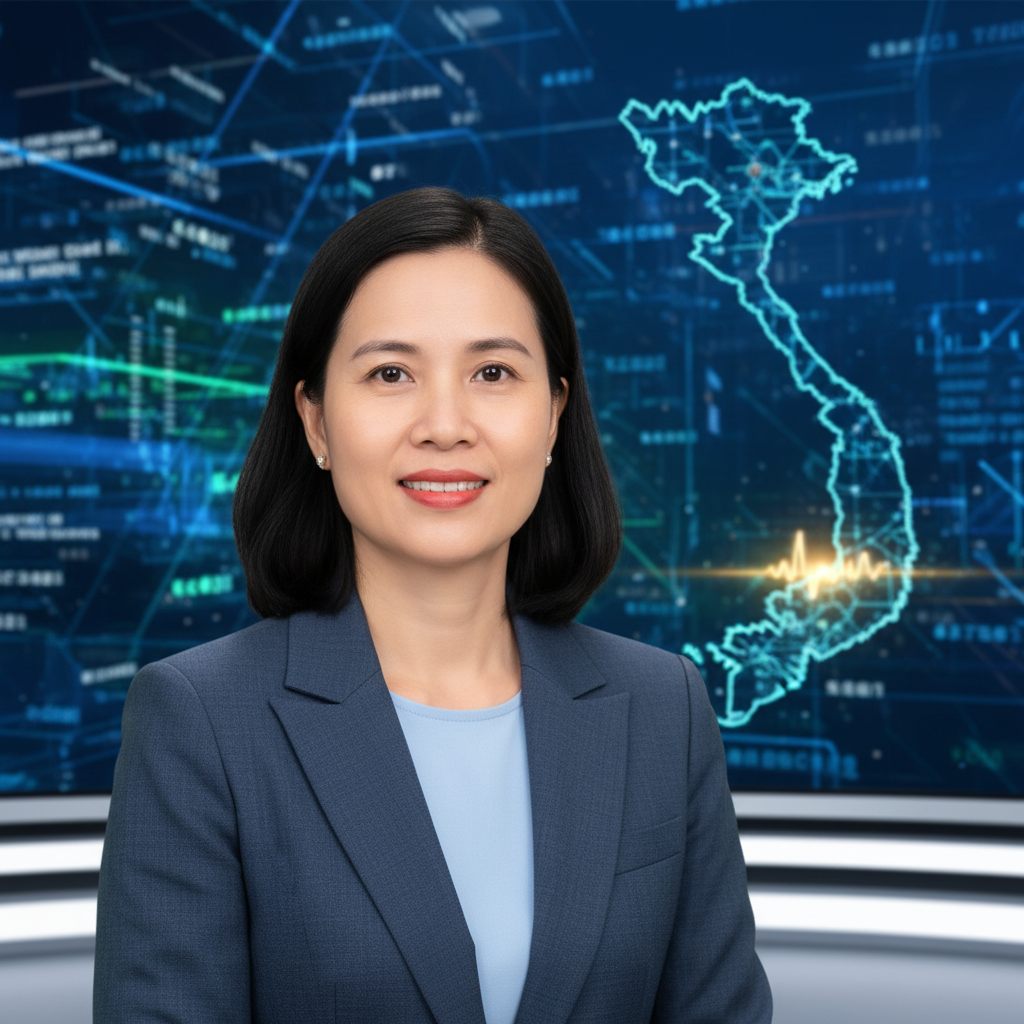

The air in Ho Chi Minh City always crackles with energy, a vibrant hum that never truly sleeps. Today, that hum felt particularly electric as I navigated the bustling streets, past the fragrant phở stalls and the endless stream of motorbikes, heading towards the Saigon Hi-Tech Park. My destination: the office of Dr. Mai Lâm, founder and CEO of VinAI Labs, a name rapidly gaining recognition in the global AI community. We were meeting to discuss something monumental: Anthropic's colossal funding rounds and the intense global race to build safe Artificial General Intelligence, or AGI. This isn't just Silicon Valley news anymore, it's a global phenomenon, and Vietnam, my beloved country, is absolutely in the thick of it. Vietnam is the dark horse of AI, and Dr. Lâm is one of its most brilliant jockeys. I could feel it in my bones, this conversation was going to be illuminating.
Dr. Lâm greeted me with a warm smile and a traditional Vietnamese handshake, her eyes bright with an almost childlike enthusiasm for her work. Her office, surprisingly minimalist amidst the city's usual maximalism, offered a panoramic view of the developing tech hub, a concrete jungle blossoming with innovation. "Ngo Thi Huừngé, it's a pleasure," she said, her voice calm yet resonant. "Please, have some trà đá." The iced tea was a welcome refreshment in the Saigon heat, a small touch of home in a conversation about the future of humanity.
I started by asking about the elephant in the room, Anthropic's recent financial triumphs. "Dr. Lâm, Anthropic has secured billions, from Amazon, Google, and others, all aimed at building Claude and, ultimately, safe AGI. What does this kind of capital injection mean for the landscape, especially for players like VinAI Labs here in Vietnam?"
She leaned back, a thoughtful expression on her face. "It's a double-edged sword, isn't it? On one hand, it validates the immense potential and urgency of AGI research. It signals to the world that this isn't just science fiction anymore, it's a tangible goal with serious investment. For us, it means the bar is constantly being raised. The pace of innovation accelerates exponentially when you have that kind of resource behind a single vision."
"But the other edge?" I prompted.
"The concentration of power and resources," she continued, without hesitation. "When a handful of companies command such vast sums, it creates an uneven playing field. The race for AGI isn't just about who builds it first, but who builds it safely and ethically. And that requires diverse perspectives, not just those from a few dominant players."
Dr. Lâm herself is a fascinating figure. Born in a small village outside Huế, she excelled in mathematics and computer science, eventually earning her PhD from Stanford University before returning to Vietnam with a fervent desire to contribute to her homeland's technological advancement. "I saw the potential here," she explained, gesturing towards the window. "The hunger for knowledge, the incredible work ethic, the innovative spirit. Ho Chi Minh City never sleeps, especially its coders. They are driven by a desire to make a real impact."
Her journey back to Vietnam wasn't just about patriotism, it was about opportunity. "When I was studying abroad, I realized that many of the fundamental challenges in AI, particularly in areas like natural language processing for low-resource languages or robust computer vision in diverse environments, were often overlooked by the big players. Vietnam, with its unique linguistic nuances and varied landscapes, became a perfect testbed for developing truly adaptable AI."
We delved deeper into the safety aspect of AGI. Anthropic's core mission revolves around 'Constitutional AI,' a method designed to make AI systems more harmless and helpful. "Do you believe their approach is the right one, or even sufficient?" I asked.
"Their focus on safety is commendable and absolutely critical," Dr. Lâm affirmed. "The idea of baking ethical principles into the AI's core, rather than just bolting them on as an afterthought, is the direction we all must take. However, safety isn't a one-size-fits-all solution. What constitutes 'safe' can vary across cultures, across societies. This is where a global, collaborative approach becomes indispensable. We need a symphony of voices, not a solo performance, to define and implement AGI safety."
She then shared a surprising insight about VinAI Labs' own work. "We're not just observing the AGI race, we're participating in it, albeit with a different strategy. While others pour billions into scaling foundational models, we're focusing on what we call 'contextual AGI.' It's about developing highly capable, safe AI that understands and operates within specific, complex real-world environments, like optimizing supply chains for perishable goods across Southeast Asia, or developing diagnostic tools for tropical diseases. These are problems that demand intelligence, adaptability, and above all, safety in deployment." This startup just changed the game, I thought, realizing the depth of their strategic thinking.
Dr. Lâm elaborated on a recent project. "We're collaborating with local hospitals to develop an AI diagnostic assistant for dengue fever, a significant health challenge in our region. The AI needs to be incredibly accurate, explainable to doctors, and robust enough to handle varying data quality. It's not about general intelligence, but highly specialized, trustworthy intelligence that saves lives. This is our contribution to the AGI safety discussion: building trust through practical, impactful, and rigorously tested applications."
Her vision for the future was both pragmatic and inspiring. "I believe the next decade will see a diversification of AGI development. While the 'mega-models' will continue to push the boundaries of general capabilities, we'll also see a rise in specialized, 'domain-specific' AGIs that excel in particular areas, bringing immense value and demonstrating safety in controlled environments. Vietnam has a unique opportunity here. Our agility, our focus on practical applications, and our deep understanding of regional challenges can position us as leaders in developing these trustworthy, contextual AGI systems."
She spoke about the need for more international collaboration, especially with institutions that share a similar commitment to ethical AI development. "We need open dialogues, shared research, and perhaps even global regulatory frameworks that are inclusive of diverse perspectives," she suggested. "The future of AGI is too important to be left to any single nation or corporation." I found myself nodding in agreement, thinking about the broader implications of such a unified approach. For more on the global AI landscape, TechCrunch offers excellent coverage.
As our conversation drew to a close, Dr. Lâm offered a final thought, her gaze once again sweeping across the vibrant cityscape. "The race for AGI is not just a technological sprint, it's a marathon for humanity. It requires not only brilliant minds and massive computing power, but also wisdom, foresight, and a deep sense of responsibility. Here in Vietnam, we might not have the same financial muscle as the global giants, but we have something equally powerful: a clear vision for how AI can serve our people and the world, built on a foundation of safety and ethical consideration. We are building the future, one intelligent, responsible step at a time."
Her words resonated deeply. The global AI narrative often centers on a few dominant players, but conversations like this remind us that innovation is a global phenomenon, thriving in unexpected corners. Vietnam, with its dynamic spirit and brilliant minds like Dr. Mai Lâm, is not just observing the future, it is actively shaping it, proving that the race for AGI is far richer and more diverse than many realize. For more on AI research and analysis, consider exploring MIT Technology Review. The journey to AGI is long, complex, and filled with both promise and peril, but with leaders like Dr. Lâm, I feel an infectious optimism for what lies ahead. After all, the future is built by those who dare to dream, and then, crucially, dare to build. You can also learn more about Anthropic's specific safety initiatives on their official website, Anthropic.