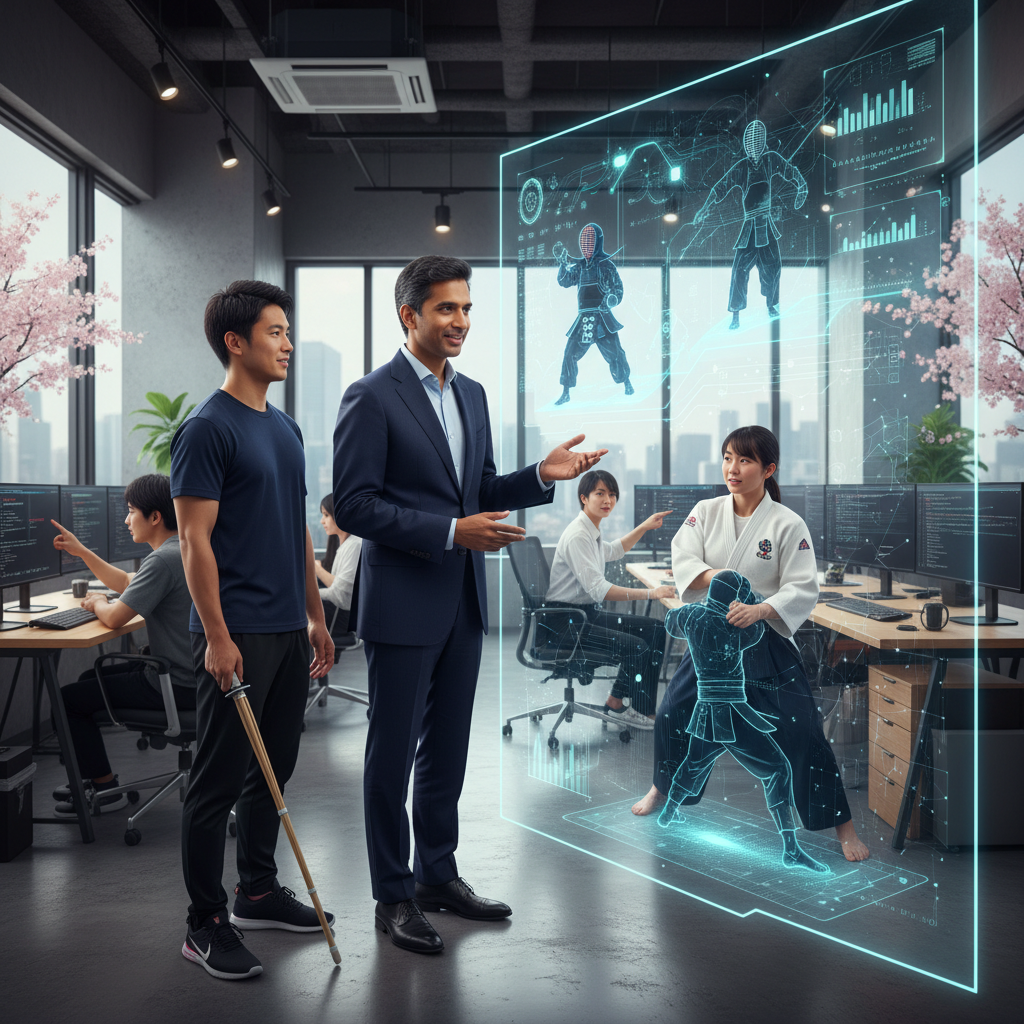
The scent of tatami mats and the sharp crack of a kendo stick hitting its target. This is the Japan I know, a land where discipline and tradition intertwine with a relentless pursuit of perfection. For generations, young athletes here have honed their skills through countless hours of practice, often pushing their bodies to the very limit. But what if there was a way to honor that dedication while also protecting these precious bodies from the unseen threats of injury and burnout? This is the question that drove Kenji Tanaka, a former kendo prodigy, to found Kagami AI.
Kenji's story is one many Japanese can relate to. He was destined for greatness in kendo, his movements fluid and precise, a true embodiment of the martial art's spirit. But at 17, a sudden, career-ending knee injury shattered his dreams. It wasn't a dramatic collision, but a subtle, cumulative stress fracture that had gone unnoticed. "It felt like a betrayal," Kenji told me, his voice soft, as we sat in his minimalist office overlooking Shibuya Crossing. "My body, which I had trained so meticulously, just gave out. I wished there had been a 'mirror' to show me what was happening inside." That quiet wish, born from personal pain, became the seed for Kagami, meaning 'mirror' in Japanese.
The Problem They Are Solving: The Unseen Strain
Japan's sports culture, from high school baseball to professional sumo, is legendary for its intensity and commitment. However, this dedication often comes at a cost. Overtraining, repetitive stress injuries, and the pressure to perform can lead to physical breakdowns that end careers prematurely. Traditional sports analytics, while good at tracking scores and basic movements, often misses the subtle biomechanical shifts that precede an injury. Furthermore, the mental strain on athletes, particularly young ones, is immense. Kagami AI aims to provide that missing 'mirror,' offering insights into both physical and psychological well-being.
"We are not here to replace coaches or doctors," Kenji explained, gesturing towards a screen displaying intricate skeletal models. "We are here to augment their incredible human intuition with data they simply cannot perceive with the naked eye. It's about empowering them to make more informed decisions, to truly care for the whole athlete." This human-centered approach is what truly sets Kagami apart.
The Technology: A Symphony of Sensors and Deep Learning
In a quiet Tokyo lab, Kagami AI's engineers have developed a sophisticated system that combines wearable sensors, high-speed optical tracking, and advanced deep learning models. Athletes wear unobtrusive, lightweight sensors embedded in their gear during training. These sensors capture an astonishing array of data points: joint angles, muscle activation patterns, ground reaction forces, and even heart rate variability. High-definition cameras, similar to those used by Google DeepMind for complex simulations, track macroscopic movements with millimeter precision.
This raw data is then fed into Kagami's proprietary AI engine, built on a foundation of transformer architectures, much like those powering OpenAI's GPT models, but specialized for biomechanical and physiological data. The AI learns to identify subtle deviations from optimal form, predict fatigue accumulation, and even flag early indicators of potential injury. "Our models can detect a 2% change in a pitcher's shoulder rotation consistency over three weeks, a change imperceptible to the human eye, but one that often precedes a serious elbow injury," said Dr. Akari Sato, Kagami's Head of AI Research, a former biomechanics professor at the University of Tokyo. "She whispered something that changed my perspective," Kenji added, "Akari reminded me that every data point represents a human body, a dream, a family's hope. Our algorithms must reflect that responsibility."
Beyond physical metrics, Kagami AI is also pioneering the use of natural language processing to analyze athlete journals and coach feedback, identifying patterns related to mental fatigue or stress. This holistic approach provides a comprehensive 'health score' for each athlete, allowing for personalized training adjustments and proactive interventions. The system even integrates with fan engagement platforms, offering real-time insights into player performance and health, creating a deeper connection between fans and their favorite athletes.
Market Opportunity: A $5 Billion Horizon in Asia
The global sports analytics market is projected to reach over $10 billion by 2028, and Asia, with its fervent sports fan base and growing investment in athletic development, represents a significant portion of that. Kagami AI is strategically positioned to capture a substantial share, particularly in Japan, South Korea, and China. Their initial focus is on high-performance sports like baseball, soccer, and track and field, where injury prevention and performance optimization yield direct, measurable returns.
"The Japanese market alone for elite sports analytics is approaching $500 million annually, and it's growing at 15% year over year," stated Hiroshi Nakamura, a leading sports economist and advisor to Kagami AI. "Beyond that, the potential for youth sports and even general fitness applications is immense. Kagami's unique blend of deep tech and cultural sensitivity gives them a significant edge here." The company recently secured a Series A funding round of $20 million, led by SoftBank Ventures Asia and a consortium of Japanese angel investors, bringing their total funding to $25 million. This capital infusion will fuel their expansion across Asia and further refine their AI models.
Competitive Landscape: Human Touch as a Differentiator
The sports analytics space is becoming increasingly crowded. Major players like Catapult Sports and Stats Perform offer robust tracking and data analysis. Tech giants like Google and Amazon are also making inroads, leveraging their cloud infrastructure and machine learning expertise. For instance, Google Cloud offers AI solutions for sports, and Amazon Web Services provides data analytics tools for leagues. However, Kagami AI believes its deep specialization in biomechanical injury prediction, coupled with its culturally nuanced approach to athlete well-being, creates a distinct competitive advantage.
"Many Western solutions focus purely on performance metrics and winning, which is important, of course," Kenji observed. "But we understand the Japanese philosophy of karada no seishin, the spirit of the body. Our AI is designed not just to make athletes faster or stronger, but to make them healthier, to extend their careers, and to foster a more sustainable relationship with their sport. This focus on the human side of the machine resonates deeply here." Their algorithms are also specifically trained on Asian athlete data, addressing potential biases that might exist in models predominantly trained on Western populations.
What's Next: Expanding the Mirror's Reach
Kagami AI is not content to merely serve elite athletes. Their vision extends to making their technology accessible to youth sports programs and even the broader health and wellness market. Imagine a future where a high school baseball player in Osaka has access to the same injury prediction insights as a professional pitcher, or where an elderly person in a rural village can use a simplified version of Kagami's tech to monitor their gait and prevent falls. "We are already piloting programs with several high schools in Saitama Prefecture," Dr. Sato revealed, "and the early results in reducing common injuries like pitcher's elbow are incredibly promising." This expansion will require further investment in scalable cloud infrastructure, potentially leveraging partnerships with providers like Microsoft Azure or Amazon Web Services to handle the immense data processing needs.
Kenji Tanaka's journey from a personal setback to a technological pioneer is a testament to the power of empathy and innovation. Kagami AI is more than just a startup; it is a reflection of Japan's enduring spirit, blending tradition with cutting-edge technology to nurture the human potential within every athlete. As I left their office, I couldn't help but feel that Kenji and his team are not just building algorithms, they are building a better future for those who dedicate their lives to sport, one healthy, optimized step at a time. The human side of the machine, indeed, is where true innovation lies, and you can read more about similar innovations in AI and sports on TechCrunch or MIT Technology Review. The path ahead for Kagami AI, much like the disciplined training of an athlete, promises both challenge and immense reward. We also covered a related topic on how AI is impacting sports in India, which you can find in our article about AI predicting Rohit Sharma's next six [blocked].