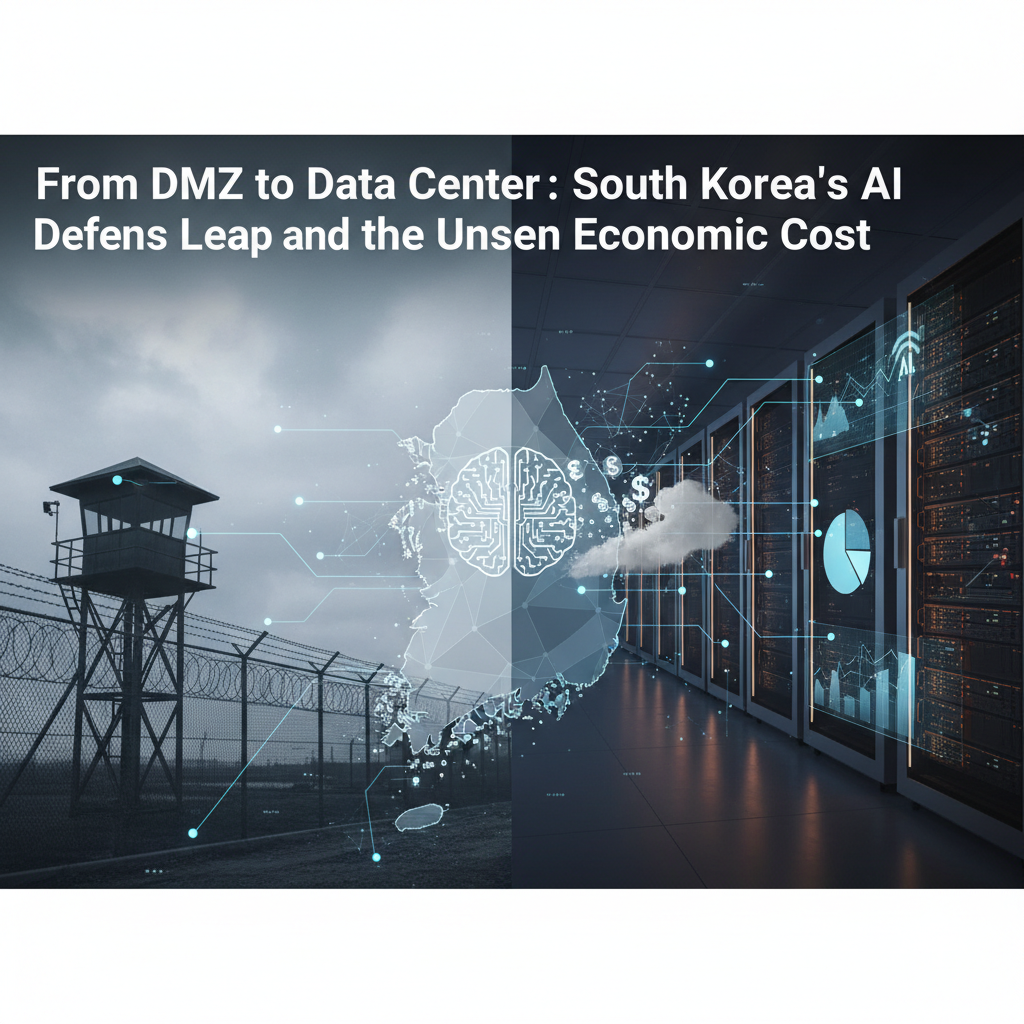
The sterile hum of servers, not the clang of steel, now defines the front lines of defense in South Korea. Inside Hanwha Systems' sprawling AI integration facility in Daejeon, a young engineer, Kim Min-jun, adjusts a holographic display projecting real-time threat assessments. His work involves optimizing AI models that sift through terabytes of sensor data, identifying anomalies with a precision that human analysts could only dream of a decade ago. This is not science fiction, it is the tangible reality of April 2026, where the nation's commitment to technological superiority is dramatically reshaping its industrial landscape and the very nature of work.
The strategic imperative for South Korea is clear. Surrounded by complex geopolitical realities, the nation has long understood that technological prowess is not merely an economic advantage but a matter of national survival. The push into AI for defense applications is a natural, albeit accelerated, evolution of this philosophy. However, the enterprise impact of this rapid integration extends far beyond the defense sector itself, touching manufacturing, software development, and even the social fabric of our highly connected society.
Data from the Ministry of National Defense indicates a staggering 78% increase in AI-related defense R&D spending over the past three years, reaching approximately ₩1.8 trillion KRW in 2025. This investment is not simply for procurement, it is fueling an entire ecosystem. "Our focus is on creating a self-sustaining AI defense industrial base," explains Dr. Lee Ji-hoon, Director of the Defense AI Research Institute, a joint venture between government and leading universities. "This means nurturing domestic talent, developing proprietary algorithms, and ensuring our hardware capabilities, particularly in semiconductors, remain world-class. The Korean approach to AI is fundamentally different, emphasizing resilience and sovereign control."
This influx of capital and strategic direction has created a bifurcated economic reality. On one side, companies deeply embedded in the defense supply chain, particularly the major chaebols, are experiencing unprecedented growth. Samsung Techwin, a subsidiary of the Samsung Group, for instance, has seen its defense AI division's revenue surge by 45% year-over-year, driven by contracts for autonomous surveillance systems and predictive maintenance algorithms for military hardware. [Samsung's latest move reveals a deeper strategy]: they are not just selling products, they are selling integrated AI solutions, bundling their advanced semiconductor capabilities with sophisticated software platforms. This vertical integration is a hallmark of the Korean industrial model, allowing for rapid deployment and proprietary control.
Hyundai Rotem, traditionally known for its K2 Black Panther tanks, is now heavily investing in AI-powered robotics for logistics and reconnaissance. Their recent partnership with a local AI startup, Visionary Robotics, aims to deploy semi-autonomous ground vehicles by 2027, reducing human exposure in hazardous zones. This shift requires a complete retooling of their manufacturing processes and a significant upskilling of their workforce, a challenge that many legacy industries are grappling with.
On the other side of this economic divide are smaller, more traditional manufacturing firms that previously supplied components for conventional military equipment. Many are struggling to adapt. A survey conducted by the Korea Chamber of Commerce and Industry last quarter revealed that 62% of small and medium-sized enterprises (SMEs) in the defense sector feel unprepared for the AI transition, citing high investment costs and a severe shortage of AI-skilled labor. This is a critical point, as the strength of the chaebols often relies on a robust network of specialized SMEs.
The impact on the workforce is equally profound. For workers like Kim Min-jun, the opportunities are immense. His starting salary at Hanwha Systems was 30% higher than the industry average for conventional engineering roles, a clear indicator of the premium placed on AI expertise. "The demand for AI engineers, data scientists, and machine learning specialists is insatiable," Kim observes. "My colleagues are constantly receiving recruitment offers, even from overseas. It feels like we are at the epicenter of something truly transformative."
However, for others, the picture is less optimistic. Consider Park Seo-yeon, a 48-year-old technician at a Busan-based factory that manufactured precision optical components for older radar systems. Her factory recently lost a major contract to a competitor offering AI-enhanced vision systems. "I've been doing this for twenty years, my hands know these machines intimately," she shared, her voice tinged with resignation. "Now, they talk about algorithms and neural networks. I've tried online courses, but it's like learning a new language overnight. My skills, once invaluable, feel obsolete." This sentiment is echoed by an estimated 15% of the defense manufacturing workforce, who face potential displacement or significant re-training challenges, according to a recent report by the Korea Development Institute. The report emphasizes the need for robust government-backed retraining programs to mitigate social disruption.
Expert analysis suggests that this is just the beginning. "We are witnessing a fundamental paradigm shift, akin to the industrial revolution, but compressed into a much shorter timeframe," states Dr. Choi Eun-kyung, a leading economist at Seoul National University. "The initial phase is characterized by capital investment and job creation in high-skill areas. The subsequent phase, however, will see AI systems automating more complex tasks, leading to efficiency gains but also potential job displacement in mid-skill roles. The challenge for South Korea, with its rapidly aging population, is to manage this transition without exacerbating social inequalities." Her research indicates that without proactive policy interventions, the Gini coefficient could rise by 0.03 points within five years due to AI-driven labor market changes.
Here's the technical breakdown: the AI systems being deployed are not simply replacing human operators; they are augmenting capabilities in ways previously unimaginable. For instance, advanced sensor fusion algorithms, often powered by NVIDIA's latest generation of GPUs, can process information from multiple sources, radar, sonar, electro-optical, and even cyber intercepts, to create a comprehensive operational picture in milliseconds. This allows for faster decision-making, predictive analytics for equipment failure, and more precise targeting. The sheer computational demand for these systems is driving significant investment in domestic semiconductor fabrication, with companies like SK Hynix and Samsung Foundry expanding their specialized AI chip production capacities. Reuters has extensively covered the global race for AI chip supremacy, a race in which South Korea is a formidable contender.
What is coming next? The trajectory points towards increasingly autonomous systems, from drone swarms capable of coordinated action without constant human oversight to AI-powered cyber defense platforms that can identify and neutralize threats in real-time. The ethical implications are, of course, a critical part of this discussion, with robust debates ongoing within the National Assembly and academic circles regarding human-in-the-loop protocols and accountability frameworks. The Ministry of Science and ICT recently announced a new regulatory sandbox for defense AI, aiming to balance innovation with ethical oversight.
The economic ramifications will continue to unfold. We can expect further consolidation in the defense industry, with smaller, innovative AI startups being acquired by larger players seeking to integrate cutting-edge capabilities. The demand for AI talent will intensify, driving up wages for specialists and creating pressure on universities to expand their curricula. Furthermore, the export potential for South Korean defense AI solutions is substantial, positioning the nation as a global leader in this niche market. This will create new revenue streams but also raise questions about technology transfer and international security. The global landscape of defense is being redrawn, not by treaties, but by algorithms, and South Korea is firmly at the vanguard of this quiet revolution.
For more insights into the broader impact of AI on Korean industry, consider reading our article on The Han River's Digital Divide [blocked].