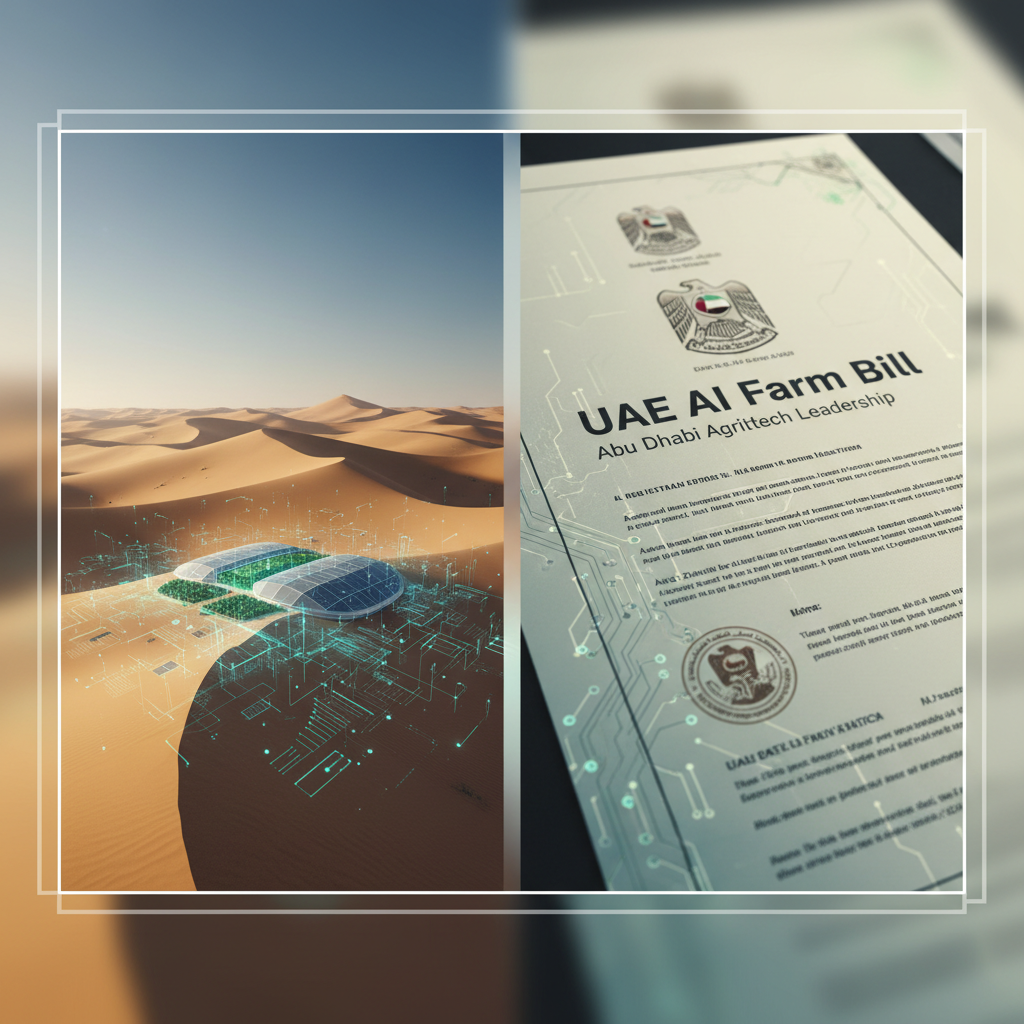

The vast, shimmering expanse of the Arabian desert has long been a symbol of both challenge and boundless ambition. For decades, the narrative surrounding agriculture in the UAE revolved around overcoming inherent environmental limitations. Today, however, a new chapter is being written, one not merely of adaptation, but of audacious innovation. The recent unveiling of the 'AI-Powered Agricultural Resilience Act' by the UAE's Ministry of Climate Change and Environment (moccae) is not just a policy; it is a blueprint for a future where food security is engineered with unparalleled precision, powered by artificial intelligence.
This legislative move, announced in early April 2026, is a testament to the UAE's unwavering commitment to diversifying its economy and securing its future. It mandates the integration of advanced AI solutions across the agricultural value chain, from precision irrigation and crop monitoring to yield optimization and supply chain management. The Act allocates an initial AED 5 billion, approximately USD 1.36 billion, over the next five years to incentivize research, development, and adoption of AI technologies in farming. This is what ambition looks like, a strategic investment designed to yield not just crops, but global leadership in agritech.
The Policy Move: Cultivating the Future Digitally
The 'AI-Powered Agricultural Resilience Act' introduces a comprehensive framework. It establishes a national AI in Agriculture Fund, offering grants and low-interest loans to farms and agritech startups that deploy approved AI systems. Crucially, it sets performance benchmarks for AI systems in areas such as water efficiency, nutrient optimization, and pest detection, ensuring that deployed technologies meet stringent sustainability goals. Furthermore, it outlines data governance protocols, safeguarding agricultural data while enabling its secure sharing for collective advancement. The policy also includes provisions for upskilling the agricultural workforce, preparing them for roles in a data-driven farming ecosystem.
Who's Behind It and Why: A Visionary Mandate
The driving force behind this groundbreaking legislation is the UAE government itself, with Moccae at the helm, supported by the UAE Artificial Intelligence Office. Her Excellency Mariam Almheiri, Minister of Climate Change and Environment, articulated the vision during the Act's announcement. “Our nation’s future prosperity hinges on our ability to innovate and secure our essential resources,” she stated. “This Act is a proactive measure, leveraging the transformative power of AI to ensure food security, optimize resource use, and create a sustainable agricultural sector for generations to come. We are not merely adapting to climate change; we are building resilience through intelligence.”
The rationale is clear: the UAE imports approximately 90% of its food. Reducing this dependency is a strategic imperative. By harnessing AI for precision farming, the nation aims to drastically improve domestic food production efficiency, reduce water consumption by up to 40% in certain crops, and minimize waste. This is a long-term play, a calculated move to future-proof the nation against global supply chain disruptions and environmental shifts. The UAE's AI strategy is decades ahead, recognizing that true sovereignty in the 21st century extends to the dinner table.
What It Means in Practice: Smart Farms Emerge
Practically, this Act will accelerate the adoption of technologies already piloted in the region. Imagine vast indoor vertical farms, their environments meticulously controlled by Google DeepMind's optimization algorithms, adjusting light, humidity, and nutrient delivery in real time. Consider vast outdoor farms, where NVIDIA-powered drones equipped with hyperspectral cameras monitor crop health at an unprecedented scale, detecting early signs of disease or nutrient deficiency with pinpoint accuracy. Farmers will receive actionable insights via intuitive dashboards, enabling them to make data-driven decisions that maximize yield and minimize input costs.
“We are already seeing incredible results from our pilot programs,” explained Dr. Ahmed Al-Mansoori, Head of Agritech Innovation at the Khalifa University of Science and Technology. “One project, utilizing AI from a regional startup, has demonstrated a 30% increase in leafy green yields while using 50% less water in a controlled environment. The Act provides the necessary framework and funding to scale these successes across the nation.” This transition will not be instantaneous, but the legislative tailwinds are now firmly in place.
Industry Reaction: A Wave of Investment and Collaboration
The industry's response has been overwhelmingly positive. Major global players, recognizing the UAE's commitment and investment, are keen to participate. Microsoft has already announced a partnership with the Abu Dhabi Food Control Authority to develop an AI-driven platform for agricultural supply chain transparency. Meanwhile, local agritech startups, many incubated within Dubai's burgeoning tech hubs, are experiencing a surge in interest and investment. “This legislation is a game-changer for us,” said Fatima Al-Hammadi, CEO of AgriSense AI, a startup specializing in AI-powered soil analysis. “It provides clarity, funding, and a clear market signal that the UAE is serious about agritech. We are now scaling our operations faster than anticipated.”
This sentiment is echoed by international investors. According to a recent report by Reuters Technology, venture capital flowing into UAE agritech has increased by 150% in the last year, largely in anticipation of such policies. The Act solidifies the UAE's position as a testbed and launchpad for cutting-edge agricultural solutions, attracting talent and capital from around the globe. Dubai doesn't just adopt the future, it builds it, brick by digital brick.
Civil Society Perspective: Balancing Progress with Equity
While the technological promise is immense, civil society organizations emphasize the need for equitable implementation. The Emirates Environmental Group, for instance, has praised the Act's sustainability focus but calls for robust programs to support small and medium-sized farms in adopting these new technologies. “The digital divide must not translate into an agricultural divide,” stated Habiba Al Marashi, Chairperson of the Emirates Environmental Group. “Training programs, subsidized access to technology, and fair pricing models for AI services are crucial to ensure that all farmers benefit, not just the large corporations.”
Concerns also touch upon data privacy and the potential for algorithmic bias in resource allocation. The Act includes provisions for data protection, aligning with the UAE's broader data privacy laws, but continuous oversight will be essential. The Ministry has committed to establishing a multi-stakeholder committee, including farmer representatives and environmental advocates, to guide the implementation process and address emerging challenges.
Will It Work? A Bet on Vision and Execution
The success of the 'AI-Powered Agricultural Resilience Act' hinges on several factors: the continued political will, the efficacy of the allocated funding, and the ability to foster a skilled workforce. The UAE has a proven track record of executing ambitious, long-term visions, from its space program to its smart city initiatives. The strategic alignment of government, industry, and academia, coupled with significant financial backing, suggests a high probability of success.
This policy is more than just a regulatory framework; it is a declaration of intent. It positions the UAE not merely as a consumer of global agritech, but as a significant contributor and innovator. The journey from desert to digital harvest will undoubtedly present challenges, but the foundation laid by this Act is robust. As the sun sets over the burgeoning smart farms of Abu Dhabi, one can almost hear the hum of servers and the gentle whir of drones, orchestrating a future where the desert blooms with intelligent abundance. This is a powerful narrative of resilience, innovation, and a nation's unwavering quest for self-sufficiency, meticulously planned and boldly executed. For more insights into how technology is reshaping global industries, explore MIT Technology Review.