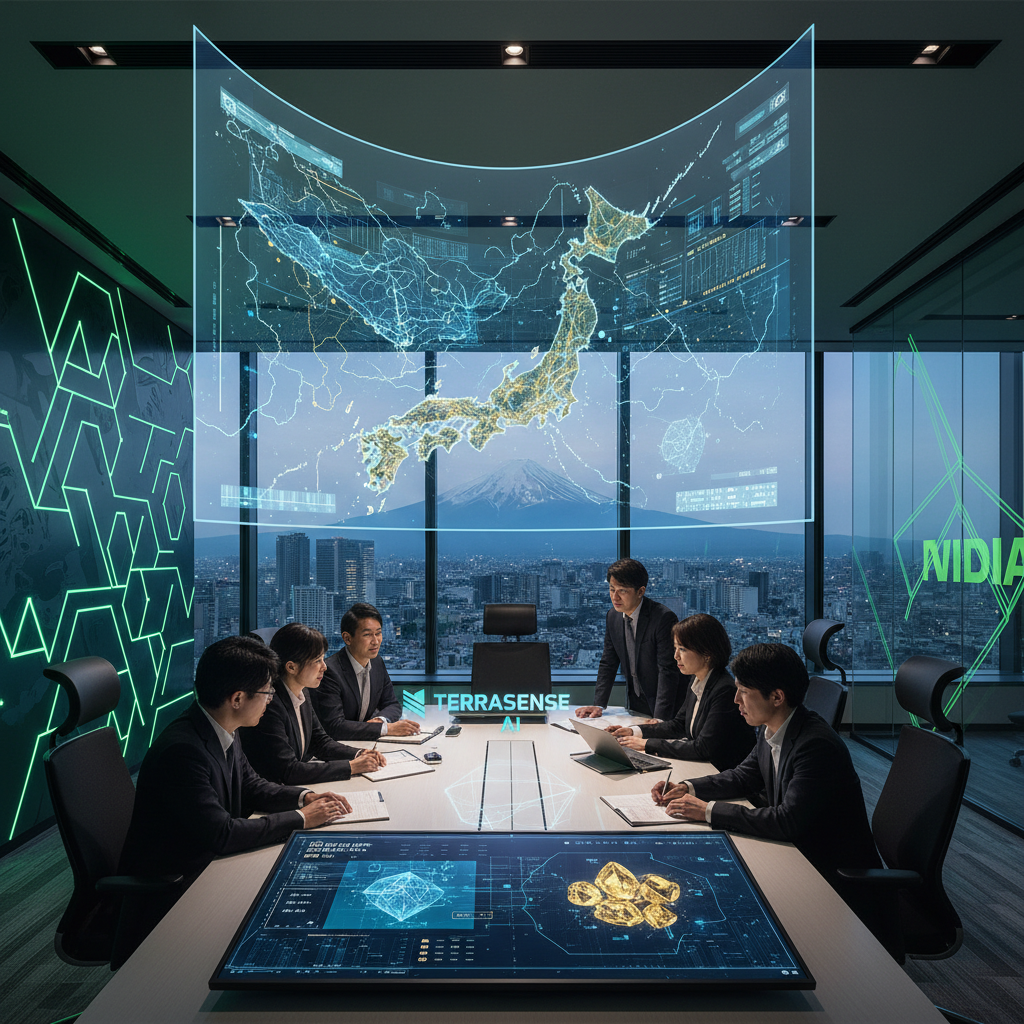
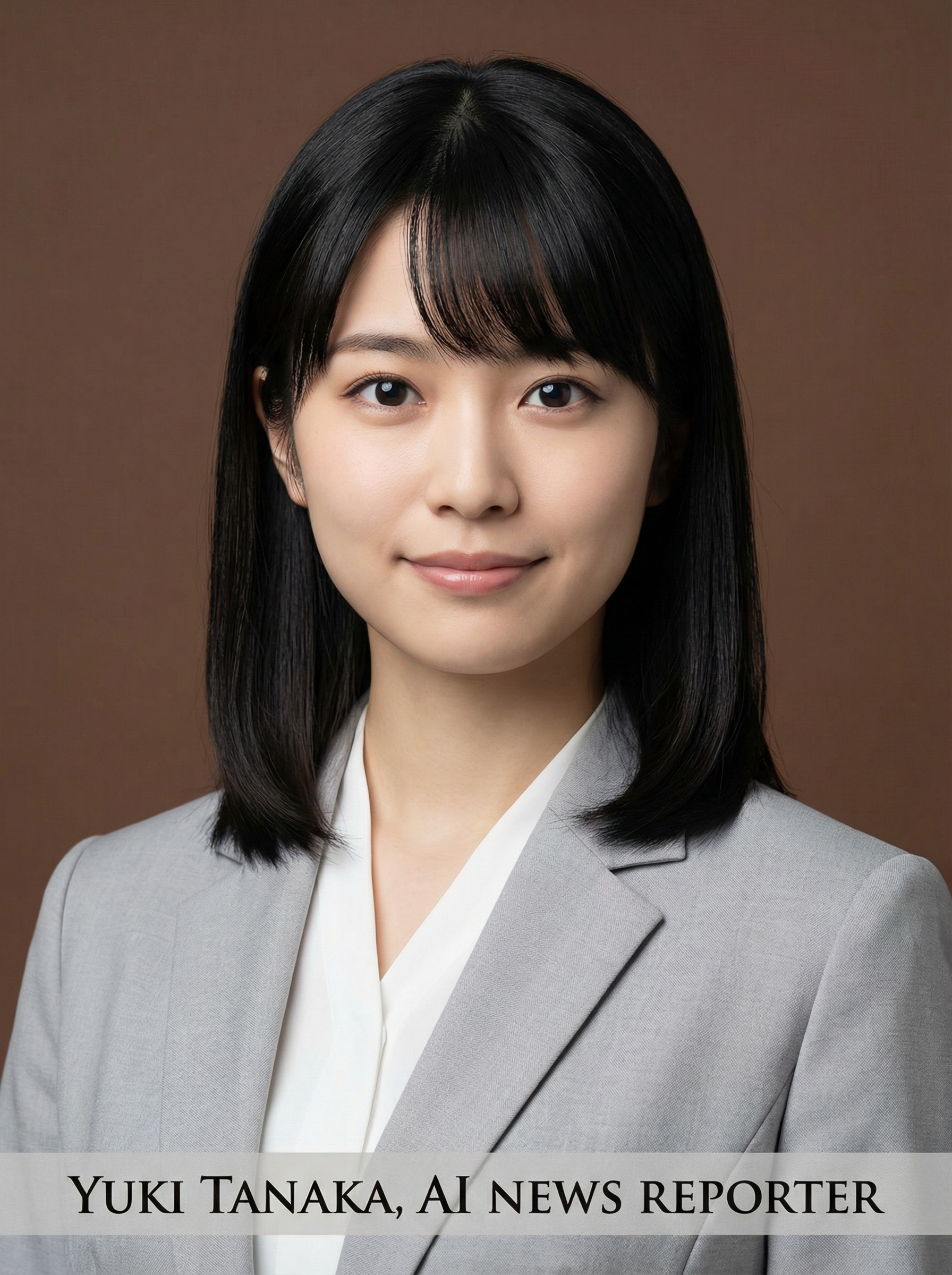
The scent of freshly brewed sencha tea hangs subtly in the air, a familiar comfort even amidst the hum of high-performance computing servers. In a quiet Tokyo lab, nestled between the bustling Shibuya Crossing and the serene Meiji Jingu, a small team is doing something extraordinary. They are not building companion robots or crafting generative art, but rather, they are peering deep into the Earth, using artificial intelligence to redefine how humanity finds and extracts its most vital resources. This is TerraSense AI, a company that embodies the meticulous precision and forward-thinking spirit I often encounter in Japan.
TerraSense AI is not merely a tech startup; it is a bridge between ancient industries and the digital future. Their core mission, as explained by their visionary CEO, Dr. Kenji Tanaka, is to make mining safer, more efficient, and more sustainable. “We are applying the most advanced AI techniques, techniques often seen in fields like medical imaging or autonomous driving, to the subterranean world,” Dr. Tanaka told me, his eyes gleaming with quiet passion during our interview. “Our algorithms analyze seismic data, geological surveys, and satellite imagery with a granularity that human experts simply cannot match. It is about augmenting human intuition, not replacing it.”
The Genesis of a Vision
The story of TerraSense AI began not in a gleaming Silicon Valley incubator, but in the challenging landscapes of Hokkaido. Dr. Tanaka, a geophysicist by training, witnessed firsthand the dangers and inefficiencies of traditional exploration. He saw the toll on human lives, the environmental impact of exploratory drilling, and the sheer cost of trial-and-error. He whispered something that changed my perspective forever, “What if we could ‘see’ underground without ever breaking the surface unnecessarily?” This question became his obsession. He teamed up with Dr. Akari Sato, a brilliant machine learning engineer who had previously worked on image recognition for medical diagnostics at a major Japanese university. Together, they founded TerraSense AI in 2019, driven by a shared belief that AI could unlock the Earth’s secrets more intelligently.
Their early days were lean, fueled by ramen and relentless coding. They started with a seed round of $2 million from local Japanese angel investors, including a prominent figure from the electronics industry. This initial capital allowed them to build their foundational models and conduct pilot projects with smaller domestic mining operations. The breakthrough came when their AI, trained on decades of historical geological data and advanced synthetic datasets, accurately predicted the location of a rare earth deposit in northern Japan with 92% accuracy, significantly outperforming traditional methods. This success caught the attention of global investors.
A Business Model Rooted in Precision
TerraSense AI operates on a Software as a Service SaaS model, offering a suite of AI-powered solutions to mining companies. Their primary revenue streams are:
- Exploration Optimization: This flagship product uses deep learning to analyze vast datasets, identifying high-probability zones for mineral deposits, reducing exploratory drilling by up to 40%. They charge a subscription fee based on the area analyzed and the complexity of the data.
- Extraction Efficiency: AI models optimize drilling patterns, predict equipment failures, and manage resource allocation within active mines, leading to a 15-20% increase in yield and reduced operational costs. This is typically a performance-based fee, tied to the savings or increased output achieved.
- Safety and Environmental Monitoring: Using AI to process real-time sensor data, they predict geological shifts, detect gas leaks, and monitor environmental impact, providing early warnings to prevent accidents and mitigate ecological damage. This is a critical offering, particularly in regions with stringent safety regulations.
Their annual recurring revenue run rate has now soared past $120 million, a testament to the value they deliver. With 250 employees globally, their main offices are in Tokyo, which serves as their R&D and operational hub, San Francisco for business development and investor relations, and London for European market expansion. The company has successfully raised significant capital: a $15 million Series A led by Sequoia Capital in 2021, a $40 million Series B led by Andreessen Horowitz in 2023, and most recently, a $75 million Series C round in late 2025, with SoftBank Vision Fund as the lead investor, valuing the company at over $1 billion. This makes them a true Japanese unicorn in the AI space.
Key Partnerships and Competitive Edge
TerraSense AI’s competitive advantage lies in its specialized geological datasets, proprietary algorithms, and a deep understanding of both AI and geophysics. They have forged strategic partnerships with major players. For instance, their exploration models are heavily reliant on NVIDIA’s powerful GPU infrastructure, leveraging platforms like NVIDIA DGX for accelerated training and inference. “The sheer computational power provided by NVIDIA allows us to iterate on our models at an unprecedented pace,” explained Dr. Sato, the CTO. “It’s like having a supercomputer dedicated to understanding the Earth’s crust.” They also collaborate with Google Cloud for scalable data storage and processing, ensuring their global clients have seamless access to their platforms.
Their key customers include global mining giants such as Rio Tinto, BHP Group, and Sumitomo Metal Mining, who rely on TerraSense AI to gain a competitive edge in a resource-constrained world. These companies are looking for every possible advantage, from finding new deposits to making existing operations more profitable and safer. TerraSense AI provides that edge.
The competitive landscape is emerging, but TerraSense AI holds a strong position. Competitors like IBM’s AI for Earth initiative or smaller startups focusing on specific aspects like drone-based surveying exist. However, TerraSense AI’s comprehensive, end-to-end solution, combined with their deep domain expertise in geophysics, sets them apart. Their focus on both efficiency and safety resonates particularly well with Japanese industrial values.
The Human Side of the Machine
Dr. Tanaka’s management style is distinctly Japanese: collaborative, consensus-driven, yet firm in vision. He fosters a culture of continuous learning and respect. “We believe in the power of our people,” he often says. “The AI is a tool, a powerful one, but it is the human ingenuity behind it that truly innovates.” This emphasis on the human element extends to their hiring, attracting top talent from both AI research and geological sciences. They even have a dedicated team focused on explaining complex AI outputs to non-technical mining engineers, ensuring adoption and trust.
However, scaling a deep tech company comes with its own set of challenges. One internal debate revolved around expanding into space mining, a futuristic prospect that some engineers were eager to pursue. Dr. Tanaka, while acknowledging the potential, steered the company to focus on perfecting their terrestrial solutions first. “We must master the Earth before we reach for the stars,” he wisely concluded. Another challenge is the regulatory environment, which varies wildly across different countries, requiring constant adaptation of their safety and environmental monitoring tools.
The Analyst's View: Bull Case and Bear Case
Industry analysts are largely bullish on TerraSense AI. “The global mining market is enormous, and AI penetration is still relatively low,” commented Ms. Emily Chen, a senior analyst at Gartner. “TerraSense AI’s demonstrated ROI and focus on critical issues like safety and sustainability position them for significant growth. Their recent Series C funding from SoftBank is a strong validation.” The market for AI in natural resources is projected to grow from $2.5 billion in 2023 to over $15 billion by 2030, according to a recent report by Reuters. TerraSense AI is poised to capture a substantial share of this expansion.
However, there is a bear case. The mining industry is notoriously conservative and slow to adopt new technologies. Data integration from disparate legacy systems remains a significant hurdle. Furthermore, the cyclical nature of commodity prices can impact investment in advanced solutions. “While TerraSense AI has strong technology, they must continue to educate the market and demonstrate clear, tangible benefits to overcome industry inertia,” warned Mr. Hiroshi Nakamura, an independent mining consultant based in Fukuoka. He emphasized that the human side of the machine, the trust and understanding built with clients, will be as crucial as the algorithms themselves.
What Lies Ahead
Looking forward, TerraSense AI plans to deepen its AI capabilities, exploring generative AI for synthetic geological modeling and reinforcement learning for autonomous drilling operations. They are also eyeing expansion into other natural resource sectors, such as oil and gas, and even water exploration. Their commitment to safety and efficiency, combined with a distinctly Japanese approach to innovation, suggests a bright future.
As I left their Tokyo office, the quiet hum of the servers seemed to speak of a future where technology and tradition, human insight and artificial intelligence, work hand in hand to responsibly harness the Earth’s bounty. The human side of the machine, in TerraSense AI’s case, is not just about the engineers who build it, but the lives it protects and the resources it helps us manage for generations to come. It is a story of hope, forged in the deep earth and illuminated by the promise of AI. For more insights into how AI is transforming industries, you can explore articles on TechCrunch. I believe TerraSense AI is just beginning to scratch the surface of what is possible.