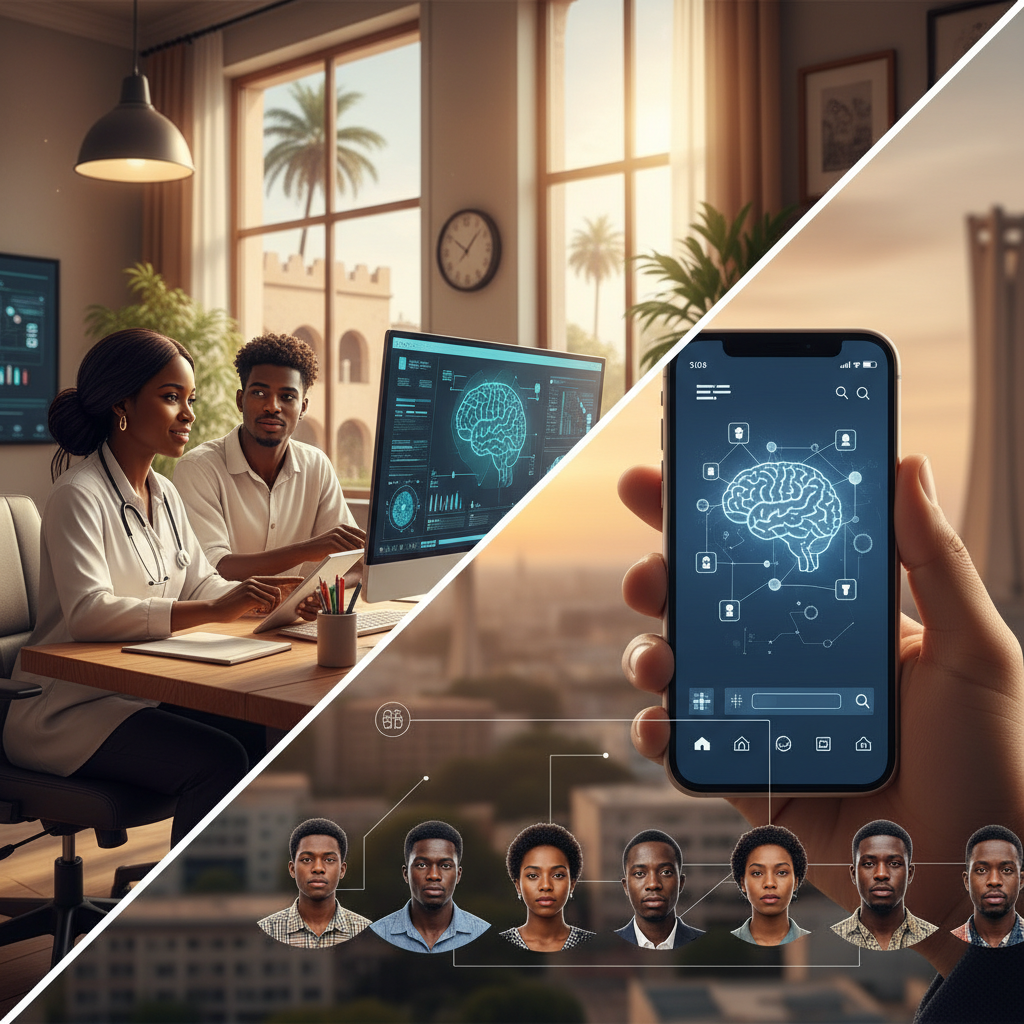

The sun rises over the Cap-Vert peninsula, painting Dakar in hues of orange and gold. As the city awakens, so too does a quiet revolution in mental health care, one powered by the very algorithms that shape our digital lives. For too long, the conversation around mental well-being in places like Senegal has been shrouded in silence, often dismissed or misunderstood. But as the world grapples with a growing mental health crisis, technology, particularly artificial intelligence, is stepping in to offer a helping hand, or rather, a digital ear.
This is a story about people, not algorithms, though the algorithms are certainly doing some heavy lifting. It is about how the complex dance of machine learning, natural language processing, and predictive analytics is being harnessed to bring solace and support to those who need it most, even in communities where traditional mental health resources are scarce. We are talking about therapy chatbots, sophisticated addiction algorithms, and digital wellness platforms, all finding their footing in West Africa's vibrant tech ecosystem.
The Technical Challenge: Bridging the Gap with Code and Compassion
The fundamental problem we are trying to solve is access. In many parts of Senegal, and indeed across Africa, the ratio of mental health professionals to the population is alarmingly low. The World Health Organization estimates there is less than one psychiatrist per 100,000 people in many low-income countries. This creates a vast chasm between need and availability. AI offers a scalable, always-on, and often anonymous solution.
The technical challenge lies in creating AI systems that are not just intelligent, but also culturally sensitive, empathetic, and effective. It is not enough to simply translate English-language therapy models; we must build systems that understand the nuances of Wolof, Pulaar, Serer, and other local languages, grasp local proverbs, and respect community values. This requires a deep understanding of natural language understanding (NLU) and natural language generation (NLG) tailored to specific cultural contexts, a significant undertaking for even giants like Google's DeepMind, let alone local startups.
Architecture Overview: A Layered Approach to Digital Care
Imagine a digital clinic, always open, always ready to listen. The architecture behind such a system is typically multi-layered, designed for robustness, scalability, and ethical operation. At its core, we see a client-server model, where user interactions on a mobile application or web interface communicate with a backend processing unit.
- Frontend Interface (Client-Side): This is the user's window into the AI. It could be a mobile app, a web portal, or even a simple SMS interface for feature phones. Key considerations here are intuitive design, low data consumption, and multi-language support. Frameworks like React Native or Flutter are popular for cross-platform mobile development, while progressive web apps (PWAs) offer accessibility.
- API Gateway and Microservices: All client requests pass through an API gateway, which routes them to various microservices. These services handle specific functions: user authentication, session management, data storage, and crucially, the AI inference engine. This modular approach allows for independent scaling and updates.
- AI Core (Backend Processing): This is the brain of the operation. It comprises several sub-components:
- NLU Module: Responsible for interpreting user input, identifying intent, extracting entities (e.g., emotions, symptoms, keywords). This often involves transformer-based models like Bert, RoBERTa, or even smaller, fine-tuned models for specific local languages. For Wolof, a custom tokenizer and embedding layer trained on a large corpus of local text would be essential.
- Dialogue Management System (DMS): This module maintains the conversation state, tracks context, and decides the next best action or response. Reinforcement learning or rule-based systems can be employed here, often combined for hybrid approaches.
- NLG Module: Generates human-like responses. This could range from template-based responses for simple queries to sophisticated generative models like GPT-3.5 or Google's Gemini for more complex, empathetic dialogues. Fine-tuning these large language models (LLMs) on therapeutic conversations, especially those culturally relevant to Senegal, is paramount.
- Knowledge Base: A repository of therapeutic techniques, crisis intervention protocols, and culturally appropriate advice. This might be a graph database or a simple relational database, continuously updated by mental health professionals.
- Data Storage and Analytics: Secure databases (e.g., PostgreSQL for relational data, MongoDB for unstructured conversation logs) are used. An analytics pipeline, often using tools like Apache Kafka for streaming data and Apache Spark for processing, helps monitor user engagement, identify common patterns, and detect potential risks.
- Ethical Oversight Module: A critical component, often overlooked. This module continuously monitors conversations for signs of distress, self-harm ideation, or inappropriate responses from the AI, flagging them for human intervention. It also tracks for bias in AI responses.
Key Algorithms and Approaches: The Digital Healers
At the heart of these systems are sophisticated algorithms. For therapy chatbots, a common approach involves a combination of retrieval-based and generative models.
- Retrieval-Based Models: These select a response from a predefined set of human-curated replies based on the user's input and conversation history. This offers control and safety, particularly for sensitive topics. A simple conceptual example:
 def retrieve_response(user_input, context):
 # 1. Preprocess user_input (tokenization, stemming)
 # 2. Embed user_input and context using a trained model (e.g., Sentence-BERT)
 # 3. Search knowledge base for best matching response vector
 # 4. Apply cultural filters or safety checks
 # 5. Return selected response
 def retrieve_response(user_input, context):
 # 1. Preprocess user_input (tokenization, stemming)
 # 2. Embed user_input and context using a trained model (e.g., Sentence-BERT)
 # 3. Search knowledge base for best matching response vector
 # 4. Apply cultural filters or safety checks
 # 5. Return selected response
- Generative Models: These create novel responses. While powerful, they require careful fine-tuning and guardrails to prevent harmful or nonsensical outputs. Fine-tuning an LLM like Google's Gemini on a dataset of therapeutic dialogues, perhaps even incorporating local storytelling traditions, can yield remarkable results. The process involves supervised fine-tuning (SFT) and then reinforcement learning with human feedback (rlhf) to align the model with therapeutic goals and cultural norms.
For addiction algorithms, the focus shifts to predictive analytics and early detection. Machine learning models, often leveraging recurrent neural networks (RNNs) or transformer architectures, can analyze patterns in user behavior, language, and self-reported data to predict relapse risk or identify early signs of problematic usage. Features might include frequency of certain keywords, sentiment analysis of messages, or changes in digital activity patterns. A logistic regression or a more complex gradient boosting model (e.g., XGBoost) could be used for risk classification.
Implementation Considerations: Building for Senegal
Building these systems for a context like Senegal requires more than just technical prowess; it demands a deep cultural understanding. Data scarcity for local languages is a major hurdle. Initiatives like the Masakhane project, which focuses on NLP for African languages, are crucial here. Collaborating with local linguists and mental health professionals to build culturally relevant datasets is non-negotiable. I sat down with Dr. Aïssatou Diallo, a leading psychiatrist at Fann Hospital in Dakar, and she emphasized, “The technology must speak to the soul of our people, otherwise it is just noise. The proverbs, the metaphors, the way we express joy and sorrow, these are not universal.”
Privacy and data security are paramount. Users, particularly those discussing sensitive mental health issues, must trust the system implicitly. Adherence to data protection regulations, robust encryption, and transparent data usage policies are essential. Low-bandwidth environments also necessitate efficient model architectures and offline capabilities where possible.
Real-World Use Cases: Seeds of Hope
- Sama Jëf (My Action) Chatbot, Senegal: Developed by a local startup in collaboration with the Ministry of Health, Sama Jëf is a Wolof-speaking chatbot providing initial mental health assessments and psychoeducation. It uses a hybrid retrieval/generative model, fine-tuned on a corpus of Senegalese therapeutic dialogues. Early data suggests a 40% increase in self-reported mental health awareness among users in pilot regions. Their eyes lit up when they told me about the impact.
- Google DeepMind's 'Minds of Africa' Initiative: While still in early research phases, Google DeepMind is exploring federated learning approaches to build robust mental health AI models without centralizing sensitive patient data. Their focus includes developing culturally adaptive NLU models for several African languages, including those spoken in Senegal, aiming for a broader impact across the continent. This initiative leverages the power of privacy-preserving machine learning techniques.
- Kër Gi (The Home) Digital Wellness Platform: This platform, incubated at Dakar's JokkoLabs, combines journaling, mindfulness exercises, and a peer-support network, all moderated by AI. Its addiction algorithm monitors user check-ins and language patterns, gently nudging users towards healthier habits or recommending human intervention when specific risk thresholds are met. It uses a combination of sentiment analysis and topic modeling to identify potential distress signals.
Gotchas and Pitfalls: Navigating the Digital Sands
The path is not without its challenges. Over-reliance on AI without human oversight can be dangerous. AI models, particularly generative ones, can hallucinate or provide inappropriate advice. The 'black box' nature of some deep learning models makes it difficult to understand why a particular recommendation was made, posing ethical and accountability issues. Furthermore, the digital divide means that those without smartphone access or reliable internet might be excluded, exacerbating existing inequalities. As the Wolof proverb says, “Nit nit ay garabam,” meaning “Man is man’s remedy.” No AI can fully replace the human touch, only augment it.
Bias in training data is another significant concern. If the data used to train these models does not adequately represent the diversity of experiences, languages, and cultural norms within Senegal, the AI could perpetuate or even amplify existing biases, leading to ineffective or even harmful outcomes. Continuous monitoring, ethical AI audits, and diverse development teams are critical to mitigating these risks.
Resources for Going Deeper
For those looking to delve further into the technical aspects, I recommend exploring research papers on culturally adaptive NLP, federated learning in healthcare, and ethical AI frameworks. The work coming out of institutions like MIT Technology Review often provides excellent insights into these areas. For a broader understanding of AI's impact and the latest developments, TechCrunch's AI section is always a good read. Also, keep an eye on projects like Masakhane for African NLP advancements, as they are truly at the forefront of culturally relevant AI development. For those interested in the ethical dimensions, Wired's AI coverage frequently addresses these complex societal implications.
As we look to the horizon, the promise of AI in mental health for Senegal is immense. It is about democratizing access, offering a discreet hand, and building bridges where none existed before. But it must be done with wisdom, with heart, and with the understanding that technology is merely a tool, and the true healing always comes from within, supported by community, culture, and compassion. The digital wind carries new possibilities, but the roots of our well-being remain firmly planted in our shared humanity.