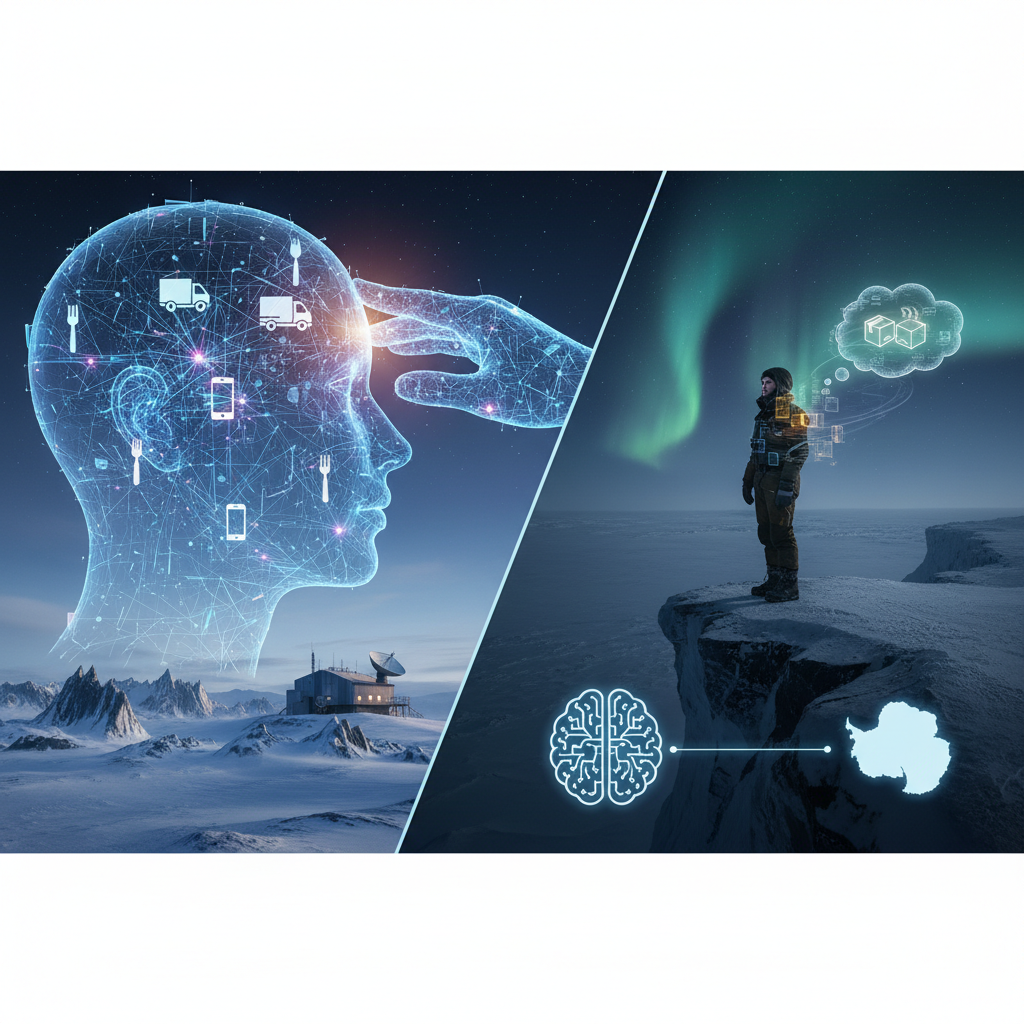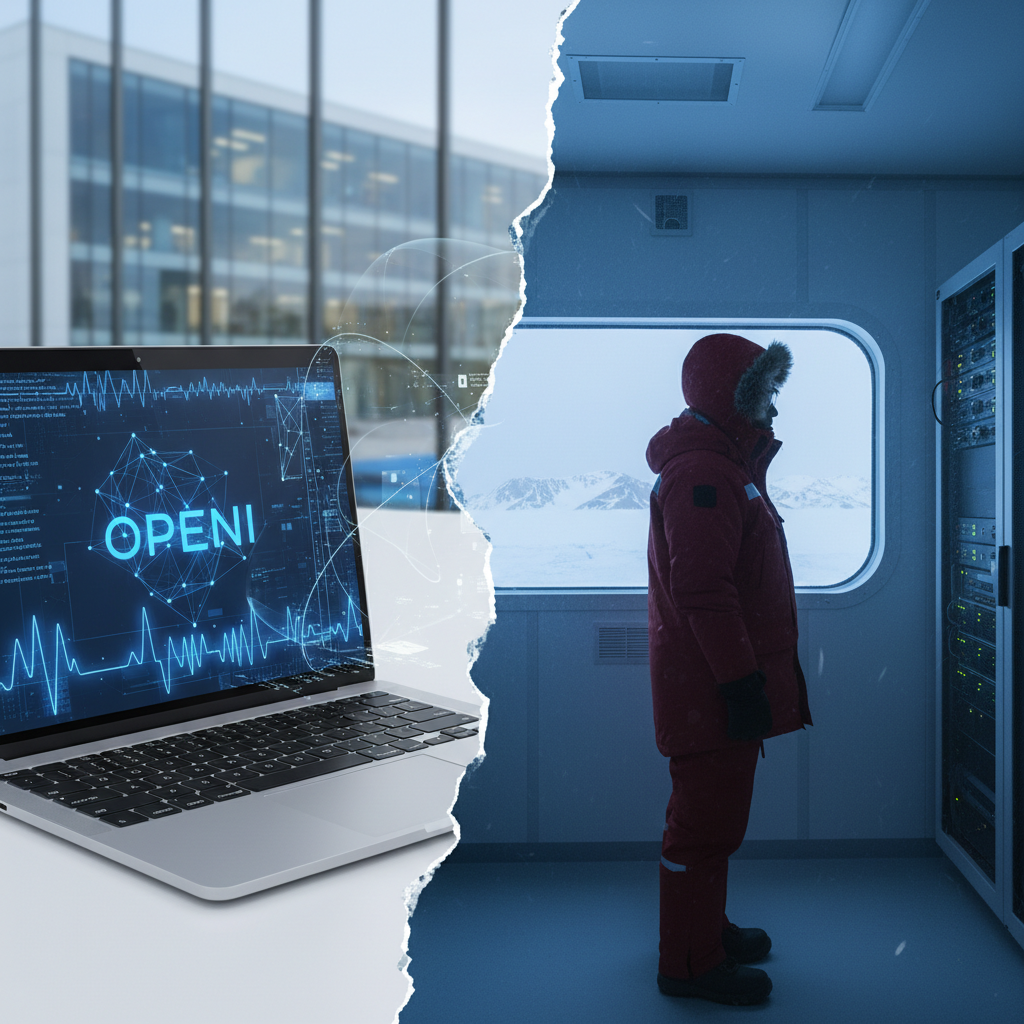

Last night, the aurora lit up our research station, painting the sky with greens and purples that defy description. It's a humbling reminder of the vast, silent beauty that surrounds us here in Antarctica, a beauty that often feels a world away from the bustling tech hubs of Silicon Valley. Yet, even in this profound isolation, the news of OpenAI's deepening partnership with Apple, bringing sophisticated AI directly to iPhones and Macs, has reached us. It has sparked a flurry of discussions among our scientists, not just about convenience, but about the very nature of connection and discovery at the end of the world.
For years, Apple has been the quiet giant, carefully curating its ecosystem, often preferring its own meticulously crafted solutions over external partnerships. Siri, while a familiar voice, has sometimes felt like a whisper compared to the booming capabilities of other AI models. So, when news broke that Tim Cook's Apple was officially joining forces with Sam Altman's OpenAI, it wasn't just a ripple; it was a seismic shift. This isn't merely about adding a new app; it's about fundamentally re-architecting the brain of billions of devices, making advanced generative AI a native, intuitive part of our digital lives. The implications, even for those of us observing glaciers and penguin colonies, are immense.
Here at Concordia Station, our connection to the outside world is precious. Satellite links are our lifeline, and every byte of data, every processing cycle, is carefully managed. The idea of an iPhone or a Mac, equipped with the kind of intelligence that OpenAI's models offer, capable of summarizing complex research papers, drafting detailed reports, or even helping to analyze vast datasets from our sensors, feels like a leap into a new era. Dr. Lena Karlsson, our lead glaciologist, shared her thoughts over a cup of strong coffee this morning. "Imagine the efficiency," she mused, her eyes reflecting the stark white landscape outside. "Instead of hours sifting through telemetry from ice core samples, an AI could highlight anomalies, suggest correlations. It frees us to focus on the truly human part of science, the interpretation, the hypothesis, the wonder."
This is what AI looks like at the end of the world: a tool not for distraction, but for deeper understanding, for accelerating the pace of critical environmental research. The partnership reportedly involves integrating OpenAI's large language models, likely a customized version of GPT, directly into Apple's operating systems. This means on-device processing for many tasks, enhancing privacy and speed, which are paramount concerns for anyone, but especially for researchers handling sensitive environmental data. The promise is a more proactive, context-aware AI assistant, a true digital companion that understands your habits, your data, and your needs, all while maintaining Apple's stringent privacy standards.
Analysts have been quick to weigh in. "This collaboration is a strategic masterstroke for both companies," stated Daniel Ives, a managing director at Wedbush Securities, in a recent interview. "Apple gains immediate access to best-in-class generative AI, closing the gap with competitors, while OpenAI secures an unparalleled distribution channel into the hands of billions of users globally." Indeed, the sheer scale is staggering. With over 1.5 billion active iPhones and hundreds of millions of Macs, the reach of this integrated AI will be unprecedented. It moves AI from a specialized application to a ubiquitous, always-on utility.
For us, the practical applications are what truly resonate. Our meteorologists, for example, spend countless hours processing weather models, predicting the fierce blizzards that can sweep across the plateau with little warning. An AI capable of synthesizing vast amounts of atmospheric data, learning from historical patterns, and offering predictive insights with greater accuracy could literally be a lifesaver. Dr. Chen Li, our station's meteorologist, often talks about the 'data deluge' from our sophisticated sensors. "In the silence of Antarctica, you hear things differently," he explained, "but the data, it screams. An AI that can quiet that scream, that can distill noise into signal, that's invaluable." He envisions an AI assistant that could, for instance, cross-reference satellite imagery with ground-based sensor readings to identify subtle shifts in ice movement or atmospheric pressure, potentially forecasting extreme weather events with greater lead time.
Of course, there are challenges. The computational demands of advanced AI are significant. While Apple is known for its custom silicon, like the M-series chips, ensuring seamless, low-power AI performance on billions of devices is no small feat. There's also the question of data. While Apple emphasizes on-device processing for privacy, the training of these powerful models requires immense datasets. OpenAI's access to a vast corpus of internet data is what makes its models so capable, but the careful integration into Apple's privacy-centric framework will be key to user adoption and trust. "The balance between powerful AI and user privacy is the tightrope walk of our generation," noted Dr. Maria Sjöberg, a researcher focusing on AI ethics at Uppsala University, in a recent online seminar. "Apple's reputation here will be tested, but also potentially strengthened, if they get it right."
This partnership also has a broader impact on the competitive landscape. Google, with its Gemini models, and Microsoft, heavily invested in OpenAI and its own Copilot initiatives, have been aggressively pushing AI integration. Apple's move solidifies a formidable triumvirate at the forefront of consumer AI. It means that the race to make AI truly useful, truly personal, and truly integrated into our daily workflows is accelerating at an incredible pace. The stakes are high, not just for market share, but for shaping how humanity interacts with information and technology for decades to come.
Here in Antarctica, far from the boardrooms and coding labs, we are reminded daily of the delicate balance of our planet. The data we collect, the insights we glean, are crucial for understanding climate change and its global implications. The prospect of having AI as a more powerful ally in this endeavor is genuinely exciting. It promises to transform not just how we use our devices, but how we understand our world, from the smallest cellular interaction to the vast, complex systems of our polar environment. The integration of OpenAI's intelligence into Apple's elegant design could mean that the next breakthrough in climate science, or the next critical environmental warning, might just come from a conversation with an AI on a device in the pocket of a scientist, right here, at the bottom of the world. It is a future that feels both distant and, with every passing day, increasingly within reach. For more on the broader implications of AI in scientific research, you can explore articles on MIT Technology Review. The evolution of these partnerships is also closely tracked by outlets like TechCrunch. The future is not just arriving; it is integrating itself, byte by byte, into the very fabric of our lives, even here, where the ice meets the sky.