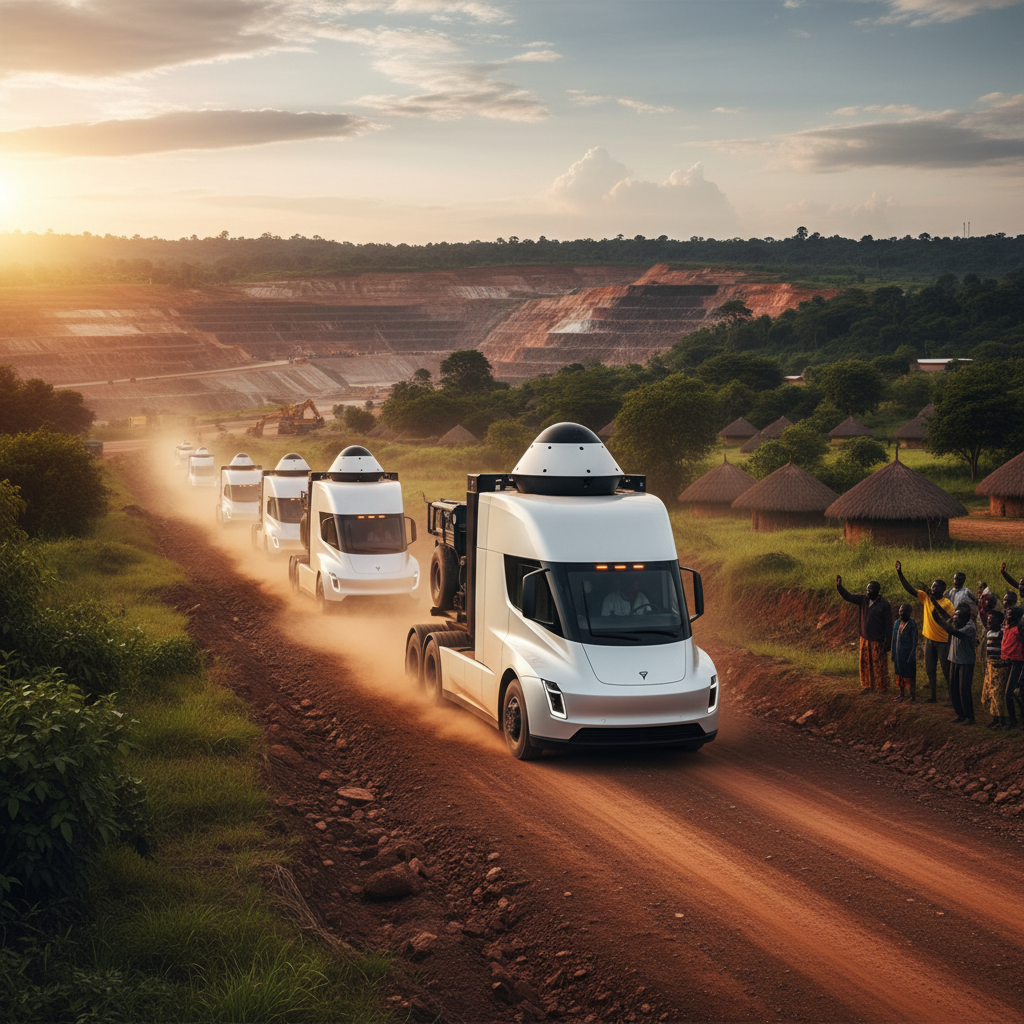

You're going to want to sit down for this. For years, the tech titans have been waxing poetic about self-driving cars ferrying us to the grocery store. Cute, I suppose. But while they were busy perfecting parallel parking algorithms for suburbanites, the real revolution, the one that could genuinely reshape economies and livelihoods, has been quietly rumbling down highways and dirt tracks alike: autonomous trucks.
We're talking about an $800 billion global logistics industry, a behemoth that keeps the world turning. And here in Zambia, where the Copperbelt’s mineral wealth needs to reach ports and markets, and agricultural produce from the fertile lands demands efficient transport, this isn't just a technical curiosity. It's a matter of national development, a potential game-changer for a country grappling with infrastructure challenges and the high cost of doing business.
The Technical Challenge: More Than Just Staying in Your Lane
When we talk about autonomous trucks, especially in a context like Zambia, we're not just talking about a glorified cruise control. The problem we're solving is multi-faceted and immensely complex. It's about reducing operational costs, improving safety, increasing efficiency, and crucially, extending reach into areas traditionally underserved by human-driven logistics due to harsh conditions or security concerns. But the technical hurdles are formidable. Imagine navigating a pothole-ridden road near Ndola, dodging stray livestock, negotiating unpredictable human traffic, and doing it all while hauling 40 tonnes of cargo. This isn't a controlled test track; it's real life.
The core challenge lies in robust perception, precise localization, intelligent path planning, and dynamic control, all operating flawlessly under highly variable environmental conditions. Unlike passenger vehicles, trucks have different dynamics: longer braking distances, wider turning radii, and a higher center of gravity. The perception stack needs to see further and more accurately, especially at night or in adverse weather, and the planning algorithms must account for these physical constraints while optimizing for fuel efficiency and delivery schedules.
Architecture Overview: A Symphony of Sensors and Silicon
At the heart of any advanced autonomous trucking system is a sophisticated sensor suite, often a fusion of LiDAR, radar, cameras, and ultrasonic sensors. Tesla's approach with its Semi, for instance, heavily leans on vision-first, using an array of cameras and a powerful neural network to interpret the world. Other players, like Waymo Via, leverage a more redundant sensor mix, combining high-resolution LiDAR for precise 3D mapping with radar for velocity and distance, and cameras for semantic understanding.
This data feeds into a central compute platform, often powered by NVIDIA's Drive platform or custom ASICs. This platform executes the perception, prediction, planning, and control modules. The system architecture typically follows a modular design:
- Perception Module: Takes raw sensor data and identifies objects (other vehicles, pedestrians, animals, road signs, lane markings), estimates their velocity and trajectory, and reconstructs the environment in 3D. This often involves deep neural networks, specifically convolutional neural networks (CNNs) for image processing and point cloud processing networks for LiDAR data.
- Localization Module: Determines the truck's precise position and orientation in the world. This is critical and often achieved through a combination of high-definition maps (HD maps), GPS, Inertial Measurement Units (IMUs), and visual odometry. For areas without pre-built HD maps, like many rural Zambian roads, Simultaneous Localization and Mapping (slam) algorithms become crucial.
- Prediction Module: Forecasts the future behavior of dynamic objects in the environment based on their current state, historical data, and behavioral models. This is where machine learning models, like recurrent neural networks (RNNs) or transformer networks, come into play, predicting pedestrian movements or other vehicle intentions.
- Planning Module: Generates a safe, efficient, and comfortable trajectory for the truck. This involves global path planning (e.g., A* or Dijkstra's algorithms on a road network graph) and local trajectory planning (e.g., Model Predictive Control MPC, or optimization-based planners that consider vehicle dynamics, traffic rules, and predicted behaviors of other agents).
- Control Module: Executes the planned trajectory by sending commands to the vehicle's actuators (steering, throttle, brakes). This is typically a low-level feedback control system, often PID controllers or more advanced non-linear controllers.*
Key Algorithms and Approaches: The Brains Behind the Brawn
For perception, object detection models like Yolo (You Only Look Once) or Faster R-cnn are commonly used with camera data, often fine-tuned on vast datasets of real-world driving scenarios. For LiDAR, algorithms like VoxelNet or PointPillars process point clouds to identify objects and their shapes. Sensor fusion, typically via Kalman filters or more advanced probabilistic methods, combines the outputs from different sensors to create a more robust and accurate understanding of the environment.
Localization in uncharted territories is a beast. While Google's Waymo has invested heavily in creating detailed HD maps for its operational domains, that's not feasible for every road in Africa. Here, visual Slam or LiDAR Slam, perhaps using graph-based optimization techniques, become vital. Imagine a truck mapping its route in real-time as it drives from Lusaka to Kasama, updating its understanding of the environment dynamically. This requires robust algorithms that can handle loop closures and drift correction without external infrastructure.
# Conceptual Pseudocode for a simplified planning step
function plan_trajectory(current_state, perceived_objects, HD_map):
 # 1. Predict future states of perceived objects
 predicted_states = predict_object_trajectories(perceived_objects)

# 2. Generate candidate paths (e.g., Frenet coordinates, polynomial splines)
 candidate_paths = generate_safe_paths(current_state, HD_map)

# 3. Evaluate paths based on cost function (safety, comfort, efficiency)
 # Cost = w1*collision_risk + w2*deviation_from_route + w3*fuel_consumption + ...
 costs = []
 for path in candidate_paths:
 cost = calculate_path_cost(path, predicted_states, HD_map)
 costs.append(cost)

# 4. Select optimal path
 optimal_path = candidate_paths[argmin(costs)]

# 5. Generate control commands (steering, acceleration)
 control_commands = generate_control_signals(optimal_path, current_state)

return control_commands
# Conceptual Pseudocode for a simplified planning step
function plan_trajectory(current_state, perceived_objects, HD_map):
 # 1. Predict future states of perceived objects
 predicted_states = predict_object_trajectories(perceived_objects)

# 2. Generate candidate paths (e.g., Frenet coordinates, polynomial splines)
 candidate_paths = generate_safe_paths(current_state, HD_map)

# 3. Evaluate paths based on cost function (safety, comfort, efficiency)
 # Cost = w1*collision_risk + w2*deviation_from_route + w3*fuel_consumption + ...
 costs = []
 for path in candidate_paths:
 cost = calculate_path_cost(path, predicted_states, HD_map)
 costs.append(cost)

# 4. Select optimal path
 optimal_path = candidate_paths[argmin(costs)]

# 5. Generate control commands (steering, acceleration)
 control_commands = generate_control_signals(optimal_path, current_state)

return control_commands
Implementation Considerations: The Devil in the Details
Practical implementation involves a multitude of challenges. First, data acquisition and labeling for diverse African driving conditions are paramount. Datasets trained on Californian highways won't cut it for the Great East Road. We need local data, reflecting local road conditions, local driving behaviors, and local obstacles. This means investment in data collection infrastructure and skilled annotators, potentially creating new job opportunities.
Then there's the compute power. Edge computing solutions are essential, as sending all raw sensor data to the cloud for processing is impractical due to latency and bandwidth constraints. Robust, fault-tolerant hardware capable of operating in extreme temperatures and dusty environments is non-negotiable. Power consumption is another factor, especially for electric autonomous trucks like the Tesla Semi, where every watt counts towards range.
Connectivity is also a major concern. While 5G is slowly rolling out in urban centers like Lusaka, vast stretches of rural Zambia still rely on patchy 3G or even 2G. Autonomous trucks need reliable communication for tele-operations, software updates, and emergency interventions. This necessitates robust onboard decision-making capabilities that can operate for extended periods without external connectivity.
Benchmarks and Comparisons: The Race for Reliability
Comparing autonomous trucking systems is complex. Metrics go beyond just miles driven. They include disengagement rates (how often a human driver has to intervene), mean time between failures, ability to handle edge cases, and operational design domain (ODD) expansion. Companies like Waymo and TuSimple (though the latter has faced recent challenges) have published extensive safety reports detailing their testing methodologies and performance. Tesla, with its vision-only approach, often emphasizes end-to-end neural network learning, which can be harder to benchmark against traditional modular systems.
For an advanced audience, the comparison often boils down to the trade-offs between a highly engineered, rule-based system augmented by machine learning versus an end-to-end deep learning approach. The former offers more interpretability and easier debugging, while the latter promises greater scalability and adaptability to unforeseen scenarios, provided it's trained on sufficiently diverse data. The irony is almost too perfect: the very complexity of Africa's roads might force the development of more resilient, generalizable AI than what's needed for predictable Western highways.
Code-Level Insights: Tools of the Trade
Developers diving into this field often leverage C++ for performance-critical components and Python for rapid prototyping, data analysis, and machine learning pipelines. Key libraries and frameworks include:
- ROS (Robot Operating System): A flexible framework for writing robot software, providing tools for hardware abstraction, device drivers, libraries, visualizers, message-passing, and package management.
- TensorFlow/PyTorch: For building and training deep neural networks for perception and prediction.
- OpenCV: For traditional computer vision tasks.
- PCL (Point Cloud Library): For processing 3D point cloud data from LiDAR.
- Apollo (Baidu's open-source autonomous driving platform): Offers a comprehensive reference architecture and modules for perception, planning, and control, providing a solid starting point for research and development.
Real-World Use Cases: Beyond the Hype
While fully autonomous operations on Zambian roads are still some years away, the global landscape shows promising deployments:
- Waymo Via (USA): Operating Level 4 autonomous trucks in Texas and Arizona, primarily for freight hauling between logistics hubs. They've accumulated millions of miles, demonstrating the viability of hub-to-hub autonomous operations.
- Einride (Sweden): Deploying electric, autonomous freight vehicles (without a driver's cab) for specific, geofenced routes in Sweden and the US, focusing on sustainable logistics and efficiency.
- Plus (USA/China): Partnering with major logistics companies to deploy Level 4 autonomous driving solutions for long-haul trucking, focusing on highway driving.
- TuSimple (USA): Before recent operational shifts, TuSimple had been testing and operating autonomous trucks on commercial freight routes in the US, aiming for fully driverless operations.
For Zambia, the initial use cases might involve autonomous convoys on dedicated mining routes, where conditions are more controlled, or last-mile delivery in urban centers using smaller autonomous vehicles. Imagine an autonomous truck moving copper from Kansanshi Mine to the smelter, reducing the risk to human drivers on challenging terrain and operating continuously.
Gotchas and Pitfalls: The Road Less Traveled
Beyond the technical glamour, there are significant hurdles. Regulatory frameworks are often non-existent or outdated. Liability in case of an accident is a legal minefield. Public acceptance and trust are crucial, especially in communities where job displacement is a genuine concern. Cybersecurity is paramount; a hacked autonomous truck carrying hazardous materials is a nightmare scenario. And then there's the sheer cost of development and deployment, which requires substantial investment and patient capital.
From a Zambian perspective, the challenge is also about ensuring that this technology serves our unique needs, not just importing solutions designed for other contexts. It's about localizing the technology, building local expertise, and ensuring that the benefits are widely distributed, perhaps through training programs for new roles in remote monitoring and maintenance.
Resources for Going Deeper: Your Next Stop
For those of you who find this as fascinating as I do, and trust me, it's more compelling than watching paint dry, there are plenty of avenues for further exploration. Start with academic papers on perception and planning algorithms, often found on arXiv. Follow the technical blogs of companies like Waymo and NVIDIA. For a broader industry perspective, TechCrunch often covers the latest startup funding and product announcements. For a deeper dive into the ethical and societal implications, MIT Technology Review is always a good read.
As Professor Moustapha Cissé, head of Google AI in Accra, once remarked,