
G’day, everyone. Braideùn O'Sullivàn here, buzzing with the kind of excitement you only get when you see the future taking shape, right before your very eyes. Today, we're not just talking about a bit of code or a fancy new gadget. We're diving deep into the very fabric of how our digital world will be governed, and believe me, it's a story that stretches from the halls of Washington D.C. all the way to the sun-drenched beaches of Sydney.
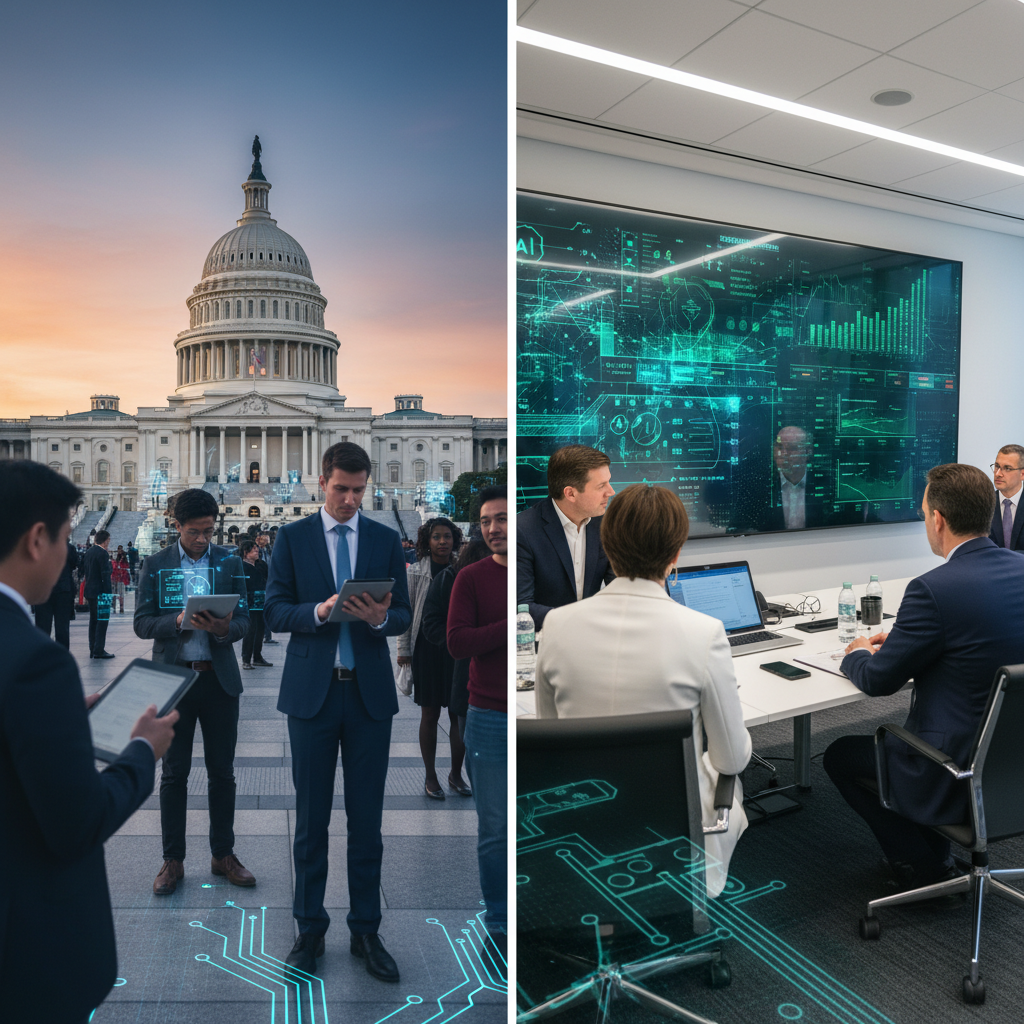
The US Congress is currently wrestling with comprehensive AI legislation, a task as monumental and intricate as building the Sydney Opera House with nothing but a few blueprints and a lot of opinions. It’s a legislative ballet, if you will, where every step is scrutinised, every move lobbied, and the stakes couldn't be higher. Why should we down here in Australia care so much about what’s happening halfway across the world? Because, my friends, when the biggest tech players and the most powerful legislative body on the planet decide on the rules for artificial intelligence, those rules often become the de facto global standard. There's something happening in the Southern Hemisphere that Silicon Valley hasn't noticed yet, but when it comes to regulation, the Northern Hemisphere often sets the pace, and we need to understand how that machine works.
The Big Picture: Why AI Legislation Now?
Think of AI as a runaway train. It’s incredibly powerful, capable of taking us to amazing new destinations, but without proper tracks and signals, it could derail with catastrophic consequences. From deepfakes influencing elections to algorithms perpetuating bias in hiring or lending, the potential harms are becoming increasingly apparent. On the flip side, AI promises breakthroughs in medicine, climate science, and productivity that could uplift humanity. The challenge for Congress is to foster innovation while mitigating risk, a classic tightrope walk.
Companies like OpenAI, Google, Microsoft, and Anthropic are pouring billions into AI research and deployment. Their rapid advancements have outpaced existing legal frameworks, which were designed for an analogue world. Regulators are playing catch-up, trying to understand not just what AI can do, but what it should do, and how to hold its creators accountable. This isn't just about consumer protection, it's about national security, economic competitiveness, and fundamental human rights.
The Building Blocks: Who Crafts the Rules?
Crafting legislation is never a solo act, and AI legislation is a full-blown ensemble performance. Here are the key players:
- Lawmakers (Senators and Representatives): These are the elected officials who introduce bills, debate them in committees, and vote on them. They often rely on expert staff to understand complex technical issues.
- Congressional Committees: Specialized committees, like the Senate Judiciary Committee or the House Energy and Commerce Committee, are where the nitty-gritty work happens. They hold hearings, gather testimony, and mark up bills.
- Industry Lobbyists: Representatives from tech giants (Google, Meta, Amazon, NVIDIA), AI startups, and industry associations (like the Chamber of Commerce or the Information Technology Industry Council) spend vast sums to influence legislation. They argue for policies that protect their business models and promote innovation, often pushing back against overly restrictive rules.
- Advocacy Groups: Civil liberties organisations, consumer protection advocates, labour unions, and ethical AI researchers also lobby Congress. They often highlight the potential downsides of AI, advocating for stronger guardrails around privacy, bias, and accountability.
- Executive Branch Agencies: Departments like Commerce, Justice, and the National Institute of Standards and Technology (nist) provide technical expertise, conduct research, and may eventually be tasked with implementing new regulations.
- Academics and Experts: University researchers, think tanks, and independent experts are frequently called upon to provide testimony and analysis, helping to bridge the knowledge gap between cutting-edge technology and legislative understanding.
Step by Step: How a Bill Becomes AI Law (in theory)
It’s a long and winding road, much like a drive along Australia's Great Ocean Road, but here's the simplified version of how an AI bill might navigate Congress:
Step 1: Idea and Introduction. A Senator or Representative, perhaps spurred by a constituent concern or an expert briefing, decides AI needs regulation. They draft a bill, often with input from their staff, industry, or advocacy groups. This bill is then formally introduced in their respective chamber (House or Senate).
Step 2: Committee Action. The bill is assigned to one or more committees with relevant jurisdiction. For AI, this could be committees dealing with judiciary, commerce, science, or intelligence. The committee holds hearings, inviting experts like Sam Altman of OpenAI or Dario Amodei of Anthropic, academics, and advocacy groups to testify. They then 'mark up' the bill, making amendments and revisions. This is where a lot of the heavy lifting and horse-trading happens.
Step 3: Floor Debate and Vote. If the committee approves the bill, it moves to the full chamber for debate. Members can propose further amendments. Eventually, a vote is taken. If it passes, it moves to the other chamber.
Step 4: Repeat in the Other Chamber. The exact same process unfolds in the other house of Congress. Often, the second chamber will pass its own version of the bill, leading to discrepancies.
Step 5: Conference Committee (if needed). If the House and Senate pass different versions of the same bill, a conference committee, made up of members from both chambers, is formed to reconcile the differences and create a single, unified bill. This is where compromises are hammered out, often late into the night.
Step 6: Final Passage. The unified bill goes back to both the House and Senate for a final vote. If it passes both, it's sent to the President.
Step 7: Presidential Action. The President can sign the bill into law, veto it (which Congress can override with a two-thirds majority vote in both chambers), or allow it to become law without signature. And voila, we have an AI law!
A Worked Example: The AI Safety, Innovation, and Accountability Act
Let’s imagine a hypothetical scenario, a bill called the 'AI Safety, Innovation, and Accountability Act'.
- The Problem: Concerns are mounting over the potential for advanced AI models to generate harmful content, spread misinformation, and be used in autonomous weapons systems. There's also a desire to ensure American companies remain competitive.
- Introduction: Senator Anya Sharma introduces the bill in the Senate. It proposes mandatory safety testing for frontier AI models, a national AI research fund, and a new federal agency to oversee AI ethics.
- Committee Hearings: The Senate Commerce Committee holds hearings. Brad Smith, Vice Chair and President of Microsoft, testifies, arguing for a balanced approach that doesn't stifle innovation. Civil rights groups, however, push for stronger provisions on algorithmic bias and transparency. Lobbyists from NVIDIA argue for tax incentives for AI hardware development. Reuters often covers these high-profile testimonies.
- Markup: The committee debates the bill. They amend the mandatory safety testing to apply only to models above a certain computational threshold, create a smaller, advisory AI commission instead of a full agency, and include some R&D tax credits.
- Senate Vote: The amended bill passes the Senate, but narrowly, after a heated debate about the scope of government oversight.
- House Action: The House of Representatives introduces its own, slightly different bill, focusing more on workforce retraining and less on safety testing. After committee work, it passes the House.
- Conference Committee: Members from both chambers meet. They compromise: mandatory safety testing for all large models, a slightly larger national AI research fund, and a joint government-industry task force for ethics, rather than a new agency. The workforce retraining provisions are kept.
- Final Passage & Presidential Signature: Both chambers approve the compromise bill. The President, seeing it as a bipartisan win for innovation and safety, signs it into law. The new law then sets the stage for how AI develops in the US, impacting global standards.
Why it Sometimes Fails: The Legislative Roadblocks
This process is fraught with peril. Legislation can fail at almost any step. Here's why:
- Partisan Disagreement: AI is a complex issue, and politicians often have vastly different ideas about the role of government, leading to deadlock.
- Lobbying Pressure: Powerful industry groups can exert significant influence, sometimes watering down regulations or pushing for loopholes that benefit their members. Conversely, strong advocacy can push for more stringent rules.
- Technical Complexity: Many lawmakers aren't AI experts, and understanding the nuances of large language models or autonomous systems can be challenging, making it difficult to craft effective legislation.
- Pace of Innovation: AI technology evolves at a dizzying speed. A bill drafted today might be outdated by the time it becomes law, a constant challenge for legislators. As Wired often highlights, the tech moves faster than the laws.
- Lack of Consensus on Harms/Benefits: There's no universal agreement on the biggest risks or the most important benefits of AI, making it hard to prioritise what to regulate.
Where This Is Heading: A Global Ripple Effect
This legislative journey in the US isn't just an American affair. It's a bellwether for the rest of the world. The European Union has already moved forward with its own comprehensive AI Act, and China has implemented various AI regulations. Australia, with its burgeoning tech sector and a keen eye on global standards, is watching intently. Our own government has been exploring AI ethics frameworks and responsible AI guidelines, often looking to international precedents.
My Irish roots taught me to question, my Australian home taught me to build, and right now, we need to question how these powerful AI systems are built and governed. The US legislation, whatever its final form, will influence how Australian companies operate, how our researchers collaborate, and even how our own government approaches AI policy. It will impact everything from the data privacy standards we adhere to, to the safety benchmarks for the AI systems we import and develop. We might even see a 'Brussels Effect' or a 'Washington Effect' where other nations, including ours, adopt similar regulatory approaches to ensure interoperability and market access. It’s a dynamic, ever-changing landscape, and understanding its mechanisms is crucial for anyone who wants to navigate the exciting, yet challenging, future of artificial intelligence.