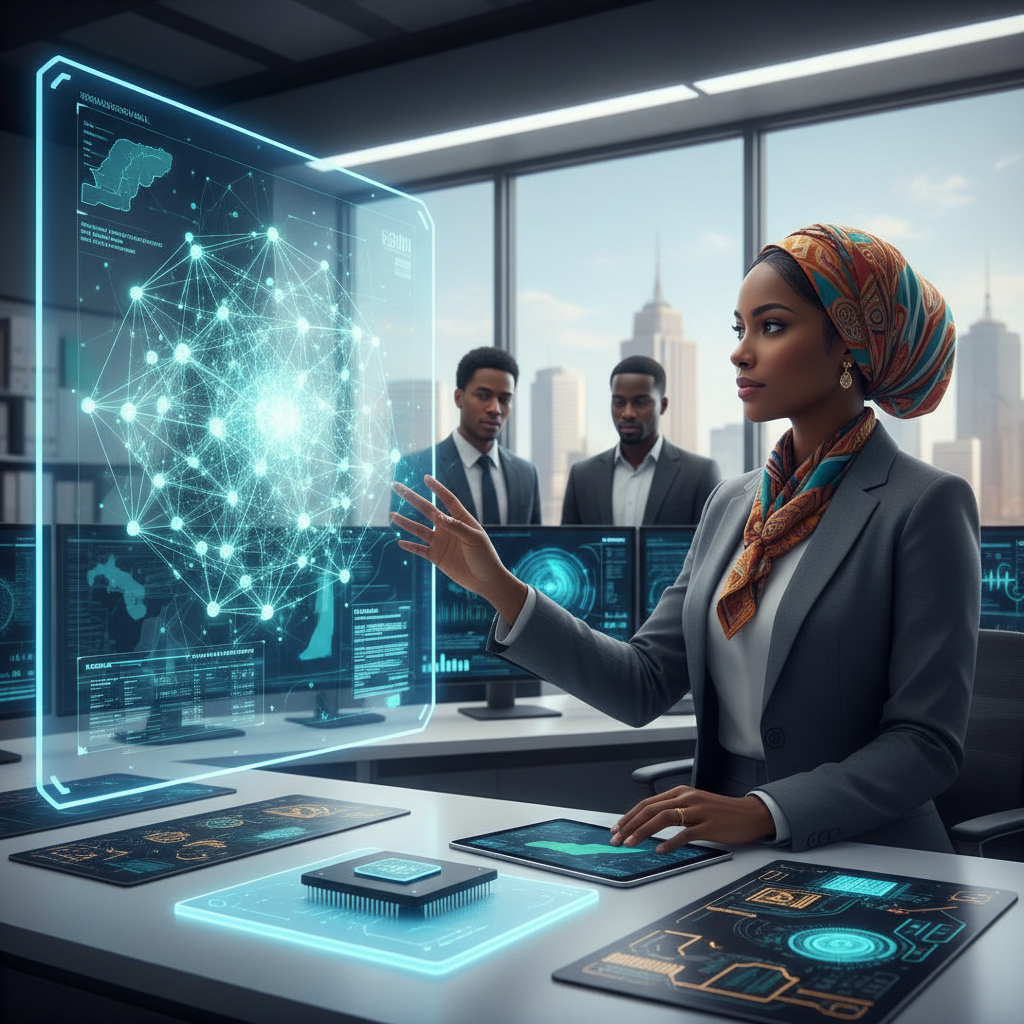

Step into any bustling market in Cairo, like Khan el-Khalili, and you will see a vibrant tapestry of commerce, culture, and connection. Goods flow, information is exchanged, and trust is built, often face to face. Now, imagine if every transaction, every conversation, every piece of knowledge shared in that market was routed through a single, foreign-owned chokepoint, controlled by entities whose interests might not align with your own. That, my friends, is a simplified, albeit dramatic, analogy for the concept of AI sovereignty, and it is what nations around the world, including my beloved Egypt, are grappling with in this new era of artificial intelligence.
What Exactly is AI Sovereignty?
At its core, AI sovereignty refers to a nation's ability to develop, deploy, and govern its own artificial intelligence capabilities and infrastructure, independently of foreign influence or control. Think of it this way: just as a nation strives for food sovereignty to ensure its people are fed, or energy sovereignty to power its industries, AI sovereignty is about securing the digital intelligence that will drive future economies, defense, and public services. It is about owning the data, the algorithms, the computing power, and the talent needed to build and control AI systems that serve national interests and values. It is not merely about having access to AI, but about having control over it.
Why Should You Care? The Stakes Are Higher Than Ever
Why should this matter to the average person, whether they are in Alexandria or Amsterdam? Well, the implications are profound. AI is rapidly becoming the foundational technology for everything from healthcare and education to national defense and economic competitiveness. If a nation relies entirely on foreign AI models, foreign cloud infrastructure, and foreign data governance, it risks several critical vulnerabilities. Data privacy could be compromised, algorithms might embed biases or serve external agendas, and critical infrastructure could be disrupted by external actors. For a country like Egypt, which is rapidly digitizing its economy and public services, this is not a theoretical concern; it is a strategic imperative. We have seen how geopolitical tensions can impact supply chains for physical goods, and the same, if not greater, risks apply to digital infrastructure.
According to a recent report by the European Commission, the global AI market is projected to reach over $1.8 trillion by 2030, underscoring the immense economic stakes involved. Nations that control their AI destiny will be better positioned to capture this value, create local jobs, and innovate in ways that are culturally and contextually relevant. "AI sovereignty is not about isolation, but about resilience," stated Dr. Aisha Bint Butti Bin Bishr, former Director General of Smart Dubai, in a recent address. "It is about building local capacity so that we are not solely dependent on external forces for our digital future." Her words resonate deeply in a region like ours, which has long sought to build self-sufficiency.
How Did This Concept Develop?
The idea of technological sovereignty is not entirely new. Nations have always sought control over critical technologies, from nuclear capabilities to space exploration. However, the rise of AI has amplified these concerns dramatically. In the early days of AI, much of the research and development was concentrated in a few tech hubs, primarily in the United States and, increasingly, China. Companies like Google, OpenAI, Microsoft, and Meta poured billions into developing foundational models and cloud computing platforms. This created a de facto dependency for many nations that lacked the resources or expertise to compete.
The turning point, perhaps, came with the rapid advancements in large language models and generative AI around 2022 and 2023. The sheer power and potential impact of these models made it clear that whoever controlled them held significant geopolitical leverage. Concerns about data privacy, algorithmic bias, and national security prompted regions like the European Union to enact comprehensive regulations like the AI Act, aiming to set global standards and foster indigenous AI capabilities. Simultaneously, China doubled down on its national AI strategy, investing heavily in domestic champions like Baidu and Alibaba, and pushing for self-reliance in semiconductors and AI research. This global competition, often dubbed the "AI arms race," is precisely what has brought AI sovereignty to the forefront.
How Does It Work in Simple Terms? Think of a Local Bakery
Let me break this down with an analogy from our daily lives. Imagine a small, local bakery in a village. For true bread sovereignty, that bakery needs to control several things: the flour, the yeast, the oven, and the skills of the baker. If they have to import all their flour from one foreign supplier, they are vulnerable to price hikes or supply chain disruptions. If they rely on a foreign-owned oven that can be remotely shut down, they are at risk. And if all the best bakers are trained abroad and then leave, the local bakery loses its core competence.
AI sovereignty works similarly. It requires control over:
- Data: The raw material for AI. Nations need to collect, store, and process their own data securely, ensuring privacy and preventing unauthorized access. This means local data centers and robust data governance frameworks.
- Models and Algorithms: The recipes for AI. This involves developing proprietary AI models, or at least having the capacity to fine-tune and adapt open-source models, rather than relying solely on black-box solutions from abroad. Companies like Mistral AI in Europe are pushing for open, sovereign models.
- Computing Infrastructure: The oven. This means access to powerful GPUs and cloud computing resources, ideally within national borders. NVIDIA is a dominant player here, but nations are investing in their own supercomputing facilities.
- Talent and Research: The skilled bakers. Investing in education, research, and development to cultivate a local pool of AI engineers, scientists, and ethicists. Universities like the American University in Cairo and Ain Shams University are crucial in this regard.
Real-World Examples: A Global Scramble for Control
The pursuit of AI sovereignty is playing out across the globe in various forms:
- European Union's AI Act: This landmark regulation, which is nearing full implementation, aims to establish a human-centric approach to AI, fostering trust and enabling European companies to innovate while ensuring fundamental rights. It is a clear attempt to set a global standard and reduce reliance on non-EU AI systems. Wired has covered its progress extensively.
- China's 'Self-Reliance' Drive: Beijing has made technological self-sufficiency a national priority, particularly in AI and semiconductors. Companies like Huawei and Baidu are central to this strategy, with massive state-backed investments aimed at developing indigenous AI capabilities and reducing dependence on US technology. This includes everything from chip manufacturing to foundational AI models.
- India's IndiaAI Mission: India has launched ambitious initiatives to build its own AI ecosystem, focusing on public digital infrastructure, data platforms, and talent development. Their goal is to leverage AI for social good and economic growth, tailored to India's unique challenges and opportunities, rather than simply importing solutions.
- Emerging Nations and Regional Hubs: Countries like the UAE and Saudi Arabia are investing heavily in AI research, data centers, and talent attraction, aiming to become regional AI powerhouses. Here in Egypt, we are seeing increased focus on AI education and local startup ecosystems, recognizing the long-term strategic importance. The Egyptian government has established the National Council for Artificial Intelligence to coordinate efforts and develop a national strategy, a vital step in building our own AI future.
Common Misconceptions
One common misconception is that AI sovereignty means technological isolation, building digital walls around a nation. This is far from the truth. True sovereignty allows for strategic collaboration and engagement on one's own terms. It is about having the option to be independent, not necessarily being isolated. Another misconception is that it is only about military applications. While defense is certainly a component, AI sovereignty is equally, if not more, about economic competitiveness, public service delivery, and cultural preservation.
What to Watch For Next
The coming years will be critical in this global race for AI sovereignty. Keep an eye on several key areas:
- Open-Source vs. Proprietary Models: The debate between open-source AI models, which can be adapted and controlled locally, and proprietary models from tech giants will intensify. The availability of powerful open-source models like Meta's Llama 3 could democratize AI development and empower more nations to build their own sovereign capabilities.
- Data Governance and Localization: More countries will likely enact stricter data localization laws, requiring data to be stored and processed within national borders. This will create challenges for global cloud providers but opportunities for local data center operators.
- Talent Development: The global competition for AI talent will only grow fiercer. Nations that invest strategically in Stem education, research grants, and attractive environments for AI professionals will gain a significant edge. We need to ensure our brightest minds stay here, contributing to Egypt's AI future, rather than seeking opportunities exclusively abroad.
- Ethical AI Frameworks: As AI becomes more pervasive, the development of ethical guidelines and regulatory frameworks that reflect national values will be crucial. This is where a nation's unique cultural perspective can truly shine, ensuring AI serves humanity in a way that aligns with our collective conscience.
Here's what's actually happening under the hood: nations are realizing that AI is not just another tool, but a fundamental layer of future power. The ability to control this layer, to shape it according to national needs and values, is becoming as important as controlling borders or currency. For Egypt and other emerging nations, navigating this complex landscape requires strategic foresight, significant investment, and a clear vision for a digitally sovereign future. The stakes are high, but the opportunity to build a resilient and prosperous future, powered by our own intelligence, is even higher. We are not just spectators in this global game; we are active players, and our choices today will define our tomorrow. For more insights into how different regions are approaching this challenge, I recommend exploring articles on MIT Technology Review.