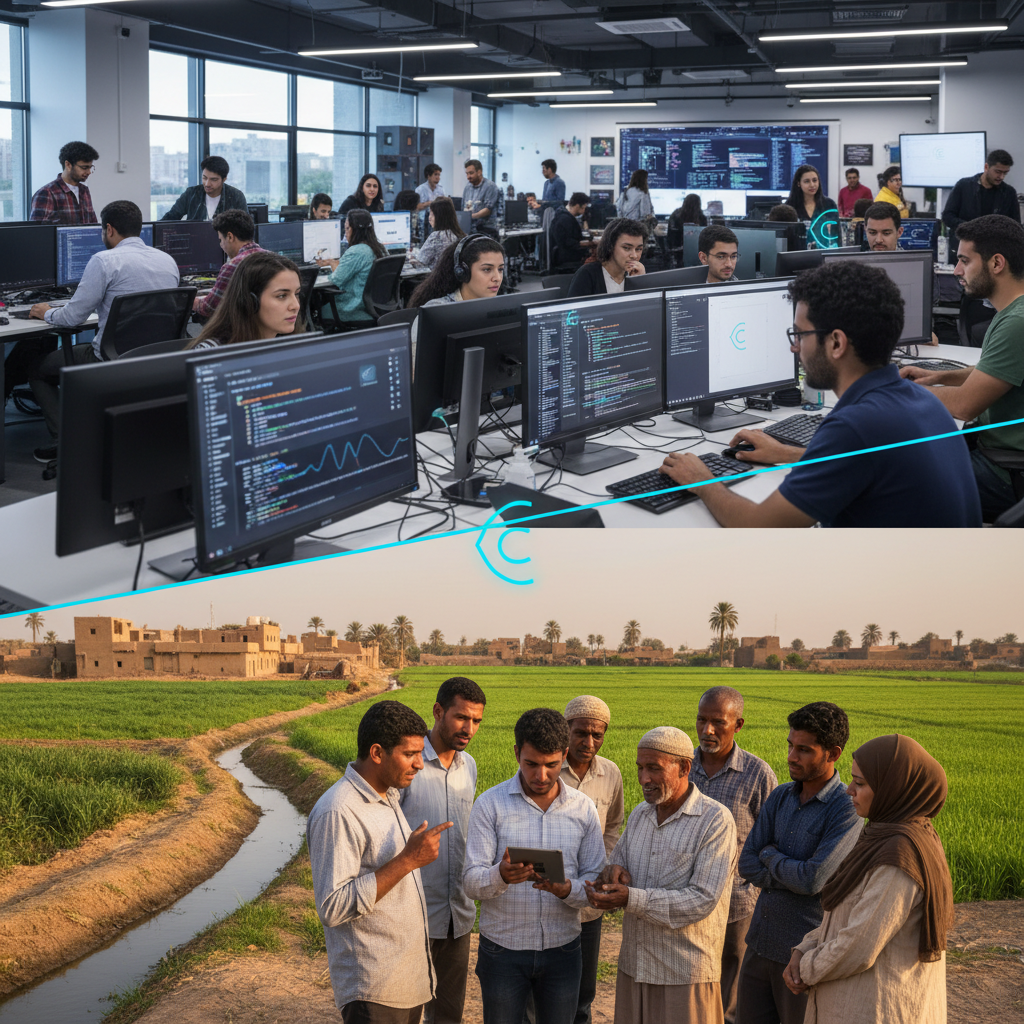

The scent of strong coffee and the hum of servers are as familiar to me as the morning call to prayer in Cairo. For years, I have walked the halls of our burgeoning tech hubs, seen the fierce intellect of our young developers, and felt the pulse of innovation trying to break free from old constraints. Now, a new force is reshaping their world, a digital assistant named GitHub Copilot, brought to us by Microsoft, and its implications for Egypt are as complex as a hieroglyphic inscription.
We are talking about AI that writes code, not just suggests it. Think of it this way: imagine a master artisan, meticulously carving a wooden mashrabiya screen. Now, imagine that artisan has a brilliant apprentice, one who anticipates their next cut, suggests the perfect curve, and even drafts entire sections of the design before being asked. That apprentice is GitHub Copilot, a tool that leverages large language models to turn natural language prompts into lines of code, functions, and even entire programs. It is a powerful concept, one that has already begun to reshape software development globally.
Globally, the numbers are compelling. Microsoft reported that Copilot users complete tasks 55% faster and feel more fulfilled, spending less time on repetitive coding. A study published by GitHub itself in 2023 indicated that developers using Copilot completed a coding task significantly quicker than those without it. This isn't just a marginal improvement; it is a paradigm shift. For developers in Silicon Valley or London, this means increased productivity and the ability to tackle more complex problems. But what does it mean for a developer in Alexandria or Aswan?
Here's what's actually happening under the hood: Copilot is trained on a vast dataset of publicly available code, learning patterns, best practices, and common solutions. When a developer types a comment or a function signature, Copilot analyzes the context and suggests relevant code snippets. It is like having an encyclopedic knowledge of programming at your fingertips, constantly learning and adapting. This capability has led to a reported 46% increase in developer satisfaction among users, according to Microsoft's internal surveys.
In Egypt, our tech ecosystem is vibrant, yet still developing. We have a growing pool of talented engineers, many of whom graduate from excellent universities like Ain Shams or the American University in Cairo. However, access to cutting edge resources, advanced training, and global networks can sometimes be a challenge. This is where Copilot presents both immense opportunity and potential pitfalls.
On the one hand, Copilot could be a great equalizer. For a junior developer in a startup in Maadi, struggling with a complex algorithm, Copilot can provide instant, contextually relevant suggestions, effectively acting as a senior mentor. It can accelerate learning, reduce debugging time, and allow smaller teams to achieve more with fewer resources. This could be transformative for our burgeoning startup scene, enabling them to compete on a more level playing field with global players. Imagine a small team building an e-commerce platform for local artisans; Copilot could help them rapidly prototype and deploy features that would otherwise take weeks.
Dr. Ahmed El-Sherif, a prominent AI researcher at the Nile University and a consultant for several Egyptian tech initiatives, shared his perspective with me. “Copilot, if leveraged correctly, can democratize access to advanced coding practices. It can be a powerful tool for upskilling our workforce, allowing them to focus on higher-level problem solving rather than syntax. We see a future where our developers, even those in remote areas, can contribute to global projects with greater efficiency,” he stated. His optimism is not unfounded; the potential for increased productivity and knowledge transfer is immense.
However, there is a flip side, a concern that echoes through many conversations I have had with local developers. The fear is that over-reliance on such tools could stunt the growth of fundamental coding skills, especially for new entrants to the field. If Copilot writes much of the code, will junior developers truly understand the underlying logic, the nuances of optimization, or the critical thinking required for complex system design? This is not a uniquely Egyptian concern, of course; it is a global debate. But in a country where foundational skills are still being solidified across a rapidly expanding workforce, the stakes feel particularly high.
“The risk is that we become consumers of AI, rather than creators,” warned Sarah Hassan, a lead software architect at a major fintech firm in Cairo. “If our young engineers rely too heavily on Copilot for basic tasks, they might miss out on developing that deep intuition, that problem-solving muscle that comes from wrestling with code line by line. We need to ensure that these tools augment human intelligence, not replace the need for it.” Her words resonate deeply with the spirit of innovation I have always championed: technology should empower, not diminish, human capability.
Another critical aspect is the economic impact. If Copilot makes developers significantly more productive, could it lead to a reduction in the demand for entry-level programmers? Or will it simply raise the bar, requiring even junior developers to be proficient in prompt engineering and code review, rather than just raw coding? For a country like Egypt, with a large youth population entering the workforce, these are not abstract questions but matters of economic opportunity and stability. The Ministry of Communications and Information Technology has been actively promoting digital skills training, and the integration of AI tools into these programs will be crucial.
Let me break this down further. The cost of access to tools like GitHub Copilot, which operates on a subscription model, is another factor. While individual licenses are relatively affordable by global standards, scaling this across thousands of developers in smaller companies or educational institutions in Egypt could be a barrier. Ensuring equitable access to these powerful AI assistants is paramount if we want to truly bridge the digital divide, rather than inadvertently widening it. Initiatives to provide subsidized access or integrate these tools into public education curricula could be vital.
Moreover, the ethical considerations around code ownership and intellectual property, given that Copilot is trained on public code, are still evolving. While Microsoft has taken steps to address these, the legal landscape in many parts of the world, including Egypt, is still catching up. Developers need clarity and protection, especially when contributing to open source projects or proprietary solutions.
The future of software development in Egypt, and indeed across Africa, will not be defined by whether we use tools like GitHub Copilot, but how we use them. It is a powerful current, and we can either learn to navigate it skillfully or risk being swept away. The goal must be to cultivate a generation of developers who are not just users of AI, but masters of it, capable of bending its capabilities to solve our unique challenges, from optimizing agricultural yields in the Delta to building robust digital infrastructure for our growing cities.
Our journey is not just about adopting the latest technology; it is about adapting it, integrating it into our unique cultural and economic fabric. The conversations happening in Cairo's cafes and university labs today will shape whether tools like Copilot become a catalyst for unprecedented growth or a subtle force that reshapes our talent landscape in unforeseen ways. The challenge, as always, is to harness the power of innovation while safeguarding the human ingenuity that fuels it. For more insights into how AI is transforming various industries, you might find articles on The Verge to be quite informative.