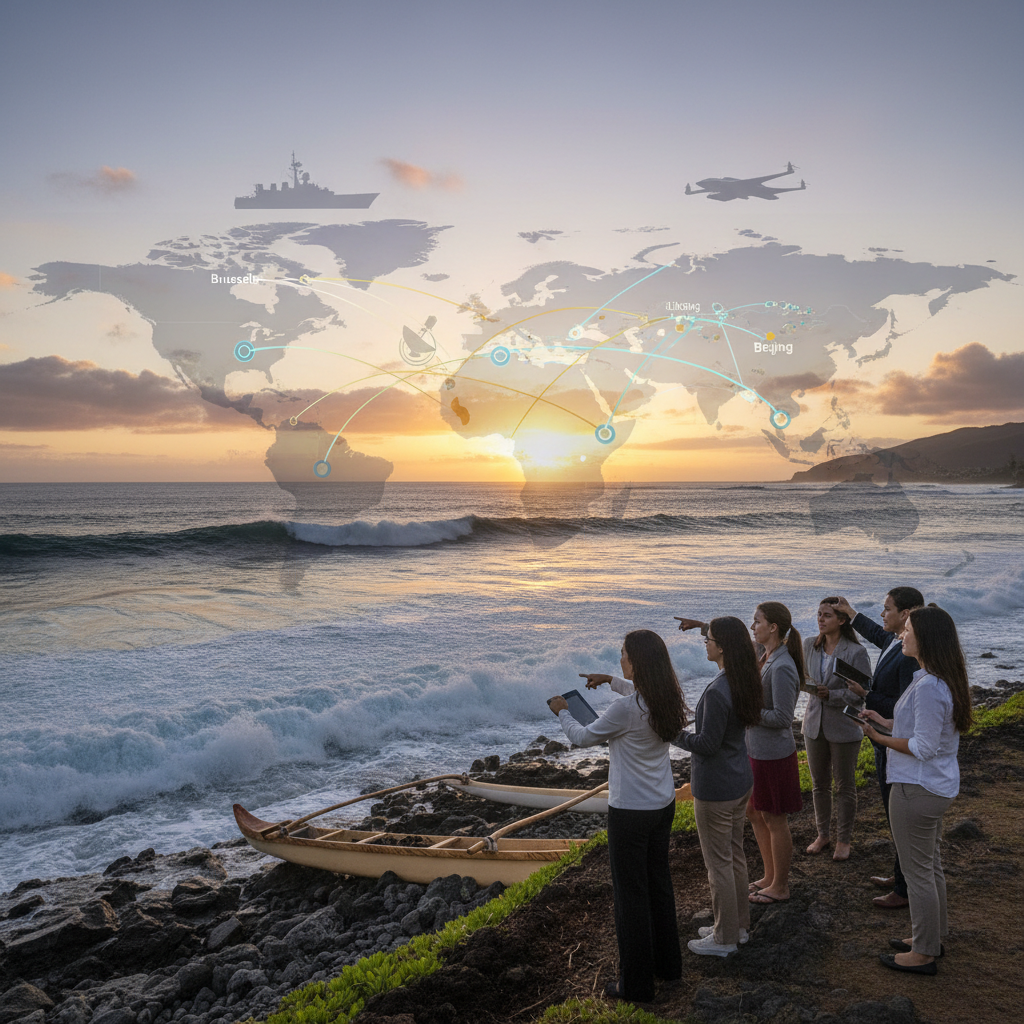
The global stage for artificial intelligence is not just a race for technological supremacy, it is a battle for the soul of the digital future. Right now, the world's titans, the European Union, the United States, and China, are each carving out their own paths for AI regulation. From my vantage point here in Hawaiʻi, where the future is being built on volcanic rock, I see these distant policy shifts not as abstract political maneuvers, but as tsunamis gathering strength, destined to reshape our Pacific shores.
For too long, the narrative around AI has been dominated by Silicon Valley's move-fast-and-break-things ethos, or Beijing's state-controlled ambitions. But what about the rest of us, especially those of us in the Pacific, who often find ourselves at the receiving end of these technological waves? The question isn't just about compliance, it is about cultural preservation, ethical integration, and ensuring that AI serves humanity, not just profit or power.
The European Union, with its landmark AI Act, is leading the charge on comprehensive, risk-based regulation. This isn't just a set of guidelines, it is a legal framework that classifies AI systems by risk level, from unacceptable to minimal. High-risk applications, like those in critical infrastructure, law enforcement, or employment, face stringent requirements: data governance, human oversight, transparency, and cybersecurity. This approach, which finally passed into law in March 2024, is rooted in European values of human rights and privacy. It is a bold statement, one that says, 'We will not sacrifice our principles at the altar of innovation.' As Ursula von der Leyen, President of the European Commission, stated during its passage, "The AI Act is not just a rulebook, it is a launchpad for responsible innovation." This kind of foresight, thinking decades ahead about societal impact, resonates deeply with our own long-term stewardship traditions here in Hawaiʻi.
Across the Atlantic, the United States has taken a different, more fragmented path. Rather than a sweeping legislative act, the US approach has largely relied on executive orders, voluntary commitments from tech giants, and sector-specific guidance. President Biden's Executive Order on the Safe, Secure, and Trustworthy Development and Use of Artificial Intelligence, issued in October 2023, is a prime example. It pushes for safety standards, protects privacy, promotes equity, and addresses national security concerns. While comprehensive in its scope, it lacks the immediate legal teeth of the EU Act, relying more on agencies like the National Institute of Standards and Technology, Nist, to develop standards and best practices. The US tech industry, often wary of heavy-handed regulation, generally prefers this more agile, innovation-friendly stance. Companies like OpenAI and Google have made public commitments to safety, but these are not legally binding in the same way the EU's mandates are. As Sam Altman, CEO of OpenAI, has often articulated, there is a delicate balance between fostering innovation and ensuring safety, a balance he believes is best struck through collaboration, not just legislation.
Then we turn to China, where the state's role in technology is fundamentally different. Beijing's regulatory framework is characterized by a top-down approach, prioritizing national security, social stability, and economic competitiveness. China has been surprisingly proactive in regulating AI, issuing rules on deepfakes, recommendation algorithms, and generative AI. These regulations often include requirements for content censorship, data localization, and algorithmic transparency to the state. The focus is on controlling information and ensuring AI aligns with socialist core values. This is not about individual privacy in the Western sense, but about collective order and state control. The speed and decisiveness with which China can implement these regulations are unmatched, allowing them to rapidly shape the domestic AI landscape. This approach, while effective for state goals, raises significant questions about freedom and autonomy, concerns that many in the Pacific, with our own histories of colonial influence, understand all too well.
So, what does this global regulatory mosaic mean for us in Hawaiʻi and across Oceania? We sit at the crossroads of Pacific and Silicon Valley, a unique position that demands we understand these currents. Our local tech ecosystem, though smaller, is vibrant, with startups exploring everything from ocean tech to sustainable agriculture, often leveraging AI. Will these companies be forced to comply with three different, potentially conflicting, sets of rules if they want to operate globally? The answer is likely yes, creating a complex compliance landscape that could stifle smaller players.
Consider data sovereignty, a critical issue for indigenous communities. The EU's GDPR, and by extension parts of the AI Act, offers robust data protection. The US approach is more fragmented. China's approach, with its emphasis on state access, could be deeply problematic for communities seeking to control their own digital heritage. For us, the concept of kuleana, or responsibility, extends to our data. Who owns it? How is it used? Is it being used in a way that benefits our community, or exploits it? These are not just technical questions, they are deeply cultural ones.
Furthermore, the ethical implications of AI, particularly concerning bias, are magnified in diverse, often marginalized, communities like ours. If AI systems are trained on data sets that primarily reflect Western or dominant cultural norms, they will inevitably perpetuate biases. The EU AI Act's emphasis on human oversight and transparency is a step in the right direction, but it's not enough. We need to ensure that the development of AI includes diverse voices from the outset, not as an afterthought. Aloha means more than hello because it's a framework for ethical AI, demanding respect, compassion, and a deep sense of shared responsibility for the well-being of all.
For instance, our astronomers on Maunakea, who use AI to process vast amounts of celestial data, need assurances that the algorithms are unbiased and robust. Our oceanographers, deploying AI-powered sensors to monitor marine ecosystems, must trust that the data is secure and that the AI's recommendations are sound. The stakes are incredibly high, not just for scientific discovery but for the health of our planet.
The lack of a unified global approach means that companies operating internationally will face a patchwork of regulations. This could lead to a 'Brussels effect,' where the EU's stringent standards become a de facto global norm simply because it's easier for companies to comply with one high standard than to tailor products for each market. Or, we could see regulatory arbitrage, where companies flock to jurisdictions with weaker rules, creating ethical loopholes. Neither scenario is ideal for fostering truly responsible global AI development.
What we need, from our perspective in the Pacific, is not just regulation, but a global conversation rooted in shared values. We need to move beyond a purely technical or economic lens and embrace a holistic view that considers social, cultural, and environmental impacts. The Pacific Islands, often overlooked in these grand geopolitical discussions, have a vital role to play in shaping this future. Our traditional knowledge systems, our emphasis on interconnectedness and long-term sustainability, offer invaluable insights into how AI can be developed and governed ethically. As Dr. Tarcisius Kabutaulaka, a prominent Pacific scholar at the University of Hawaiʻi, recently remarked, "Our communities have always understood the importance of balance and reciprocity. These are the principles that should guide our engagement with new technologies like AI."
The coming decades will see AI permeate every aspect of our lives. How we regulate it today will determine whether it becomes a tool for liberation and progress, or for control and division. The showdown between the EU, US, and China is more than a policy debate, it is a fundamental choice about the kind of future we want to build. And from our vantage point, amidst the ancient wisdom and modern innovation of these islands, we believe that future must be guided by aloha, a spirit of respect, unity, and responsibility for all. The world is watching, and the ripples from these regulatory decisions will reach even the most remote corners of our vast ocean. It is time for us to ensure those ripples carry messages of hope, not just compliance. For more on the global AI landscape, you can often find insightful analysis on MIT Technology Review. We must all engage, for the future of AI is the future of humanity, and it is being shaped right now. We also see similar challenges in other regions, as explored in The AI Babel Tower: How Brazil Navigates the Global Governance Gap, From Brasília to São Paulo [blocked], highlighting the universal need for thoughtful governance.