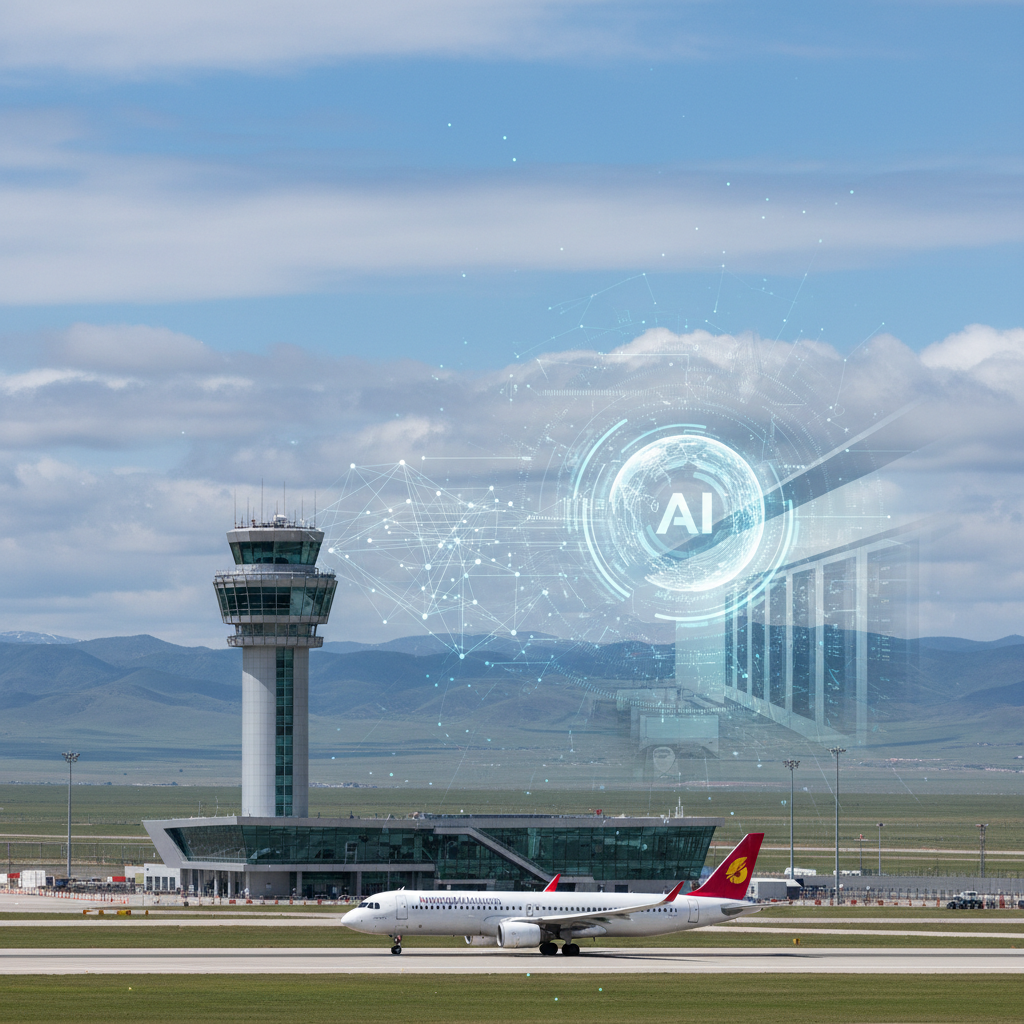

The wind whips across the steppe, a constant companion to anyone living in Mongolia. It's a land of immense distances, where a journey that might take hours by air could consume days, or even weeks, by road, especially in winter. For a country so reliant on air travel to connect its scattered population centers and facilitate trade, the efficiency and safety of aviation are not mere conveniences, they are necessities. This is why the advancements in artificial intelligence for flight optimization, predictive maintenance, and air traffic control are not just global headlines, but practical innovations being watched closely here.
I've seen enough technology fads come and go to know that true progress is often quiet, built on solid data and real-world application. The buzz around AI in aviation isn't just hype, it's about making planes safer, flights smoother, and operations more cost-effective. For a country like Mongolia, where resources are often stretched and infrastructure can be challenging, these efficiencies translate directly into better connectivity and economic stability.
Consider predictive maintenance. For airlines operating in harsh climates, where extreme temperature fluctuations and dust storms are common, the wear and tear on aircraft components can be significant. Traditionally, maintenance schedules are based on fixed intervals or flight hours, leading to either unnecessary inspections or, worse, unexpected failures. AI changes this equation. By analyzing vast datasets from sensors on engines, landing gear, avionics, and other critical systems, AI algorithms can predict when a component is likely to fail before it actually does. This allows for proactive repairs, reducing unscheduled downtime and improving safety.
Miat Mongolian Airlines, our national carrier, has been exploring these technologies. While they haven't made specific public announcements about full-scale AI integration, the industry trend is clear. Companies like GE Aerospace and Rolls-Royce have been at the forefront, developing AI-powered monitoring systems for their engines. GE's Predix platform, for example, collects and analyzes data from thousands of sensors on jet engines, providing insights that can extend engine life and optimize maintenance schedules. This kind of technology is a game-changer for smaller airlines that cannot afford extensive spare parts inventories or lengthy ground times for repairs. It means fewer delays and more reliable service, crucial for connecting our remote aimags with Ulaanbaatar.
Air traffic control is another area ripe for AI transformation. Mongolia's airspace, while vast, sees a significant amount of international overflight traffic, given its strategic location between Europe and Asia. Managing this complex flow, especially with varying weather conditions and limited ground infrastructure, is a monumental task. AI can assist human controllers by optimizing flight paths to avoid congestion, minimize fuel burn, and navigate around turbulent weather. It can process real-time data from radar, satellite, and weather forecasts much faster than any human, suggesting optimal trajectories and alerting controllers to potential conflicts.
Airbus and Boeing's research divisions, alongside specialized AI firms, are heavily invested in this. For instance, companies like Aireon are leveraging space-based Ads-b data to provide global air traffic surveillance, feeding into AI systems that can offer unprecedented insights into global air traffic patterns. This is particularly relevant for countries with large, sparsely populated territories like ours, where ground-based radar coverage can be limited. The steppe meets the server farm, indeed, as satellite data streams down to inform decisions on the ground.
Flight optimization, too, is seeing massive gains. AI algorithms can analyze factors like wind patterns, air pressure, aircraft weight, and even real-time fuel prices to calculate the most efficient flight path. This isn't just about shaving a few minutes off a journey; it's about significant fuel savings, which directly impacts an airline's bottom line and reduces carbon emissions. For an airline operating with tight margins, these savings are critical. According to a report by the International Air Transport Association, fuel can account for 20-30% of an airline's operating costs. Even a small percentage reduction through AI optimization can lead to millions in savings annually.
I recently spoke with Dr. Enkhjargal Bat-Erdene, a senior aviation analyst at the Civil Aviation Authority of Mongolia. She emphasized the practical benefits. "For us, AI isn't about replacing people, it's about empowering them," she told me. "Our air traffic controllers and maintenance crews are highly skilled, but they can only process so much information. AI tools give them a clearer picture, faster, allowing them to make better decisions. Mongolia's challenges are unique and so are its solutions, and AI is proving to be a powerful tool for us to overcome them."
However, implementing these technologies is not without its hurdles. The initial investment in AI infrastructure, data collection systems, and specialized training can be substantial. There are also regulatory considerations. Aviation is one of the most heavily regulated industries globally, and integrating AI into safety-critical systems requires rigorous testing, certification, and oversight. The Civil Aviation Authority, like its counterparts worldwide, is working to develop frameworks for AI integration that ensure safety and reliability.
Another key player is the Mongolian University of Science and Technology, which has been fostering research into AI applications relevant to local industries. Their aerospace engineering department, though small, is collaborating with international partners to understand how these global AI trends can be localized and adapted to Mongolia's specific needs. This kind of academic groundwork is essential for building a sustainable, AI-powered future for our aviation sector.
The global aviation industry is seeing significant investment in AI. Major players like Google and Microsoft are providing the underlying cloud infrastructure and AI platforms that airlines and aviation tech companies use to develop their solutions. For example, Microsoft Azure's AI capabilities are being leveraged by various aerospace companies for data analytics and machine learning model deployment. This ecosystem of global tech giants and specialized aviation AI startups is driving rapid innovation.
Looking ahead, the potential for AI in aviation extends beyond these immediate applications. We could see AI-powered pilot assistance systems that reduce workload, intelligent gate assignment at airports, and even drone-based inspections of aircraft. The goal is always the same: to make air travel safer, more efficient, and more accessible. For a country like Mongolia, where the sky is often the most direct route, these innovations are not just futuristic dreams, but essential steps towards a more connected and prosperous future.
As the world continues to shrink through technology, Mongolia stands ready to embrace the tools that can help it navigate its own vastness. Practical innovation is what truly matters, and in aviation, AI is delivering just that.