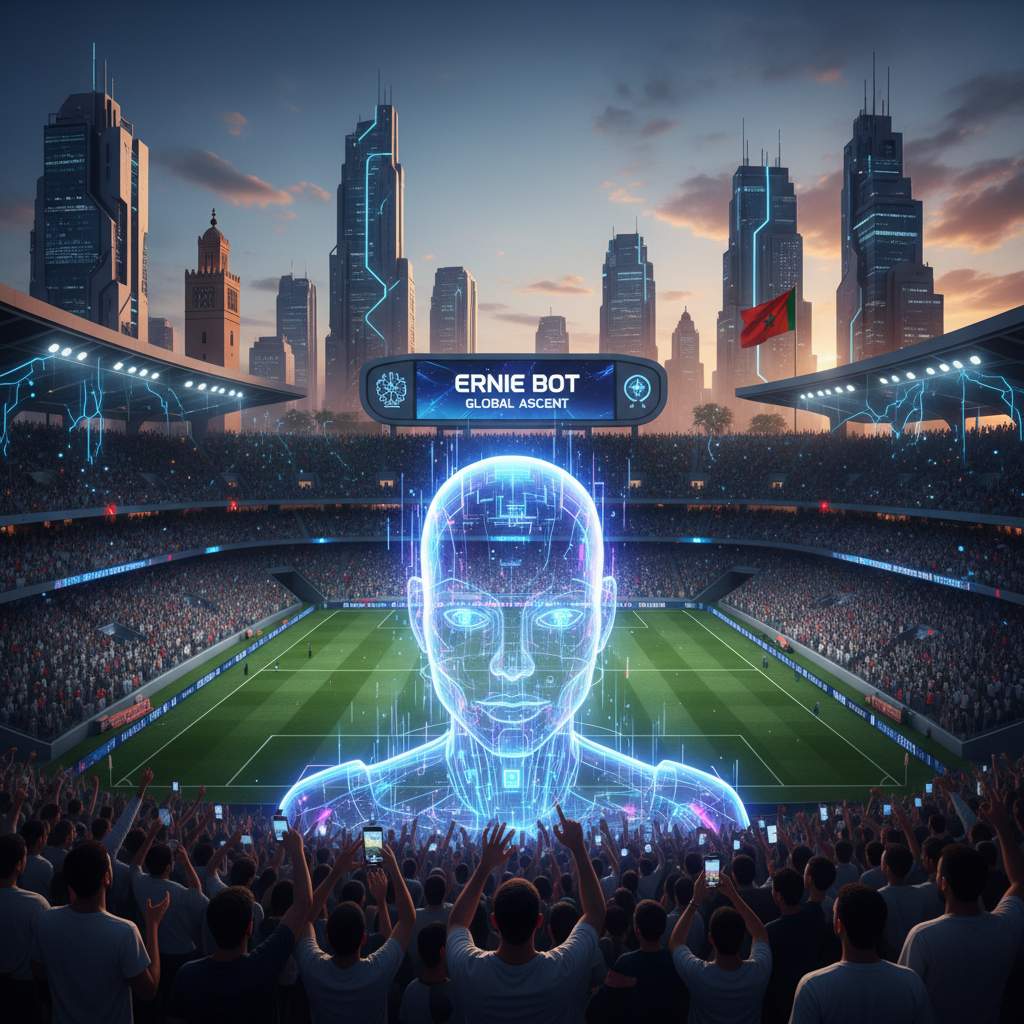
The world of artificial intelligence is not a static landscape, it is a shifting desert, constantly reshaped by new winds and rising dunes. For too long, the narrative has been dominated by a singular, Western-centric vision. Yet, from my vantage point in Morocco, at the crossroads of Africa, Europe, and the Arab world, I see a different story unfolding, one where the East is not just catching up, but actively redefining the future. This is particularly evident in the formidable rise of Baidu's Ernie Bot and China's broader AI ecosystem, a challenge to Western dominance that carries immense implications for our continent.
For years, the conversation around large language models, or LLMs, revolved almost exclusively around OpenAI's GPT series, Google's Gemini, and Anthropic's Claude. These are powerful tools, no doubt. But while the West was busy iterating, China was building its own parallel universe of AI innovation, tailored to its unique cultural and linguistic nuances, and now, increasingly, looking outward. Baidu's Ernie Bot, launched in March 2023 and rapidly evolving, is perhaps the most visible spearhead of this movement. It is not merely a copycat; it is a sophisticated, deeply integrated AI system that reflects a different philosophical approach to technology development.
Consider the scale: Baidu, a company often dubbed China's Google, has poured billions into AI research and development for over a decade. Ernie Bot, powered by the Ernie 4.0 foundation model, boasts capabilities that rival its Western counterparts in areas like natural language understanding, code generation, and multimodal interactions. Reports from late 2023 indicated Ernie Bot had already amassed over 100 million users, a staggering adoption rate that speaks to its utility and accessibility within the Chinese market. This is not just a domestic success story, it is a blueprint for global expansion, particularly into regions like Africa where digital transformation is accelerating at an unprecedented pace.
What does this mean for Morocco, for Africa? It means choice. It means competition. It means an opportunity to leapfrog traditional development paths. For decades, our technological infrastructure and digital solutions often followed Western models, sometimes imperfectly suited to our unique contexts. Now, with Chinese AI champions like Baidu, Alibaba, and Tencent making significant strides, we see alternative paradigms emerging. These companies often operate with a different philosophy, one that emphasizes rapid deployment, integration with existing digital ecosystems, and a willingness to adapt to local conditions.
Take the automotive sector, a burgeoning industry here in Morocco. We are seeing significant investment in smart manufacturing and electric vehicles. Chinese companies are at the forefront of integrating AI into automotive design, production, and autonomous driving systems. Imagine the synergy: Morocco's growing manufacturing capabilities combined with Chinese AI expertise. This is not a distant dream, it is a tangible reality being built today. The Sahara is vast, but the data flowing across it is vaster, and it is increasingly carrying the digital blueprints of a new, interconnected future.