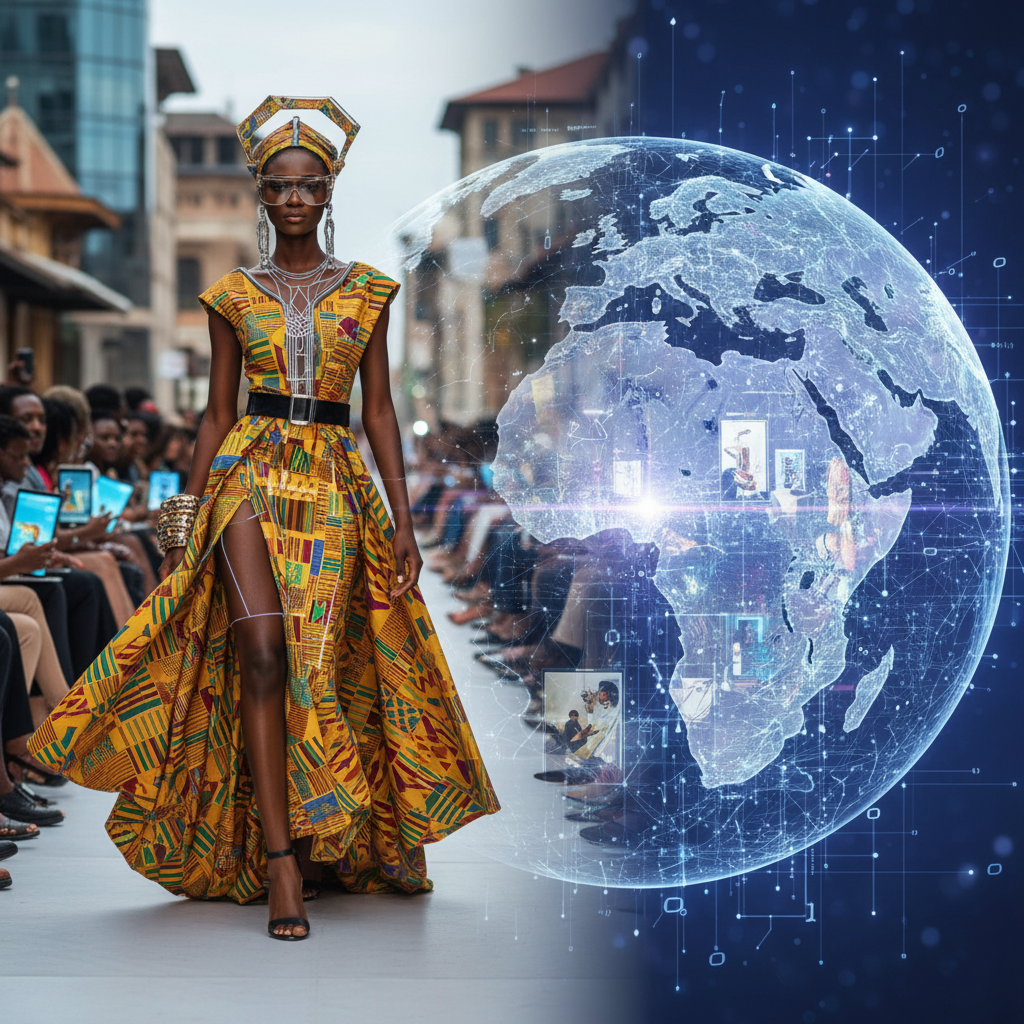

My friends, let me tell you, the energy here in Accra is absolutely electric. Every day, I see young innovators, designers, and tech enthusiasts building something incredible, something that challenges the status quo. And right now, one of the most exciting transformations is happening in an industry you might not immediately associate with deep tech: fashion. Forget the old notions, because AI is not just enhancing fashion, it is fundamentally reimagining it, and Ghana is proving the skeptics wrong, leading the charge in West Africa.
We are talking about a multi-billion dollar global industry, one that has historically been slow to adopt advanced technology. But that is changing, and fast. The numbers don't lie: market research suggests the global AI in fashion market is projected to reach over $10 billion by 2030, growing at a compound annual growth rate exceeding 30%. This isn't just about pretty clothes; it is about precision, efficiency, and sustainability, driven by algorithms and data. For developers, data scientists, and technical professionals, the opportunities are immense.
The Technical Challenge: Weaving Intelligence into Fabric
The fashion industry faces monumental challenges, from predicting fickle consumer tastes to managing complex supply chains and tackling its significant environmental footprint. AI offers potent solutions across three key areas: trend prediction, virtual try-on, and sustainable design. Each presents its own unique technical hurdles.
Trend Prediction: Imagine trying to forecast what millions of people will want to wear six months from now, across diverse cultures and climates. Traditional methods rely on human intuition, fashion shows, and historical sales data, which are often slow and prone to bias. The technical challenge here is to ingest vast, unstructured datasets, including social media posts, street style images, news articles, economic indicators, and even weather patterns, then extract meaningful, predictive signals. This requires robust natural language processing (NLP), computer vision, and time series analysis.
Virtual Try-On: The online shopping experience often lacks the tactile and visual feedback of a physical store. Returns due to poor fit or appearance are a massive problem, costing retailers billions annually. The goal is to create a hyper-realistic digital representation of how a garment would look on an individual, without them physically wearing it. This demands advanced 3D modeling, real-time rendering, pose estimation, and sophisticated image synthesis techniques, all while maintaining high accuracy and low latency across various devices.
Sustainable Design: The fashion industry is a major polluter, responsible for an estimated 10% of global carbon emissions. Reducing waste, optimizing material usage, and promoting circularity are critical. The technical challenge involves analyzing material properties, supply chain data, manufacturing processes, and consumer behavior to recommend eco-friendly alternatives, optimize production runs, and even design garments for longevity and recyclability. This leans heavily on optimization algorithms, material science databases, and life cycle assessment (LCA) integration.
Architecture Overview: The Digital Loom
At the heart of these AI applications is a sophisticated, multi-layered architecture designed for data ingestion, processing, model training, and deployment. Think of it like a digital loom, weaving data into actionable insights.
-
Data Ingestion Layer: This is where raw data from diverse sources is collected. For trend prediction, this includes web scraping social media platforms (Instagram, TikTok), fashion blogs, news sites, e-commerce platforms, and internal sales data. For virtual try-on, it involves 3D body scans, garment CAD files, and high-resolution texture maps. For sustainability, it means supply chain logs, material databases, and manufacturing telemetry. Technologies like Apache Kafka or Google Cloud Pub/Sub handle real-time streaming data, while distributed file systems like Hdfs or cloud object storage (Amazon S3, Azure Blob Storage) manage batch data.
-
Data Processing and Feature Engineering Layer: Raw data is messy. This layer cleans, transforms, and extracts relevant features. For images, this might involve resizing, normalization, and feature extraction using pre-trained convolutional neural networks (CNNs). For text, it means tokenization, sentiment analysis, and embedding generation. Time series data requires aggregation and statistical feature extraction. Apache Spark is a common tool here for its distributed processing capabilities.
-
Model Training Layer: This is where the magic happens. Different AI tasks require different model architectures:
- Trend Prediction: Often employs a combination of recurrent neural networks (RNNs) or Transformers for sequential data (text, time series) and CNNs for image data. Graph neural networks (GNNs) can also model relationships between fashion items and influencers. Ensemble methods often combine multiple models for improved accuracy.
- Virtual Try-On: Generative adversarial networks (GANs), particularly conditional GANs (cGANs) or StyleGANs, are crucial for generating realistic images of garments on different body shapes. Diffusion models are also showing immense promise here. Pose estimation models, often based on CNNs like OpenPose, detect key body points. 3D reconstruction techniques, using neural radiance fields (NeRFs) or similar, build realistic digital avatars and garment representations.
- Sustainable Design: Machine learning algorithms like Random Forests, Gradient Boosting Machines (XGBoost), or even deep reinforcement learning can optimize material selection and production processes. Graph databases can model complex supply chain relationships, allowing for efficient pathfinding and impact assessment.
-
Model Deployment and Inference Layer: Trained models are deployed as microservices, often using Docker containers and Kubernetes for scalability. APIs expose model predictions to front-end applications (e-commerce websites, mobile apps). Low-latency inference is critical for virtual try-on, often leveraging GPUs or specialized AI accelerators. Frameworks like TensorFlow Serving or PyTorch Serve facilitate this.
-
Feedback and Monitoring Layer: Continuous learning is vital. User interactions, sales data, and environmental impact metrics are fed back into the system to retrain and improve models. Monitoring tools track model performance, drift, and resource utilization.
Key Algorithms and Approaches
Let us dive a bit deeper into the algorithms that power these innovations.
For Trend Prediction: Multi-Modal Fusion and Transformers
Imagine a system that watches everything. It sees a certain color palette popping up on TikTok, notes a resurgence of a vintage silhouette in fashion magazines, and observes a spike in searches for a specific fabric on e-commerce sites. A multi-modal Transformer architecture can process all this. It uses separate encoders for different data types (e.g., a Vision Transformer for images, a BERT-like model for text, and a simple MLP for tabular data). The encoded representations are then concatenated and fed into a final Transformer encoder, which learns cross-modal relationships and predicts future trends. This approach is powerful because it captures the complex interplay of factors influencing fashion.
For Virtual Try-On: Conditional GANs and Diffusion Models
The core idea here is image-to-image translation. A cGAN takes an image of a person and an image of a garment, then generates a new image of the person wearing that garment. The 'generator' tries to create realistic images, while the 'discriminator' tries to tell if the image is real or fake. This adversarial process drives both networks to improve. More recently, diffusion models like Dall-e 3 or Midjourney, though often used for general image generation, are being fine-tuned for virtual try-on. They work by gradually adding noise to an image and then learning to reverse that process, allowing for highly realistic and controllable image synthesis. The key is precise control over garment placement and deformation, often achieved through dense pose estimation and warp fields.
For Sustainable Design: Reinforcement Learning for Supply Chain Optimization
Consider a scenario where a fashion brand wants to minimize waste and carbon footprint across its entire supply chain. This is a complex optimization problem. Reinforcement learning (RL) agents can be trained to make decisions at various stages: material sourcing, production quantity, logistics, and end-of-life management. The agent receives a 'reward' for positive outcomes (e.g., reduced waste, lower emissions) and a 'penalty' for negative ones. Algorithms like Proximal Policy Optimization (PPO) or Deep Q-Networks (DQN) can learn optimal strategies over time, navigating trade-offs between cost, speed, and environmental impact.
Implementation Considerations: From Concept to Runway
Building these systems requires careful planning. Data quality is paramount; garbage in, garbage out, as we say. For virtual try-on, high-resolution 3D scans of garments are essential for realism. For trend prediction, diverse and unbiased data sources are crucial to avoid perpetuating existing biases. Computational resources are also a significant factor, especially for training large generative models, often requiring powerful GPUs like NVIDIA's H100s. Scalability is key; a system must handle fluctuating demand, particularly during peak shopping seasons. Ethical considerations, such as data privacy and algorithmic bias in trend prediction, must be addressed from the outset. Ensuring fairness in virtual try-on across different body types and skin tones is also critical.
Benchmarks and Comparisons: Measuring the Fit
How do we know these AI solutions are actually working? For trend prediction, metrics like F1 score, precision, and recall are used to evaluate the accuracy of trend identification. Comparing AI predictions against human expert forecasts or actual sales data provides a real-world benchmark. For virtual try-on, perceptual studies, user satisfaction scores, and objective metrics like image quality (FID score, Ssim) and garment deformation accuracy are employed. In sustainable design, the impact is measured by reductions in waste, carbon emissions, and water usage, often quantified through Life Cycle Assessment (LCA) frameworks. These AI approaches consistently outperform traditional methods in speed, scale, and often, accuracy.
Code-Level Insights: The Digital Thread
For developers, the Python ecosystem is king. Libraries like TensorFlow and PyTorch are indispensable for deep learning. Hugging Face's Transformers library simplifies working with advanced NLP models. OpenCV is crucial for computer vision tasks. For 3D rendering and manipulation, libraries like Open3D or even Blender's Python API can be integrated. Data scientists will find Scikit-learn invaluable for traditional ML models and Pandas for data manipulation. Cloud platforms like AWS, Google Cloud, and Azure offer managed services for data pipelines, model training, and deployment, significantly accelerating development.
Real-World Use Cases: Ghana's Fashion Forward
- AfroTrendy (Accra, Ghana): This Ghanaian startup is leveraging AI for hyper-local trend prediction. They analyze social media conversations, local market data, and even traditional textile patterns to advise emerging designers on popular colors, motifs, and styles for upcoming seasons. Their platform uses a multi-modal Transformer model, trained on a unique dataset of West African fashion content, to provide actionable insights. This has helped local designers reduce overproduction and better meet consumer demand.
- StitchFix (Global): While not African-based, StitchFix is a prime example of AI in fashion. They use sophisticated algorithms to personalize clothing recommendations, reducing returns and improving customer satisfaction. Their system integrates customer style preferences, fit data, and inventory to curate personalized boxes. This is a blueprint for what African e-commerce platforms can achieve.
- Zeekit (acquired by Walmart): A leader in virtual try-on, Zeekit developed technology that allows customers to see how clothes look on their own body shape and size. Their approach combines advanced image processing with deep learning to create realistic digital representations. This technology significantly boosts conversion rates and reduces returns for online retailers.
- Renewable Fashion Initiative (Lagos, Nigeria): This initiative is exploring AI to optimize textile recycling and upcycling. They are developing models that can identify fabric composition from images and recommend the best recycling pathway, or even suggest new design patterns from existing waste materials. This is a crucial step towards a circular fashion economy in Africa.
Gotchas and Pitfalls: Navigating the Fabric of Data
While the potential is enormous, there are challenges. Data scarcity, especially high-quality, labeled fashion data from diverse African contexts, can hinder model performance. Bias in training data can lead to models that perpetuate stereotypes or fail to cater to diverse body types and cultural preferences. Over-reliance on AI without human oversight can stifle creativity or lead to homogenous trends. The computational cost of training and deploying advanced generative models can also be prohibitive for smaller startups. And of course, ensuring data privacy and security is paramount.
Resources for Going Deeper: Unraveling the Code
For those eager to dive deeper, I recommend exploring research papers on multi-modal learning and generative models on arXiv. The MIT Technology Review often publishes excellent articles on the broader implications of AI. For practical implementation, check out tutorials and documentation from TensorFlow and PyTorch. Courses on Coursera or edX focusing on deep learning for computer vision and NLP will provide a solid foundation. And for the latest industry news and startup developments, TechCrunch is always a great source.
This is bigger than anyone realizes. The fusion of AI and fashion is not just a technological upgrade; it is a cultural and economic revolution. Here in Ghana, with our rich textile heritage and burgeoning tech talent, we are not just spectators. We are becoming architects of this future, weaving innovation into every thread and pattern. The runway is set, and AI is helping us stride confidently into a more intelligent, sustainable, and stylish tomorrow. Akwaaba to the future of fashion!```