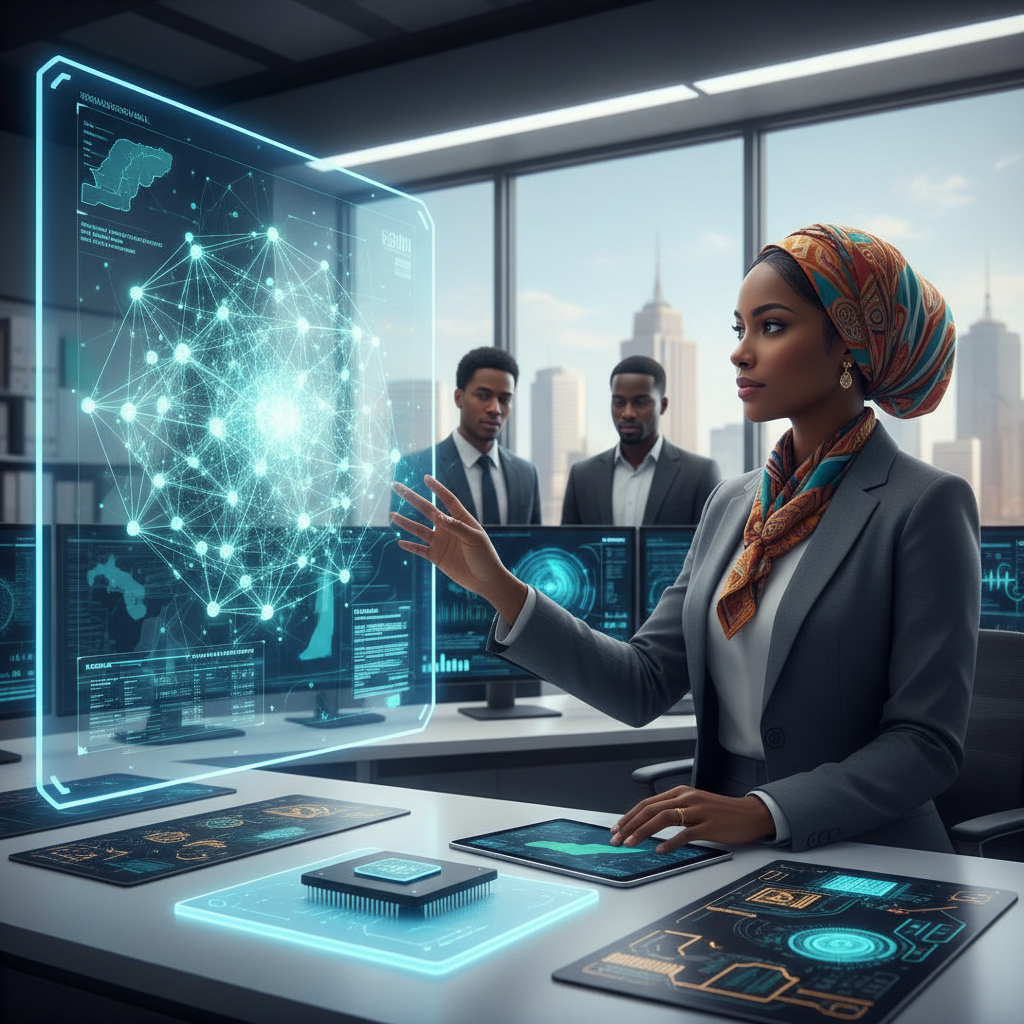

The sun was already high, painting the dusty roads of Malkerns in shades of ochre, when Nompumelelo Dlamini first saw the problem with her own eyes. Her cousin, a talented seamstress, spent hours hunched over her phone, scrolling through gig platforms, hoping for a decent tailoring job. Each notification brought a flicker of hope, often followed by the sting of a low-paying offer, dictated by an algorithm that seemed to care more about profit margins in faraway Silicon Valley than the dignity of a family in Eswatini. This wasn't just about finding work; it was about fair work, about respect, about the very fabric of community that holds us together here. It was a moment that solidified her resolve: the gig economy, as it stood, was broken, especially for those in places like ours. We in Eswatini, we say 'umuntfu ngumuntfu ngebantfu' a person is a person through other people, and Nompumelelo felt that AI should learn this lesson too. It should uplift, not exploit. This tiny kingdom has big ideas about technology, and Nompumelelo's was one of the biggest. She envisioned an AI that served the people, not just the platforms.
Nompumelelo, a brilliant software engineer who had spent years working for a major tech firm in Cape Town, had always felt the pull of home. Her background was steeped in the practicalities of rural life, yet her mind soared with the possibilities of code. After completing her master's degree in artificial intelligence at the University of Cape Town, she returned to Eswatini, initially consulting for local businesses. The 'aha moment' wasn't a sudden flash, but a slow burn of frustration watching her community struggle. She saw how global platforms like Uber and TaskRabbit, while offering access to work, also created a new kind of digital boss, an opaque algorithm that set prices, dictated terms, and often left workers feeling powerless and undervalued. "It was like being in a modern-day serfdom, but instead of a feudal lord, it was a line of code," Nompumelelo told me during a recent interview at her modest office in Mbabane, a space buzzing with youthful energy. "Our people are resilient, skilled, and deserve to be compensated fairly for their labor, not just what a distant algorithm decides is 'market rate' for a global pool of workers."
The Problem: Algorithmic Control and Exploitation
The gig economy promised flexibility and independence, but for many, especially in emerging markets, it delivered precarity and control. Studies show that over 70% of gig workers globally feel they have little to no control over their earnings and working conditions, with algorithms often penalizing them for declining low-wage tasks or taking breaks. In Eswatini, where informal labor is a significant part of the economy, these issues are amplified. A driver might spend hours waiting for a ride, only for the platform to take a hefty commission, leaving them with barely enough to cover fuel. A craftsperson might be undercut by prices set by an algorithm that doesn't understand the local cost of living or the cultural value of their work. This isn't just about economics; it chips away at human dignity and community ties. The algorithms of global tech giants like Google, Meta, and Amazon are designed for scale and efficiency, often overlooking the nuanced human element.
Umphakatsi Connect: An AI for the People
Nompumelelo's startup, 'Umphakatsi Connect' (Umphakatsi meaning 'royal village' or 'community' in Siswati, signifying a place of gathering and governance), directly addresses this imbalance. Launched in late 2025, Umphakatsi Connect is an AI-powered platform designed to connect local gig workers with local clients, but with a crucial difference: its algorithms are built from the ground up to prioritize worker well-being and fair compensation, not just platform profit. "We're not just a matching service; we're a community-driven ecosystem," Nompumelelo explained. "Our AI, which we call 'Sisekelo' meaning 'foundation' or 'support', learns from local economic conditions, traditional wage structures, and worker feedback to suggest fair pricing and optimal task allocation. It's about creating a foundation of support for our workers."
Sisekelo uses a hybrid AI model. It combines machine learning for predictive analytics, like demand forecasting and skill matching, with a rules-based system informed by local labor laws and community-agreed fair wage thresholds. For example, if a global platform's algorithm suggests a delivery fee of E20 (Eswatini Lilangeni) for a particular route, Sisekelo might analyze local fuel costs, average hourly wages, and even the time of day, then recommend E35, ensuring the driver makes a living wage. It also incorporates a unique 'community reputation' system, where workers and clients rate each other not just on task completion, but on reliability, communication, and fairness, fostering a sense of mutual respect that often gets lost in anonymous global platforms. "We also integrate with local payment systems, including mobile money, which is critical for financial inclusion here," added Khulekani Mkhonta, Umphakatsi Connect's Head of Operations, a former banking executive who joined Nompumelelo early on.
Market Opportunity: A Local Solution to a Global Problem
The market for gig work in Eswatini, though smaller than global giants, is significant and growing. With a population of around 1.2 million, and a youth unemployment rate hovering around 40%, platforms that provide accessible, fair work are desperately needed. Umphakatsi Connect isn't just targeting the traditional gig economy; it's also formalizing informal sectors. Think local artisans selling crafts, home repair services, small-scale farmers needing help with harvest, or even traditional healers offering consultations. Nompumelelo estimates the total addressable market for local gig services in Eswatini to be over E500 million annually, with potential for regional expansion into neighboring Southern African Development Community (sadc) countries. "Our initial focus is Eswatini, but the model is scalable," she said. "The issues of algorithmic control are universal, but the solutions need to be local and culturally sensitive."
Funding for Umphakatsi Connect has been a mix of local and international investment. They secured an initial seed round of E10 million (approximately $550,000 USD) from local angel investors and a grant from the Eswatini National Provident Fund's innovation arm. More recently, they closed a pre-Series A round of E30 million ($1.6 million USD) led by a South African venture capital firm, with participation from a European impact investor. "They saw the potential not just for profit, but for genuine social impact," noted Thandiwe Nxumalo, a board member and prominent local businesswoman. "This isn't just about technology; it's about building a more equitable economy for our youth."
Competitive Landscape: David vs. Goliath, with a Local Twist
Umphakatsi Connect faces competition from established global players like Uber, Bolt, and various freelance platforms. These giants have massive resources, brand recognition, and advanced AI systems like Google's Gemini or OpenAI's GPT models powering their operations. However, Nompumelelo believes their 'local-first' approach is their strength. "Their algorithms are trained on global data, optimized for global markets. They don't understand the nuances of Eswatini, the cultural context, the local cost of living, or our community values," she argued. "We're not trying to beat them at their own game; we're playing a different game entirely, one where the community is the ultimate winner."
Their competitive edge lies in their deep understanding of the local market, their culturally sensitive AI, and their commitment to fair practices. While a global platform might offer a driver E15 for a short trip, Umphakatsi Connect's Sisekelo AI might recommend E25, knowing that E15 barely covers fuel and a fair hourly wage in Eswatini. This difference, while seemingly small, is monumental for a worker trying to feed their family. They are also exploring partnerships with local cooperatives and traditional community structures, further embedding themselves into the social fabric, something a large, impersonal tech company struggles to do.
What's Next for Umphakatsi Connect?
Looking ahead, Nompumelelo and her team are focused on expanding their service categories, from skilled trades to agricultural support and even local tourism guides. They plan to launch a dedicated 'skills development' module within the platform, offering free online courses to help gig workers upskill and increase their earning potential, a move that would truly empower the workforce. "We're also exploring how our Sisekelo AI can help local businesses forecast demand and manage their own informal workforce more effectively, creating a win-win for everyone," Khulekani added.
Nompumelelo dreams of a future where Umphakatsi Connect becomes a model for other developing nations, a testament to the idea that technology, when built with intention and empathy, can be a force for good. She believes that by focusing on the human element, by understanding that a worker is not just a data point but a person with a family and dreams, AI can truly serve humanity. As I left her office, the afternoon sun casting long shadows, I couldn't help but feel a surge of pride. It's a powerful reminder that while the tech world often looks to Silicon Valley for innovation, sometimes the most profound changes, the ones that truly put people first, emerge from unexpected corners of the globe. You can learn more about the challenges and opportunities in the global gig economy on TechCrunch's AI section. The fight for fair labor practices in the digital age is a global one, and Eswatini is showing us a new path. For more on how AI is shaping the future of work, you might find articles on MIT Technology Review insightful. It reminds me of the discussions around how AI impacts local economies, much like the debate on smart city surveillance in our own country, as discussed in 'Eswatini's Wisdom for Silicon Valley: Why Google's Smart City Surveillance Needs a 'Ubuntu' Heart' [/article/eswatinis-wisdom-for-silicon-valley-why-googles-smart-city-surveillance-needs-a-ubuntu-heart-mojrdm2h]. This is more than just a startup; it's a movement. And it's one that could redefine what a truly human-centered AI looks like. For more global insights into AI and its societal impacts, check out Wired's AI coverage.