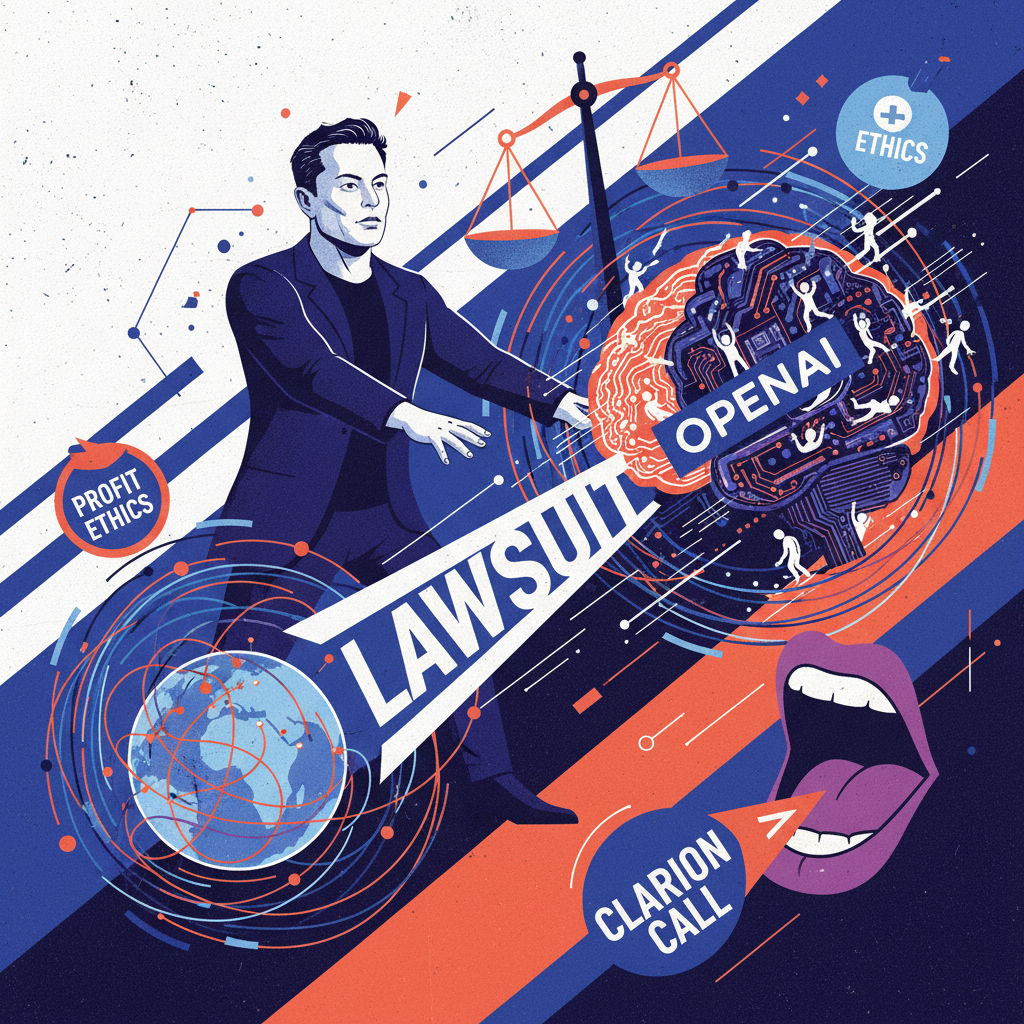

The hallowed halls of Silicon Valley, often portrayed as crucibles of innovation, are now echoing with the clang of legal battles, none more resonant than the ongoing dispute between Elon Musk and OpenAI. This is not merely a squabble between billionaires, nor a simple contract disagreement. No, this is a profound ideological clash, a struggle for the very soul of artificial intelligence, and one that carries significant implications for how Europe, and indeed the world, will govern this transformative technology. From my perspective here in Ireland, a nation that has become a de facto European headquarters for many of these tech giants, the nuances of this legal drama are particularly pertinent.
Musk's lawsuit, filed in a San Francisco court, alleges that OpenAI, once a non-profit entity co-founded by him, has abandoned its original mission to develop artificial general intelligence, or AGI, for the benefit of humanity. Instead, he claims, it has become a for-profit subsidiary of Microsoft, driven by commercial imperatives rather than altruistic goals. He contends that OpenAI's pursuit of AGI now serves corporate interests, specifically those of Microsoft, which has invested billions into the company. Behind the press release lies a very different story, one of shifting allegiances and the corrosive influence of capital on what was once envisioned as a public good.
Musk's original vision for OpenAI, as he articulated it, was to counter the potential dangers of corporate-controlled AGI, particularly from behemoths like Google. He foresaw a future where AGI, if developed by a single entity, could become an unchecked power. His lawsuit posits that OpenAI's current trajectory, with its close ties to Microsoft and its increasingly commercial focus, directly contravenes this founding principle. He argues that the original agreement implied a commitment to open science and non-profit development, a commitment he believes has been systematically eroded.
OpenAI, for its part, vehemently denies these claims. They assert that their mission remains unchanged and that their partnership with Microsoft is essential for securing the vast computational resources required to develop cutting-edge AI models, such as GPT-4 and its successors. They maintain that their for-profit arm, necessary for attracting investment and talent, is structured to ensure that their non-profit mission remains paramount. Sam Altman, OpenAI's CEO, has consistently emphasized the company's dedication to safe and beneficial AGI, often speaking about the need for careful alignment and control. "Our commitment to building safe and beneficial AGI for all of humanity is unwavering," Altman stated in a recent interview, a sentiment echoed by other OpenAI executives.
This legal entanglement forces us to confront a fundamental question: can the development of something as potentially powerful as AGI truly remain altruistic when billions of dollars are at stake? The Irish tech sector has a secret it doesn't want you to know, and that secret is how easily the lines between public good and private profit blur when immense capital is involved. The very nature of AI development, requiring colossal investments in hardware, research, and talent, makes it incredibly difficult for any entity to operate purely as a non-profit without significant external backing. When that backing comes from a publicly traded company with shareholder obligations, the tension becomes palpable.
Critics of Musk's lawsuit argue that his motivations are not entirely pure, suggesting a degree of sour grapes given his own ambitions in the AI space, notably with xAI. They point to his past departures from OpenAI and his subsequent establishment of a competing venture as evidence of his own commercial interests. Indeed, the very notion of a single individual, even one as influential as Musk, dictating the ethical framework for AGI development is problematic. As Dr. Kate Crawford, a distinguished research professor and author on AI, has frequently warned, "The power dynamics in AI development are deeply concerning, and we must scrutinize who holds the reins of this technology." Her words resonate deeply when observing this particular dispute.
However, to dismiss Musk's concerns entirely would be a grave error. His lawsuit, regardless of its ultimate legal outcome, serves as a vital reminder of the ethical quandaries embedded within the pursuit of AGI. The founding principles of OpenAI, centered on open research and humanity's benefit, were noble and necessary. The shift towards a more commercial model, while perhaps pragmatic for survival and rapid development, undeniably introduces new risks. The European Union, with its pioneering AI Act, is attempting to grapple with these very issues, seeking to impose guardrails on high-risk AI systems. This lawsuit underscores the urgency of such regulatory efforts.
Consider the implications for data privacy, a cornerstone of European regulation. If OpenAI's models become increasingly integrated into Microsoft's vast ecosystem, how will user data be handled? What assurances do European citizens have that their data, used to train these powerful models, will not be exploited for commercial gain beyond the stated purpose? These are not trivial questions. The GDPR, for all its strengths, faces an unprecedented challenge from the rapid evolution of AI. The opacity surrounding the training data and internal workings of large language models, often referred to as black boxes, makes effective oversight incredibly difficult.
I spent three months investigating this, and what I found was a complex web of financial incentives, technological ambition, and ethical compromises. The original spirit of OpenAI, as a counterweight to corporate AI, has undeniably evolved. Whether this evolution is a necessary adaptation or a betrayal of trust is the crux of the matter. The legal system, with its slow and deliberate pace, may eventually render a verdict on the contractual specifics, but the broader ethical and societal questions will remain long after the gavel falls.
Ultimately, this dispute transcends the personal animosity or corporate rivalry between Musk and OpenAI. It is a stark illustration of the challenges inherent in developing a technology with such profound societal implications. The stakes are too high to allow the future of AGI to be solely determined by the whims of billionaires or the pressures of quarterly earnings reports. Europe, with its emphasis on human-centric AI and robust regulatory frameworks, has a critical role to play in shaping this future. We must demand transparency, accountability, and a genuine commitment to the public good from all developers of advanced AI.
The outcome of this legal battle, while important, is merely a symptom of a larger systemic issue. The true battle is for the ethical foundation of AI, and it is one that requires constant vigilance, robust regulation, and a collective commitment to ensuring that AGI truly serves humanity, not just corporate balance sheets. For more on the ongoing legal and ethical debates surrounding AI, you can follow reporting from outlets like Reuters Technology or MIT Technology Review. The path OpenAI chooses, and the legal precedents set by this case, will reverberate across the global AI landscape for decades to come, profoundly influencing how we, in Europe, approach the integration and governance of these powerful systems. For a deeper dive into the regulatory landscape, consider the implications of the EU's approach to high-risk AI, a topic often covered in detail by The Verge.