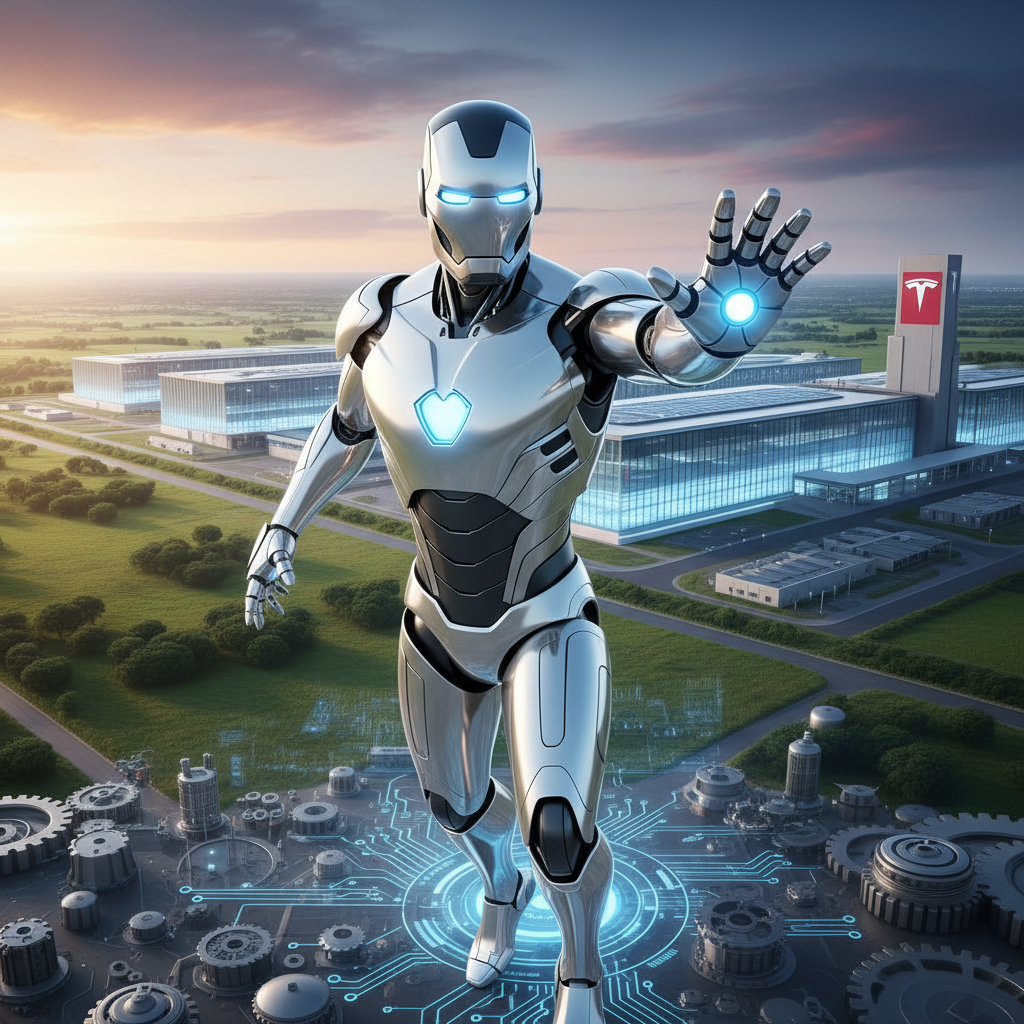
The spectacle of a bipedal robot attempting rudimentary tasks, occasionally stumbling, has become a familiar sight on technology news feeds. Tesla's Optimus, Elon Musk's ambitious foray into humanoid robotics, often elicits a mixture of awe and skepticism. Critics point to its current limitations, its seemingly slow progress compared to Boston Dynamics' acrobatic creations, or its perceived irrelevance in a world already brimming with specialized industrial robots. Yet, to dismiss Optimus as mere futuristic showmanship is to overlook a profound, tectonic shift occurring beneath the surface of global manufacturing. This is not just about a new product; it is about a new paradigm, one that Poland, with its robust industrial base and skilled workforce, cannot afford to ignore.
Why Most People Are Ignoring It: The Attention Gap
The public imagination, much like a child distracted by a shiny new toy, tends to fixate on the most sensational aspects of technological advancement. For humanoid robots, this often means viral videos of robots dancing or performing parkour. Tesla's Optimus, in its current iteration, lacks this immediate, captivating flair. It is designed for utility, for the repetitive, often mundane, tasks that underpin modern production lines. Its development is a marathon, not a sprint, and the incremental progress, while significant to engineers, rarely captures the fleeting attention of the general populace or even many business leaders. They see a human-shaped machine and think of science fiction, not the pragmatic, cost-saving, and efficiency-boosting implications for their factories. This attention gap creates a dangerous blind spot, especially for nations like Poland, which thrive on manufacturing exports and industrial innovation.
How It Affects YOU: The Looming Transformation of Work
Consider the average Polish manufacturing worker, perhaps assembling components for automotive giants or white goods. Their skills are honed over years, their movements precise and efficient. Now, imagine a robot, like Optimus, capable of learning these very tasks, not just in a controlled, caged environment, but in a dynamic, human-centric factory floor. The algorithm works like this: Optimus is designed to operate in environments built for humans, using tools designed for human hands. This means factories will not need radical retooling to accommodate robots, a significant barrier to automation in the past. This portability of automation, the ability to deploy general-purpose robots into existing infrastructure, is the game changer.
From a systems perspective, this implies a future where human labor is augmented, or in some cases, replaced, by robotic counterparts. This is not a distant dystopian fantasy; it is a near-term economic reality. For the individual, this means a re-evaluation of skills. The demand for purely manual, repetitive labor will likely diminish, while the need for robot programmers, maintenance technicians, and human-robot collaboration specialists will surge. This transformation will be felt acutely in regions like Silesia or Greater Poland, industrial heartlands where manufacturing forms the backbone of local economies. The stakes are personal: job security, career trajectories, and the very fabric of community life will be impacted.
The Bigger Picture: Societal, Economic, and Political Implications
The economic implications are staggering. A fully autonomous, humanoid workforce could drive down labor costs, increase production speed, and enhance quality control to unprecedented levels. For companies, this translates to higher profits and greater competitiveness. For nations, it means a potential shift in global manufacturing dominance. Countries that embrace and integrate these technologies effectively could gain a significant economic edge. Poland, strategically located in Central Europe, with its strong engineering tradition and proximity to major markets, is uniquely positioned to either lead or lag in this transition.
However, the societal implications are equally profound. What happens when a significant portion of the workforce is displaced? How do we ensure a just transition, providing new opportunities and retraining for those affected? These are not merely economic questions; they are deeply political and ethical ones. The social contract, the relationship between labor, capital, and the state, will be tested. Governments will need to consider universal basic income, extensive retraining programs, and new forms of social safety nets. The political stability of nations could hinge on their ability to manage this transition equitably.
What Experts Are Saying: A Chorus of Caution and Optimism
Experts across the globe are weighing in on the impending robotic revolution. Dr. Agnieszka Wykowska, a leading cognitive scientist at the Italian Institute of Technology, whose work often explores human-robot interaction, has frequently emphasized the need for careful integration. She stated in a recent interview,