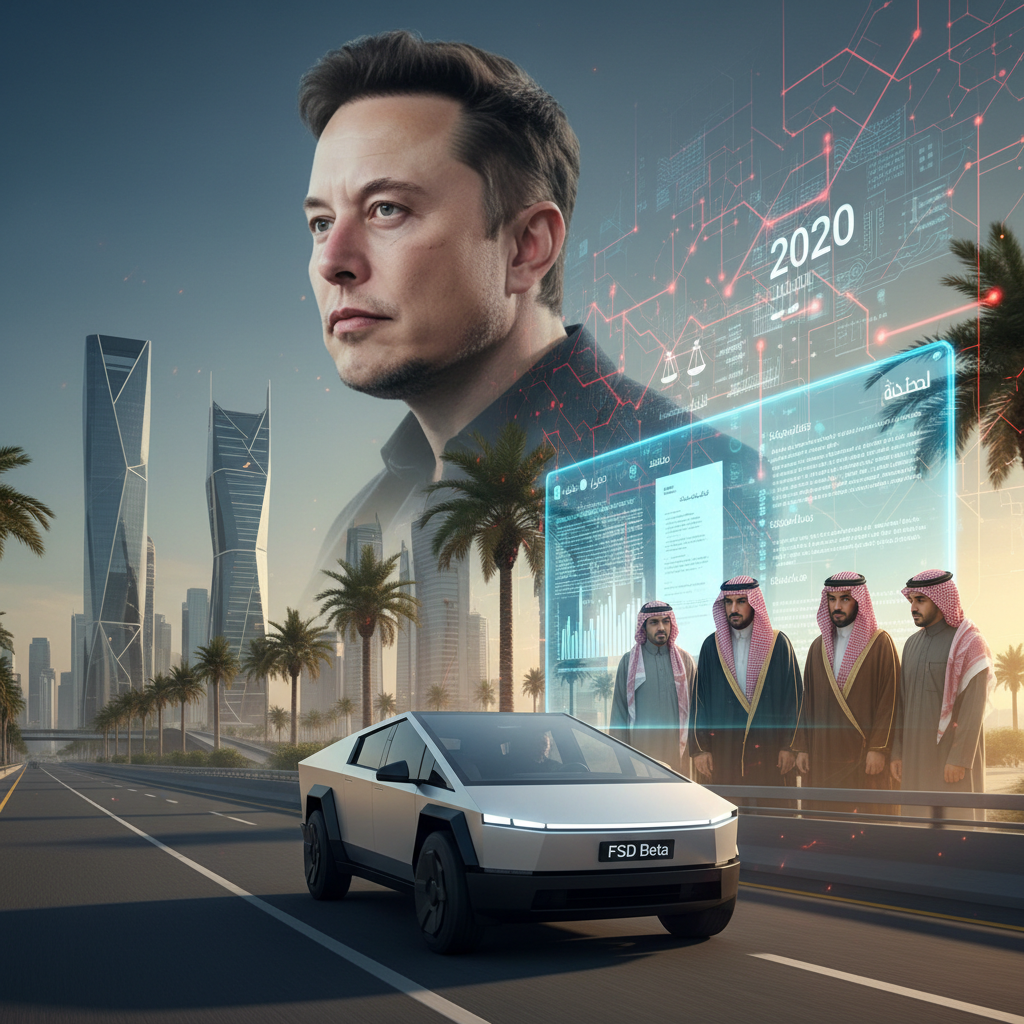
The promise of fully autonomous vehicles, once a distant science fiction trope, now drives headlines and investment decisions across the globe. Yet, as companies like Tesla push the boundaries of what their 'Full Self-Driving' (FSD) systems can achieve, the stark reality of regulatory oversight and public safety concerns casts a long shadow. In Saudi Arabia, where the pace of technological adoption is often breathtaking, this global debate takes on a particularly nuanced character, blending cutting-edge innovation with a pragmatic approach to implementation.
Elon Musk's pronouncements regarding Tesla's FSD capabilities have consistently outpaced the technology's widespread, unimpeded deployment. While the system has evolved significantly, moving from a supervised driver-assist feature to one that claims increasing autonomy, its journey has been punctuated by both fervent advocacy and serious questions regarding its safety record. Data from the National Highway Traffic Safety Administration (nhtsa) in the United States, for instance, has repeatedly highlighted incidents involving advanced driver-assistance systems, including Tesla's, necessitating human intervention or resulting in collisions. Such statistics are not lost on regulators in Riyadh, a city rapidly transforming into a hub for smart infrastructure.
"The Kingdom's Vision 2030 demands results, not promises," stated Dr. Fahad Al-Qahtani, Director of the Saudi Transport General Authority's Autonomous Systems Division, in a recent interview. "Our objective is clear: to integrate advanced technologies that enhance safety, efficiency, and quality of life. This includes autonomous vehicles. However, this integration must be meticulously planned, rigorously tested, and underpinned by a robust regulatory framework that prioritizes the safety of our citizens above all else. We cannot simply import technology without understanding its full implications for our unique environment and legal structures." Dr. Al-Qahtani's words underscore a fundamental divergence: Silicon Valley's 'move fast and break things' ethos often clashes with the Kingdom's measured, data-driven approach to large-scale technological deployment.
Saudi Arabia, with its ambitious projects like Neom and its burgeoning smart cities, presents an ideal testbed for autonomous mobility. The controlled environments of new urban developments could theoretically accelerate the adoption of FSD technologies. Indeed, the concept of driverless taxis and logistics vehicles seamlessly navigating futuristic cityscapes aligns perfectly with the Kingdom's futuristic aspirations. However, the path to realizing this vision is fraught with technical, legal, and ethical complexities.
One significant hurdle is the legal liability framework. In the event of an accident involving a fully autonomous vehicle, who bears responsibility? Is it the vehicle owner, the manufacturer, the software developer, or the operator? Existing traffic laws globally, including in Saudi Arabia, are largely predicated on the assumption of a human driver. Adapting these legal structures to accommodate AI-driven vehicles requires extensive legislative work and careful consideration of precedent. "The legal implications are profound," explained Ms. Layla Al-Mansoori, a legal expert specializing in technology law at King Saud University. "We are not just talking about modifying a few clauses; we are discussing a paradigm shift in how we define responsibility and negligence on our roads. This demands a comprehensive national dialogue and collaboration between legal scholars, engineers, and policymakers."
Another critical aspect is data privacy and cybersecurity. Autonomous vehicles are essentially data centers on wheels, collecting vast amounts of information about their surroundings, occupants, and operational performance. Ensuring the secure handling and ethical use of this data is paramount, particularly in a region highly sensitive to data sovereignty. "The desert is blooming with data centers, and with them comes an increased responsibility," remarked Mr. Omar Bakr, CEO of Riyadh-based cybersecurity firm, SecureByte Solutions. "Autonomous vehicles represent a new frontier for data collection, and the potential for misuse or breaches is significant. Any company seeking to deploy such technology here must demonstrate an ironclad commitment to data protection standards that meet, or exceed, our national requirements. This is non-negotiable."
The practical challenges of operating FSD in Saudi Arabia also warrant attention. While Tesla's FSD has been developed primarily for North American road conditions, the Kingdom's diverse topography, ranging from sprawling urban centers to vast desert landscapes, presents unique operational considerations. Extreme temperatures, dust storms, and varied road markings could all impact sensor performance and algorithmic decision-making. Furthermore, the cultural nuances of driving behavior, while perhaps less critical for a truly autonomous system, still form part of the broader societal acceptance equation.
Despite these challenges, the allure of autonomous vehicles remains strong. The potential benefits are substantial: reduced traffic congestion, improved road safety through the elimination of human error, enhanced mobility for individuals unable to drive, and significant economic efficiencies in logistics and transportation. "Oil money meets machine learning in a very tangible way here," observed Dr. Karim Hassan, a senior analyst at the King Abdullah Petroleum Studies and Research Center (kapsarc). "The investment in AI infrastructure, from high-performance computing to advanced sensor networks, is immense. This is not merely about buying Teslas; it is about building an entire ecosystem for smart mobility that can serve as a model for the region and beyond. The regulatory clarity and safety assurances will be the cornerstones of this success."
Recent reports indicate that Saudi Arabia is actively engaging with leading automotive and technology firms to establish pilot programs for autonomous vehicles in designated zones. These controlled trials aim to gather critical data on performance, safety, and public acceptance, informing the development of future regulations. This methodical approach, prioritizing real-world data over speculative deployment, reflects the Kingdom's characteristic pragmatism.
As Tesla continues to refine its FSD technology and push for broader adoption, its success in markets like Saudi Arabia will depend not just on technological prowess, but on its ability to navigate a complex web of regulatory requirements, legal considerations, and cultural expectations. The road to full autonomy is long, and in the Kingdom, it will be paved with careful planning and rigorous evaluation, ensuring that innovation serves the greater good and adheres to the highest standards of safety and responsibility. The world watches to see if Elon Musk's vision can truly align with Riyadh's measured reality. For further insights into global AI developments, consider reading reports from Reuters Technology or MIT Technology Review. The journey towards truly autonomous urban environments is not a sprint, but a meticulously planned expedition, especially in a nation building its future on data and foresight.