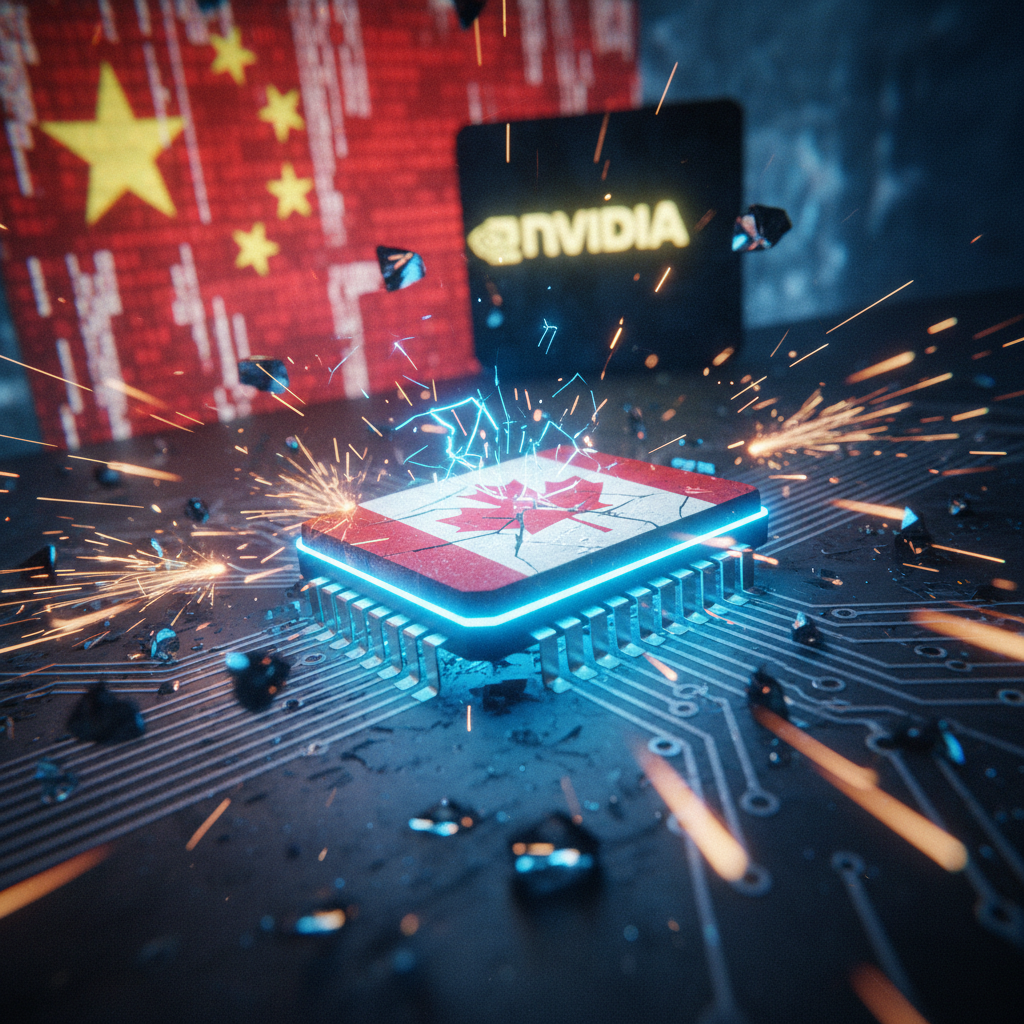

The calm Canadian morning was shattered today by a seismic policy shift from Ottawa, one that reverberated instantly across global tech markets and left many in the AI industry scrambling. The federal government, under Prime Minister Justin Trudeau, announced a new directive significantly restricting foreign, particularly Chinese, state-owned enterprise investment in Canada's critical minerals sector. This isn't just a dry policy update, mes amis, this is a strategic play in the high-stakes chess game of global technology supply chains, and it has profound implications for everything from electric vehicles to the very AI chips powering our future.
At its core, this directive is about control. Canada possesses vast reserves of critical minerals like lithium, nickel, cobalt, and rare earth elements. These are the unsung heroes of the digital age, the foundational ingredients for everything from smartphone batteries to the advanced semiconductors that NVIDIA and others rely on for their powerful AI accelerators. For years, China has been a dominant force in the processing and supply of many of these materials. Now, Canada is drawing a line in the sand, prioritizing national security and economic sovereignty over unfettered foreign capital.
Let me break down what Ottawa just published. The new framework, which builds on existing national security review provisions under the Investment Canada Act, explicitly targets non-likeminded state-owned enterprises. While not naming China directly, the intent is clear. Any proposed investment, acquisition, or even a minority stake by such entities in Canadian critical mineral companies will face intense scrutiny, with a strong presumption against approval. This isn't just a tweak; it's a fundamental reorientation of Canada's approach to its natural resources in an era of escalating geopolitical tensions and technological competition.
The immediate impact was palpable. Shares of several Canadian junior mining companies with existing or potential Chinese partnerships saw fluctuations. More importantly, the news sent a shiver through the global tech supply chain, particularly for companies like NVIDIA, which are at the forefront of the AI boom. NVIDIA, a titan in the AI chip space, depends heavily on a stable, diverse, and secure supply of raw materials and components. Any disruption, any uncertainty in the foundational layers of that supply chain, can have cascading effects.
Official reactions were swift. François-Philippe Champagne, Canada's Minister of Innovation, Science and Industry, was unequivocal in a press conference this morning. “Canada is a trusted supplier of critical minerals to our allies, and we will continue to strengthen those supply chains,” he stated firmly. “This new policy ensures that our critical mineral resources are developed in a way that benefits Canadians and reinforces our national security interests, not those of geopolitical rivals.” His words echoed a sentiment that has been growing in Ottawa for some time: Canada will not be a passive player in the global scramble for strategic resources.
Across the border, in Washington, the announcement was met with quiet approval. The United States has been actively pushing for its allies to de-risk their supply chains from China, particularly in areas deemed critical for national security. This Canadian move aligns perfectly with the broader North American strategy to build more resilient and regionally integrated supply networks. It’s like two neighbours deciding to build a stronger fence together, not just for their own yards, but for the whole community.
However, not everyone is cheering. Some industry analysts expressed concern about the potential for reduced investment in a sector that requires massive capital. “While the intent is understandable, the practicalities of developing these mines are immense,” noted Dr. Sarah Jenkins, a senior fellow at the Centre for International Governance Innovation in Waterloo, Ontario. “Canada needs billions in investment to bring these projects online, and limiting the pool of potential investors, even for strategic reasons, introduces new challenges. We need to ensure we don't inadvertently stifle the very growth we're trying to secure.”
The expert analysis points to a complex balancing act. On one hand, securing a domestic supply of critical minerals is paramount for Canada's long-term economic and technological sovereignty. On the other, the global nature of mineral extraction, processing, and manufacturing means that complete decoupling is a fantasy. The reality is that China currently dominates many aspects of the critical mineral supply chain, from refining capacity to magnet production. For example, China controls an estimated 80% of global rare earth processing capacity, a figure that highlights the sheer scale of the challenge for Western nations.
For companies like NVIDIA, this means an accelerated push towards diversification. Jensen Huang, NVIDIA's CEO, has spoken extensively about the need for resilient supply chains, particularly in the context of geopolitical uncertainties. While NVIDIA doesn't mine minerals directly, the stability and predictability of the entire ecosystem, from the ground to the fab, is crucial for their ability to deliver cutting-edge GPUs. This Canadian policy, alongside similar moves by the US and Europe, will likely spur further investment in alternative sources and processing capabilities in allied nations. It’s a bit like a chef needing a specific spice for a signature dish. If their usual supplier becomes unreliable, they’ll invest in finding new farms or even growing it themselves, no matter the effort.
What happens next? We're likely to see a flurry of diplomatic activity as Canada seeks to solidify partnerships with like-minded countries, particularly the US, UK, and EU, to co-invest in critical mineral projects. Expect to see more announcements about joint ventures, technology sharing agreements, and perhaps even direct government funding to de-risk these capital-intensive projects. The goal is to create a parallel, secure supply chain that can reduce reliance on adversarial nations. This could also mean a boost for Canadian innovation in mineral processing and refining, areas where we have significant potential.
For Montreal's AI scene, which is world-class, here's the proof: this policy creates both challenges and opportunities. On the challenge side, any instability in the global chip supply could impact research and development, potentially delaying access to the latest hardware. On the opportunity side, a more secure and domestically controlled supply chain could foster new industries and research areas within Canada, from advanced materials science to AI-driven exploration and processing technologies. Imagine AI models optimizing mineral extraction, reducing waste, and improving efficiency right here at home. The research is fascinating, and I wouldn't be surprised if Mila, our renowned AI institute, starts looking more closely at these applications.
Why should you care? Because the chips that power ChatGPT, the GPUs that train the next generation of medical AI, and the batteries that drive your electric car all depend on these critical minerals. Where they come from, who controls their supply, and how securely they reach the market, are no longer just economic questions. They are national security imperatives, and Canada just made a bold move to assert its place in this new geopolitical reality. The global tech supply chain is being reshaped before our very eyes, and Canada is ensuring it has a firm grip on the foundational elements of its future. For more on how these shifts impact the broader tech landscape, keep an eye on Reuters Technology and TechCrunch's AI section. We are living through a pivotal moment, and the implications will be felt for decades to come, from the mines of Northern Ontario to the data centers of Silicon Valley.