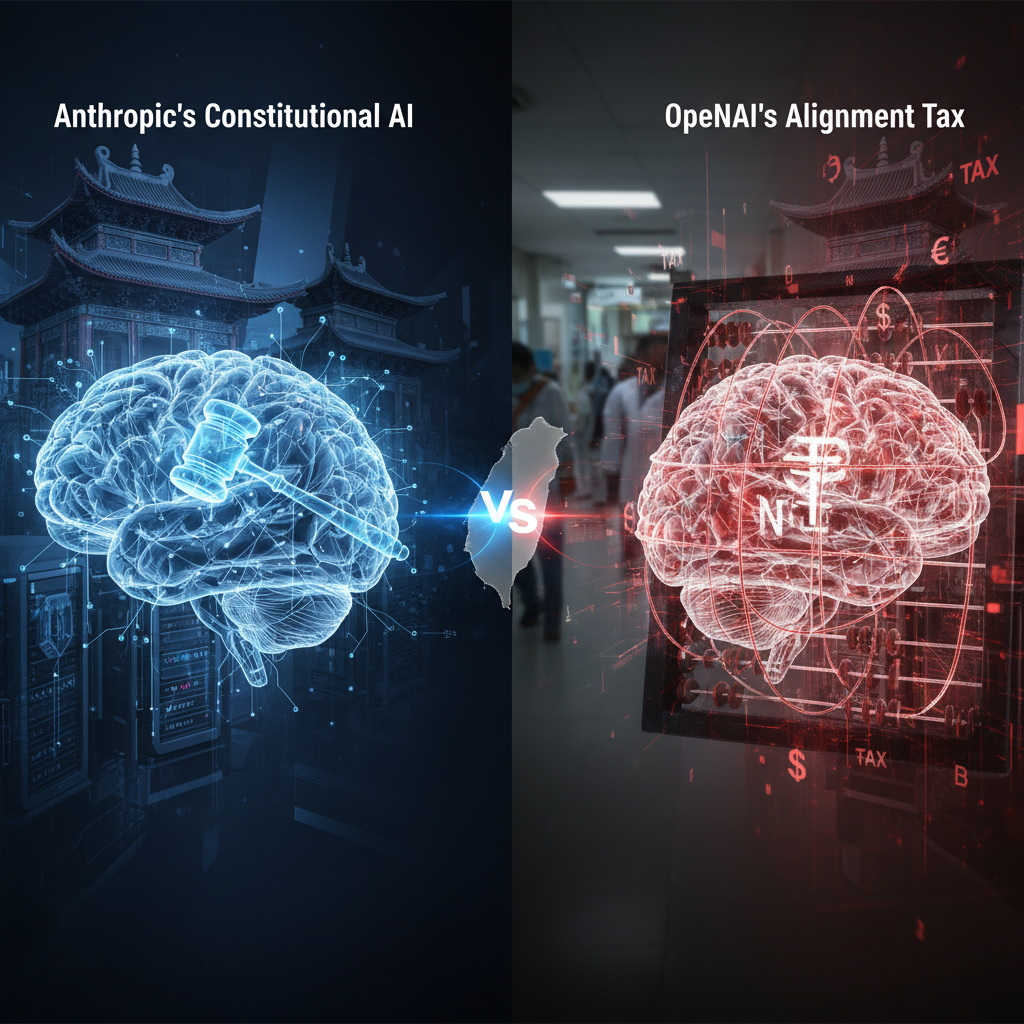

The global discourse surrounding artificial intelligence often fixates on capabilities, on the sheer power of models to generate text, images, or code. Yet, beneath the impressive demonstrations lies a more fundamental debate: how do we ensure these increasingly autonomous systems operate in humanity's best interest? This question, far from being purely philosophical, has profound technical implications, particularly for a region like Taiwan, which is rapidly integrating AI into its sensitive healthcare infrastructure.
Two prominent players, Anthropic and OpenAI, exemplify contrasting philosophies in this crucial domain. OpenAI, with its widely recognized GPT series, has largely pursued alignment through sophisticated reinforcement learning from human feedback, or Rlhf. Anthropic, on the other hand, champions what it terms 'Constitutional AI,' a method designed to imbue models with a set of guiding principles from the outset. For Taiwan's hospitals and research institutions, the choice between these paradigms is not merely academic; it directly impacts the reliability, safety, and ethical footprint of their AI deployments.
The Technical Challenge: Ensuring Trustworthy AI in Healthcare
Imagine an AI system tasked with assisting physicians in diagnosing rare diseases or recommending personalized treatment plans. The stakes are extraordinarily high. A hallucination, a biased output, or an ethically questionable recommendation could have dire consequences. The core technical challenge is to build AI that is not only highly performant but also consistently aligned with human values, transparent in its reasoning, and robust against misuse. This is particularly salient in healthcare, where data privacy regulations, such as Taiwan's Personal Data Protection Act, are stringent, and patient trust is paramount. The question is not just 'can it do it,' but 'can we trust it to do it correctly and ethically every time?'
Architecture Overview: Divergent Paths to Alignment
Both Anthropic and OpenAI leverage transformer architectures as their foundational large language models, or LLMs. The divergence occurs primarily in the alignment layer, the mechanism by which these powerful models are steered towards desirable behavior. OpenAI's approach typically involves a multi-stage process. First, a base LLM is pre-trained on vast datasets. Then, a supervised fine-tuning stage refines its output based on human-curated examples of preferred responses. Finally, and most critically, Rlhf is employed. Here, human annotators rank multiple AI-generated responses, and this feedback is used to train a reward model. The LLM is then optimized against this reward model using reinforcement learning, effectively learning to produce outputs that humans deem 'good.'
Anthropic's Constitutional AI, as described in their research, seeks to bypass some of the challenges associated with extensive human feedback. Their method involves training an AI model, often called a 'helpful, harmless, and honest' or HHH model, to evaluate and critique its own responses based on a set of explicit, human-articulated principles or a 'constitution.' This constitution is a collection of rules, often expressed in natural language, that define desirable and undesirable behaviors. The process involves generating a response, having another AI model (the 'critic') evaluate it against the constitution, and then using this critique to refine the original response through self-correction or further fine-tuning. This iterative self-improvement loop aims to instill ethical guidelines directly into the model's behavior without requiring as much direct human labeling for every single output. It is a fascinating proposition, akin to teaching a student to self-reflect and adhere to a moral code, rather than simply rewarding them for correct answers.
Key Algorithms and Approaches: A Closer Look
For OpenAI, the Rlhf process can be conceptualized as follows:
- Supervised Fine-Tuning (SFT): Train a base LLM on a dataset of high-quality human demonstrations to learn desired conversational behavior.
 # Conceptual SFT step
 model = TransformerModel()
 optimizer = Adam(model.parameters(), lr=1e-5)
 for epoch in range(num_epochs):
 for prompt, human_response in sft_dataset:
 loss = model(prompt, labels=human_response).loss
 loss.backward()
 optimizer.step()
 # Conceptual SFT step
 model = TransformerModel()
 optimizer = Adam(model.parameters(), lr=1e-5)
 for epoch in range(num_epochs):
 for prompt, human_response in sft_dataset:
 loss = model(prompt, labels=human_response).loss
 loss.backward()
 optimizer.step()
- Reward Model Training: Collect a dataset of AI-generated responses ranked by human annotators. Train a separate reward model to predict human preferences.
 # Conceptual Reward Model training
 reward_model = NeuralNetwork()
 for prompt, (response_A, response_B), preference in preference_dataset:
 score_A = reward_model(prompt, response_A)
 score_B = reward_model(prompt, response_B)
 loss = max(0, score_B - score_A + margin) if preference == A_preferred else max(0, score_A - score_B + margin)
 # Backpropagate and update reward_model
 # Conceptual Reward Model training
 reward_model = NeuralNetwork()
 for prompt, (response_A, response_B), preference in preference_dataset:
 score_A = reward_model(prompt, response_A)
 score_B = reward_model(prompt, response_B)
 loss = max(0, score_B - score_A + margin) if preference == A_preferred else max(0, score_A - score_B + margin)
 # Backpropagate and update reward_model
- Reinforcement Learning: Fine-tune the SFT model using Proximal Policy Optimization (PPO) or similar algorithms, with the reward model providing feedback.
 # Conceptual PPO step for LLM fine-tuning
 # Policy network (LLM) generates responses
 # Value network estimates state values
 # Reward model provides rewards for generated responses
 # Update policy and value networks based on PPO objective
 # Conceptual PPO step for LLM fine-tuning
 # Policy network (LLM) generates responses
 # Value network estimates state values
 # Reward model provides rewards for generated responses
 # Update policy and value networks based on PPO objective
Anthropic's Constitutional AI, in contrast, might involve:
- Initial Prompting and Generation: The model generates a response to a user query.
- AI Self-Correction (Critique & Revision): The model is prompted with its own response and a set of constitutional principles. It then generates a critique of its response based on these principles and subsequently revises the response.
 # Conceptual Constitutional AI iteration
 response = model.generate(user_query)
 critique_prompt = f
 # Conceptual Constitutional AI iteration
 response = model.generate(user_query)
 critique_prompt = f