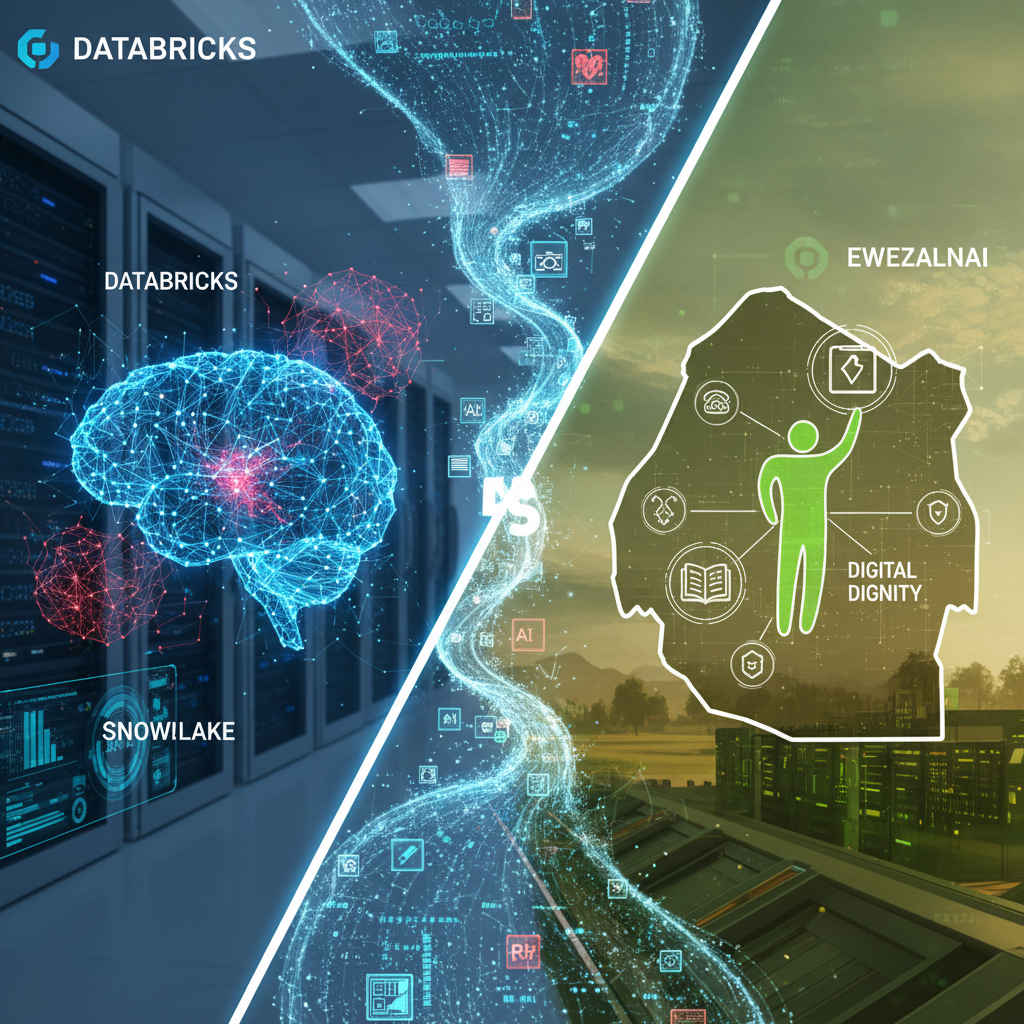

Ah, the buzz around Databricks and Snowflake. It’s like watching two grand old bulls from different kraals, both magnificent, both powerful, circling each other in a pasture that stretches across the entire globe. They are battling, as the tech whispers go, for the very soul of enterprise data and artificial intelligence. Here in Eswatini, a tiny kingdom with big ideas about technology, we watch these skirmishes not just with curiosity, but with a keen eye on what it means for us, for our communities, and for our own digital journey.
Now, for those who might not spend their days immersed in the intricacies of data platforms, let me paint a picture. Imagine your grandmother’s recipe book, filled with generations of wisdom, ingredients, and methods. Databricks, with its roots in Apache Spark, is like a master chef who not only organizes all those recipes but also teaches you how to invent new ones, experiment with flavors, and even run a whole restaurant based on that culinary knowledge. It’s built for heavy lifting, for machine learning, for turning raw ingredients into gourmet meals. Snowflake, on the other hand, is like the most meticulously organized pantry and dining hall you’ve ever seen. It’s designed for seamless storage, easy access, and serving up meals quickly and efficiently to many diners, making sure everyone gets exactly what they need, often without them even realizing the complexity behind it. Both are essential, but they approach the 'food' of data differently.
The recent breakthroughs in their respective ecosystems are not just about faster queries or more scalable data lakes; they are about democratizing access to complex AI capabilities. Databricks, for instance, has been pushing its Lakehouse Platform, a hybrid architecture that aims to combine the best of data lakes and data warehouses. This means businesses can store vast amounts of raw data, like a data lake, but also structure and query it with the ease of a data warehouse. Their acquisition of MosaicML last year, reportedly for over $1 billion, was a huge statement. It signaled a serious commitment to making custom large language models (LLMs) more accessible and affordable for enterprises. Imagine, if you will, a company being able to train its own LLM on its proprietary data without needing an army of AI researchers or a supercomputer. That’s the promise.
On the other side, Snowflake, traditionally known for its cloud data warehousing prowess, has been rapidly expanding its AI capabilities. Their Snowpark platform allows data scientists to build and deploy machine learning models directly within Snowflake, leveraging its scalable infrastructure. They’ve also integrated with various AI tools and launched features like Cortex, which offers pre-built AI functions and LLM-powered experiences. This means even companies without deep AI expertise can start to infuse intelligence into their operations, using familiar SQL commands. It’s like giving everyone a smart assistant who understands their language and can fetch complex information or even predict trends with a simple request.
Why does this matter beyond the boardrooms of global corporations? Because the innovations these companies are driving, particularly in making AI more accessible, have profound implications for places like Eswatini. Here, we might not have the same scale of enterprise data as a Fortune 500 company, but our need for intelligent solutions in healthcare, agriculture, and education is just as pressing. If these platforms can truly lower the barrier to entry for building and deploying AI, then perhaps our local innovators, our young people at the University of Eswatini, can leverage them to solve uniquely Eswatini problems.
Consider the research. A paper published by researchers from Databricks and Stanford University, for example, on 'Large Language Models as a Foundation for the Data Lakehouse' explores how LLMs can enhance data discovery and governance within these complex data environments. This isn't just theoretical; it means an AI could help a local health clinic in Eswatini better understand its patient data, identify patterns in disease outbreaks, or even predict resource needs, all without needing a team of data scientists. The potential for efficiency and improved public services is immense.
Similarly, Snowflake’s partnerships and integrations with AI powerhouses like NVIDIA, enabling faster model training and inference, are not lost on us. While we may not be building the next global LLM, the underlying technology that makes AI more efficient and scalable could be adapted for local applications. Think about optimizing crop yields in our fields or personalizing learning experiences for students in rural schools. These are not small dreams; they are fundamental to our progress.
Dr. Felecia Jones, a data ethics researcher at the African Institute for Mathematical Sciences, recently noted, “The democratisation of AI tools, whether from Databricks or Snowflake, presents a double-edged sword for emerging economies. It offers unprecedented opportunities for innovation but also demands robust frameworks for data governance and ethical AI development.” Her words resonate deeply here. In Eswatini, we say 'umuntfu ngumuntfu ngabantfu' which means 'a person is a person through other people'. AI should learn this lesson. It must be built with our community values in mind, not just for profit.
“The real challenge for countries like Eswatini,” explains Professor Sabelo Dlamini, head of the computer science department at the University of Eswatini, “is not just accessing these powerful tools, but ensuring we have the local talent and infrastructure to wield them responsibly and effectively. We need to move beyond being mere consumers of technology to becoming active participants and innovators.” He emphasizes the need for local capacity building, a sentiment I hear often in our tech hubs and educational institutions.
What comes next in this global data battle? I believe we will see an intensified focus on vertical solutions. Both Databricks and Snowflake will likely tailor their offerings more specifically to industries like healthcare, finance, and manufacturing, providing pre-built models and templates. This could be a boon for smaller markets, as it reduces the need for bespoke development. We might also see more emphasis on data sovereignty features, allowing countries to keep their data within their borders while still leveraging cloud-based AI. This is a critical point for Eswatini, where control over our national data is paramount.
The competition between these two giants is not just a spectacle for the tech world; it’s a bellwether for how AI will be built, deployed, and consumed globally. For us in Eswatini, it’s a reminder that while the battle rages in Silicon Valley boardrooms, the impact ripples all the way to our valleys and mountains. Our task is to understand these waves, to adapt, and to ensure that the tide of AI lifts all boats, especially those in our own small but mighty kingdom. We must ensure that these powerful tools serve our people, enhance our culture, and contribute to a future where technology truly empowers everyone. It’s a big ask, but sometimes the smallest countries have the biggest vision. For more on how AI is shaping global business, you can often find insightful analyses on Reuters Technology. The academic discussions around these technologies are also rich, often appearing on platforms like arXiv where new research is shared. And for a broader perspective on the societal implications, MIT Technology Review often provides excellent deep dives.