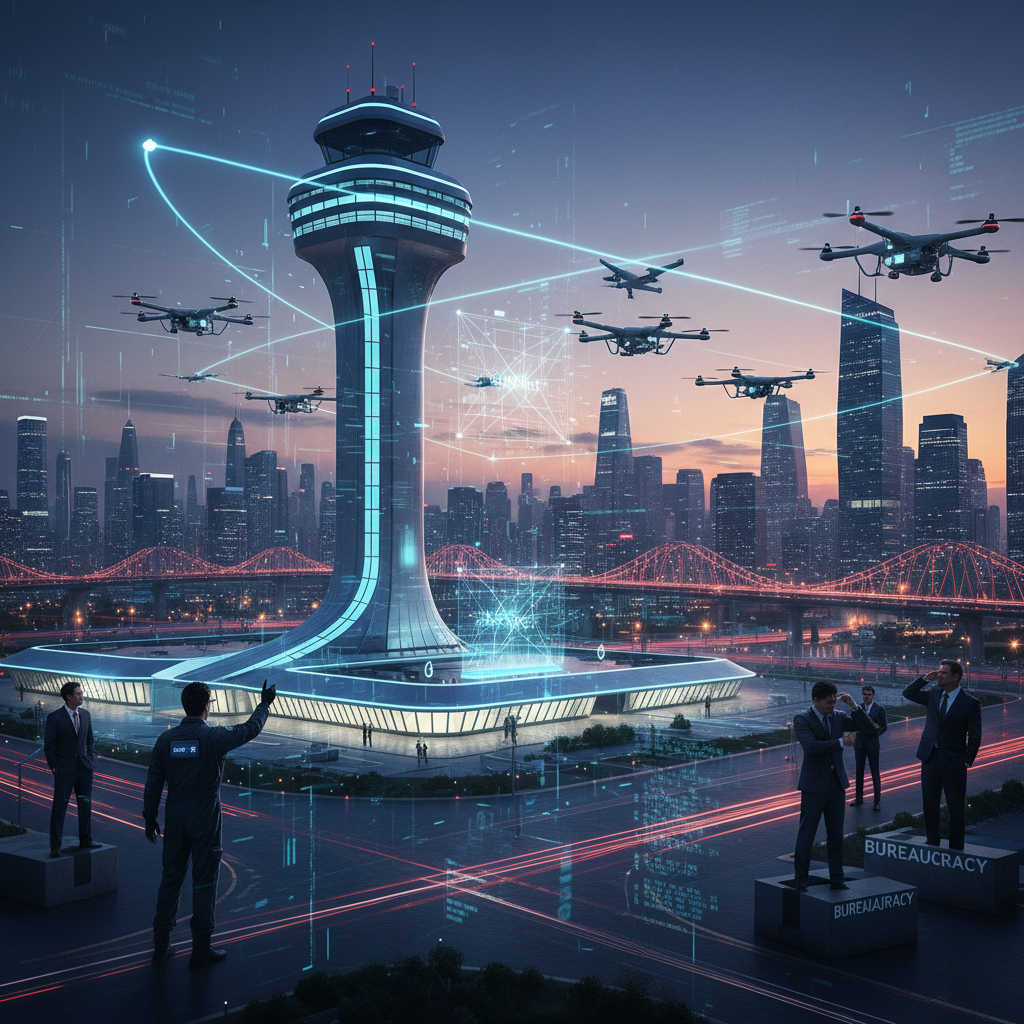

The skies above China are becoming a laboratory for artificial intelligence, a vast, complex canvas where algorithms are being trained to manage the very fabric of flight. It is not merely about incremental improvements; it is about a fundamental reimagining of how aircraft move, how they are maintained, and how the invisible ballet of air traffic is choreographed. As a journalist who has spent years peeling back the layers of China's tech ambitions, I can tell you that the story here is far more intricate than the glossy press releases suggest. The real story is in the supply chain, in the data, and in the strategic calculus of Beijing.
For years, Western aviation has relied on established, often decades-old, air traffic management systems. These systems, while robust, are inherently reactive and human-intensive. In contrast, China, unburdened by the same legacy infrastructure and driven by a national mandate for technological leadership, is leapfrogging directly to AI-powered solutions. Companies like Baidu, known globally for its search engine and autonomous driving initiatives, are now quietly becoming key players in aviation. Their 'SkyNet' project, a comprehensive AI suite for air traffic management, is already being piloted in several regional airports, processing vast amounts of data from radar, weather forecasts, and flight plans to predict congestion, optimize routes, and even anticipate maintenance needs.
Consider flight optimization. Traditional flight planning involves human dispatchers making decisions based on available information, often leading to suboptimal routes and fuel burn. Baidu's AI, leveraging deep reinforcement learning, can analyze millions of flight paths, real-time weather, and air traffic density to suggest routes that reduce fuel consumption by an estimated 5-8 percent per flight. This might sound like a small percentage, but when scaled across thousands of flights daily, the savings are astronomical, both in yuan and in carbon emissions. "We are moving from a system of human-assisted decision-making to AI-driven optimization, where human oversight becomes the exception, not the rule," explains Dr. Li Wei, head of AI Aviation Solutions at Baidu, during a rare public address at a Beijing tech summit. "The sheer volume of variables, from wind shear to runway availability, makes it an ideal problem for advanced AI models."
Predictive maintenance is another area where AI is making significant inroads. Historically, aircraft maintenance has been time-based or reactive, leading to unnecessary downtime or, worse, unexpected failures. Now, sensors on engines, landing gear, and avionics feed continuous data streams to AI models. These models, often developed by Chinese aerospace firms in collaboration with AI powerhouses, can detect subtle anomalies that indicate impending component failure long before a human technician could. For example, a system developed by Avic, China's state-owned aerospace conglomerate, in partnership with Alibaba Cloud, reportedly reduced unscheduled maintenance events by 15 percent across its test fleet over the past year. This translates to fewer delays, enhanced safety, and substantial cost reductions for airlines.
Air traffic control, perhaps the most critical and complex aspect of aviation, is also undergoing a radical transformation. The human air traffic controller, a figure of immense responsibility and skill, is being augmented, and in some cases, partially replaced, by AI. In a trial at Chengdu Tianfu International Airport, a hybrid system saw AI manage routine flight spacing and sequencing, freeing human controllers to focus on complex situations and emergencies. The system, developed by a consortium including China Electronics Technology Group Corporation (cetc) and Huawei, boasts a 10 percent increase in airspace capacity during peak hours without compromising safety. "The AI acts as a tireless co-pilot for our controllers, handling the mundane so they can concentrate on the critical," stated Wang Jian, a senior air traffic controller involved in the Chengdu trial. "It is a significant step towards a fully autonomous air traffic management system, something many in the West still consider science fiction."
Beijing isn't saying this publicly, but the strategic implications of these advancements are profound. Control over air traffic management systems, especially those powered by proprietary AI, grants a nation a significant advantage. It is not just about economic efficiency; it is about national security and technological sovereignty. The data generated by these systems, from flight patterns to maintenance records, forms an invaluable intelligence asset. This is why the US-China tech war extends far beyond semiconductors and 5G; it reaches into the very skies we fly through. According to Bloomberg Technology, the global market for AI in aviation is projected to reach over $5 billion by 2030, with China poised to capture a dominant share.
One cannot ignore the challenges, of course. The ethical considerations surrounding AI in safety-critical applications are immense. Who is accountable when an AI makes an error that leads to an incident? How do we ensure these complex algorithms are transparent and auditable? These are questions that Chinese developers and regulators are grappling with, albeit often with a different philosophical approach than their Western counterparts. The emphasis here is often on robust testing and national standards, rather than public debate and international consensus. "The regulatory framework needs to evolve as fast as the technology," acknowledges Professor Chen Ling, an aviation law expert at Peking University. "We must ensure that innovation does not outpace our ability to guarantee public safety and trust."
The development of these AI systems also relies heavily on advanced computing infrastructure, particularly high-performance GPUs. While China has made significant strides in domestic chip production, it still relies on foreign suppliers, notably NVIDIA, for the most cutting-edge AI accelerators. This dependency remains a vulnerability, one that Beijing is aggressively trying to mitigate through massive investments in indigenous chip design and manufacturing. To truly connect the dots, one must look at the entire ecosystem, from the silicon beneath the servers to the algorithms guiding the aircraft.
What does this mean for the rest of the world? As Chinese airlines expand their global reach and more airports adopt these advanced systems, the pressure will mount on international bodies and other nations to either integrate with these new paradigms or risk being left behind. The interoperability of different AI systems across national borders will become a critical issue. Will a Chinese AI system seamlessly communicate with a European one, or will we see a fragmentation of global air traffic management? The answers to these questions will shape the future of air travel for decades to come.
This is not just about faster flights or cheaper tickets. It is about the digital architecture of our world, and China is building a significant piece of it, one algorithm at a time. The implications for global standards, data privacy, and geopolitical influence are only just beginning to unfold. As always, the truth is not just in what is said, but in what is built. For more insights into the broader technological landscape, you might find our article on NVIDIA's power hunger [blocked] relevant, as the demand for computational power underpins many of these advancements. The skies are changing, and China is leading the charge, forcing the world to adapt to its vision of an AI-powered future. The question is, are we ready for it? The answers will dictate not just the speed of our journeys, but the very sovereignty of our data and skies. For further reading on AI's impact on various industries, TechCrunch often provides timely updates on startup innovations and market shifts.