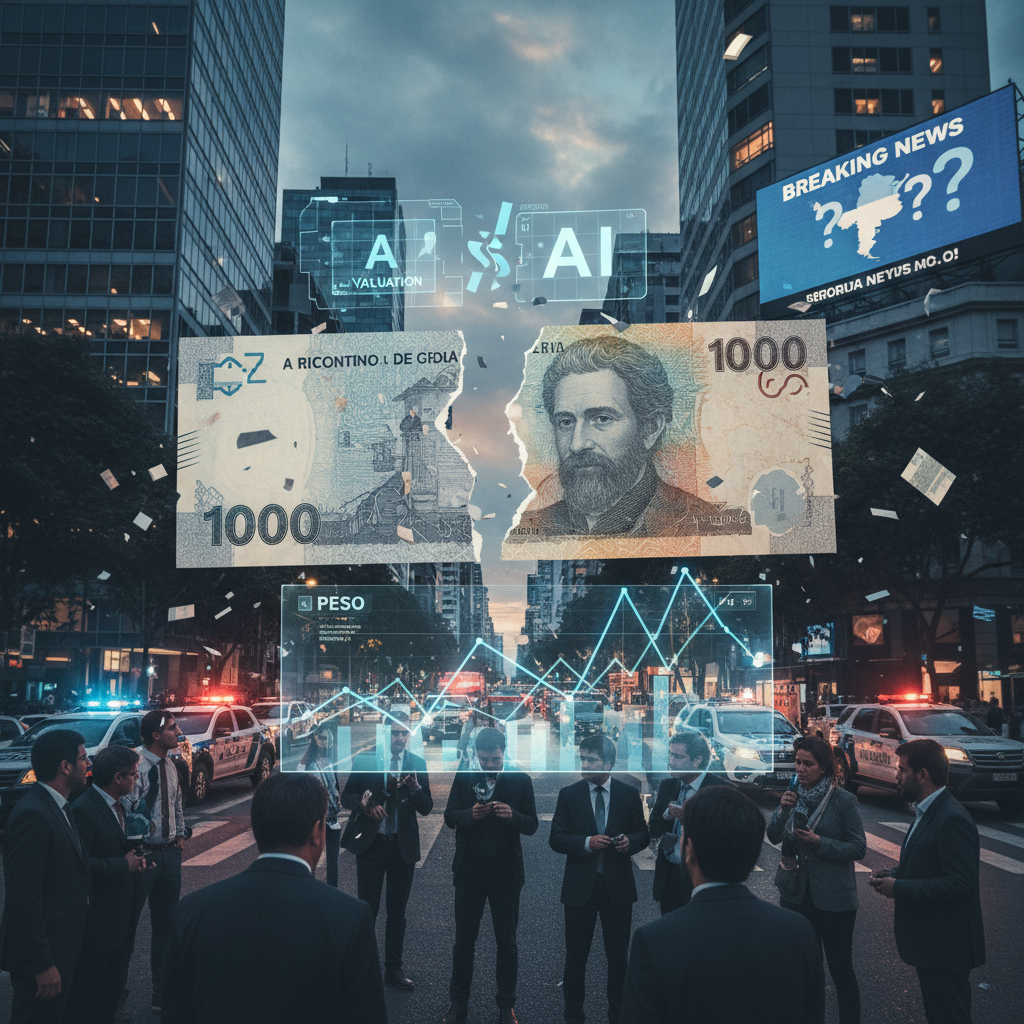

Buenos Aires, Argentina, The digital sirens have been singing, promising an era where artificial intelligence can untangle even the most convoluted markets. Today, that promise landed squarely on Argentina's real estate sector with the launch of 'Patagonia AI,' a new platform claiming to offer real-time, AI-driven property valuations, virtual tours, and market predictions. While the company, a collaboration between a local tech firm, Inmobiliaria Digital, and a prominent US-based AI development house, CogniProp, touts unprecedented accuracy and efficiency, a healthy dose of skepticism is warranted, particularly from an Argentine perspective.
For decades, property valuation in Argentina has been an art form, a delicate dance between brick and mortar, location, and the ever-present shadow of economic instability. The peso's fluctuating value, inflation rates that can redefine 'hyper' on a monthly basis, and a deep-seated distrust in formal financial systems have historically made precise, future-proof valuations a near impossibility. Now, Patagonia AI enters this arena, armed with machine learning models and vast datasets. But does this actually work, or is it merely another example of technology attempting to impose a universal logic onto a distinctly local chaos?
The breaking news, announced this morning from a press conference in Palermo, detailed Patagonia AI's ambitious scope. The platform reportedly integrates satellite imagery, historical transaction data, local economic indicators, and even social media sentiment to generate property valuations. Its virtual tour capabilities, leveraging advanced 3D scanning and generative AI, promise immersive experiences, reducing the need for physical visits. Furthermore, its market prediction module aims to forecast price movements and demand shifts with a claimed 85% accuracy over a six-month horizon, a figure that immediately raises eyebrows in a country where economic forecasts often become obsolete before the ink dries.
Official reactions have been predictably mixed. The Secretary of Innovation and Digital Economy, Dr. Sofía Ramírez, expressed cautious optimism. "This initiative represents a significant step towards modernizing our real estate market," she stated, her words carefully chosen. "We believe that AI can bring transparency and efficiency, reducing information asymmetry for both buyers and sellers. However, the government will closely monitor its impact, ensuring it serves the public interest and adapts to our unique economic dynamics." Her emphasis on 'unique economic dynamics' was not lost on observers, a subtle acknowledgment of the formidable challenges inherent in applying standard AI models to Argentina's volatile landscape.
Conversely, the president of the Argentine Chamber of Real Estate, Sr. Ricardo Gómez, voiced more direct concerns. "While innovation is welcome, we must ask: can an algorithm truly understand the nuances of a property's value when the currency itself is in constant flux?" Gómez questioned during a radio interview. "The human element, the experience of a local broker who understands the micro-markets, the informal economy, and the psychological factors driving investment in times of uncertainty, cannot be easily replicated by data points alone. We have seen many 'solutions' from abroad fail to grasp the Argentine reality." His skepticism reflects a sentiment widely held among those who navigate the market daily.
Let's look at the evidence. The core of any AI valuation model lies in its training data. Patagonia AI claims to have ingested millions of property records, including historical sale prices, rental yields, property characteristics, and neighborhood demographics. However, a significant portion of real estate transactions in Argentina, particularly in the informal sector, are not fully transparent or publicly recorded. Furthermore, the official inflation statistics, often used to adjust historical prices, have themselves been a subject of debate for years, making consistent data normalization a monumental task. If the foundational data is incomplete or inherently flawed due to economic distortions, the output of even the most sophisticated algorithm becomes suspect.
Dr. Elena Rojas, a leading economist at the University of Buenos Aires, offered a more academic perspective. "The promise of AI in real estate is undeniable globally, but the Argentine perspective is more nuanced," she explained in a recent seminar. "Our economy is characterized by high inflation, capital controls, and a strong preference for dollar-denominated transactions in real estate, often negotiated unofficially. An AI model trained predominantly on stable economies will struggle to accurately price assets here. It must account for the 'blue dollar' rate, the implicit inflation expectations, and the flight to tangible assets as a store of value, not just as an investment." She emphasized the need for locally developed, context-aware models rather than simply importing foreign solutions.
The virtual tour aspect, while technologically impressive, faces fewer economic hurdles. The use of generative AI to create highly realistic digital walkthroughs could indeed streamline the viewing process, particularly for international investors or those in remote areas. This application seems to be the most immediately viable and beneficial component of Patagonia AI, offering a tangible improvement in user experience. "The efficiency gains from virtual tours are clear," noted María Soler, a tech analyst specializing in proptech. "It reduces logistical costs and broadens reach. This is where AI offers a straightforward value proposition, irrespective of economic volatility." For more on the broader applications of AI in various sectors, one might consult TechCrunch.
The market prediction module, however, is where the greatest doubts converge. Forecasting property values in a market driven by speculative capital, currency devaluation, and unpredictable government policies is a challenge that has historically stumped human experts. To suggest an AI can achieve 85% accuracy in such an environment borders on the fantastical. While advanced neural networks can identify patterns in complex data, the sheer number of exogenous variables and their unpredictable interactions in Argentina's economy might simply overwhelm even the most robust models. The risk of over-reliance on these predictions, leading to misguided investment decisions, is considerable.
What happens next? Patagonia AI's launch will undoubtedly force traditional real estate agencies to adapt, potentially integrating some of its less volatile features, like advanced virtual tours, into their own offerings. The platform's success, or failure, will serve as a critical case study for the application of AI in highly unstable economic environments. Regulators will need to consider how to verify the accuracy of these AI valuations, especially if they begin to influence lending decisions or property taxation. The Central Bank, for instance, might find itself needing to understand the underlying logic of these algorithms if they impact financial stability. For a deeper dive into the ethical and societal implications of AI, Wired often provides insightful analysis.
Why should readers care? This development is more than just a new app; it is a live experiment at the intersection of cutting-edge AI and profound economic instability. It forces us to confront the limitations of universal technological solutions when faced with unique local realities. If Patagonia AI can genuinely navigate the complexities of Argentina's market, it could set a precedent for AI adoption in other volatile economies. If it falters, it will serve as a stark reminder that data alone is insufficient without a deep, contextual understanding of the human and economic systems it seeks to model. The future of AI in real estate, at least from our vantage point in Buenos Aires, remains very much an open question, one that algorithms might struggle to answer definitively. The journey of AI in such a dynamic environment is fraught with challenges, as explored in discussions around AI ethics.
This unfolding story highlights a fundamental truth: technology, no matter how advanced, is not a panacea. It is a tool, and its effectiveness is inextricably linked to the context in which it is applied. As Patagonia AI begins its operations, the real test will not be its computational power, but its ability to learn, adapt, and ultimately prove its worth in a market that has consistently defied easy categorization. The Argentine perspective is more nuanced; we have seen enough cycles of boom and bust to know that true value often lies beyond the numbers on a screen.