
The cherry blossoms have just begun to fall, a gentle reminder of life's fleeting beauty, and here I sit, contemplating a future that feels anything but gentle: the world of spatial computing, powered by artificial intelligence, and spearheaded by devices like Apple Vision Pro. It is a future that promises boundless possibilities, a seamless blend of our digital lives with the tangible world around us. Yet, as I observe the initial excitement, particularly from a Japanese perspective, I cannot help but feel a profound unease. Are we truly building bridges to new experiences, or are we, perhaps inadvertently, constructing new walls around ourselves, isolating us further in an already fractured society?
My argument is this: while the technological marvel of Apple Vision Pro and its spatial AI capabilities are undeniable, their current trajectory, particularly in a culture like Japan's, risks exacerbating existing societal challenges like loneliness and the erosion of genuine human connection. The emphasis seems to be on individual immersion, on personal digital cocoons, rather than on fostering shared experiences and strengthening community bonds. This is a critical oversight, one that could have profound implications for how we live, work, and relate to one another.
Think of the elderly in Japan, a demographic that is growing rapidly. Many already grapple with loneliness, a quiet epidemic that often goes unaddressed. The promise of companion AI, of virtual assistants that can fill the silence, is alluring. But what happens when these advanced spatial devices, with their sophisticated AI, become the primary mode of interaction, replacing the warmth of a grandchild's hand or the shared laughter over a cup of tea? I remember speaking with Dr. Hiroshi Ishiguro, a renowned robotics professor at Osaka University, who has dedicated his career to understanding human-robot interaction. He once told me, "Technology must augment humanity, not replace it. The essence of connection is empathy, and that is something a machine, however advanced, cannot fully replicate." His words echo in my mind as I consider the implications of widespread spatial computing.
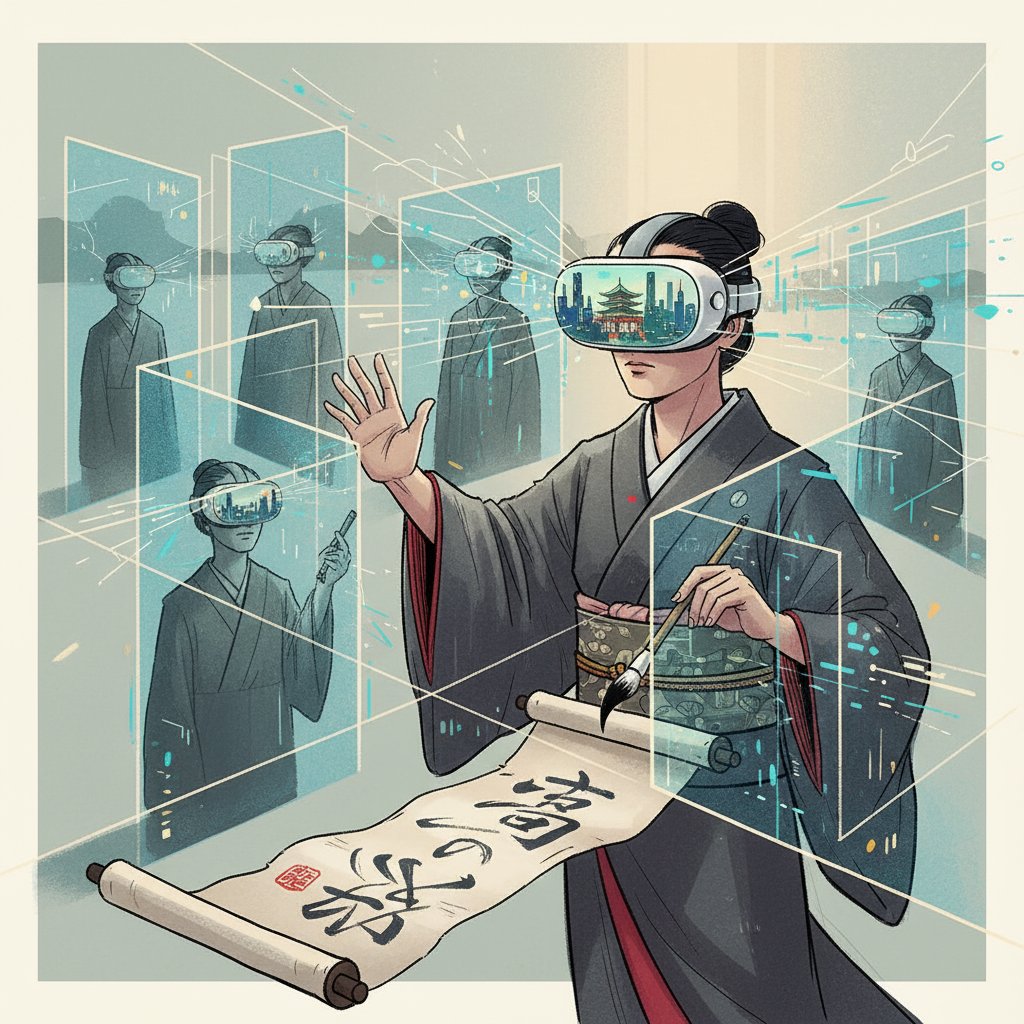
Indeed, the technical prowess is breathtaking. Apple Vision Pro, with its sophisticated eye tracking, hand gestures, and spatial audio, creates an incredibly immersive experience. The integration of advanced AI allows for intuitive interaction, understanding user intent, and seamlessly blending digital objects into the physical environment. Imagine a virtual koi pond appearing on your living room floor, or a digital assistant whispering reminders directly into your ear, seemingly from the air itself. This is not science fiction; it is the present. Companies like Apple are pouring billions into this vision, confident that this is the next major computing platform. According to Reuters, the market for augmented and virtual reality devices is projected to grow significantly in the coming years, driven by these innovations.
However, the very strength of this immersion can be its greatest weakness. When our gaze is constantly drawn to the digital overlay, when our attention is fragmented between the real and the virtual, what happens to the subtle cues of human interaction? The fleeting glance, the slight shift in posture, the unspoken understanding that forms the bedrock of Japanese communication, or ishin-denshin. These are not easily replicated or even acknowledged by a device, no matter how clever its AI. We risk becoming more adept at navigating virtual interfaces than at truly seeing and hearing the people right in front of us.
Some might argue that these devices can actually enhance connection. They point to shared virtual experiences, collaborative workspaces, or even the ability to bring distant loved ones into a shared spatial environment. And yes, there is truth in that. For instance, the ability to collaborate on a 3D model with colleagues across continents, feeling as if you are in the same room, could revolutionize industries. Or consider how a family separated by distance might use spatial computing to share a virtual meal, seeing each other's digital avatars at the same table. This is the human side of the machine that developers often highlight, the promise of overcoming geographical barriers.
But I contend that these are often exceptions, not the rule, and they come with their own set of caveats. A virtual meal, however realistic, cannot replace the shared aroma of a home-cooked dish or the accidental brush of elbows. The convenience of a virtual meeting often overshadows the serendipitous conversations that happen before or after a physical gathering. We must be wary of confusing simulation with genuine presence. As Professor Yuko Harayama, a former Executive Member of the Council for Science, Technology and Innovation in Japan, once observed, "Innovation should serve society, not dictate it. We must always ask: what human value are we truly enhancing, and what might we be losing in the process?" Her wisdom reminds us to look beyond the dazzling technology.
My concern is particularly acute for Japan, a country where communal harmony, or wa, is deeply valued. Our society, with its emphasis on group cohesion and subtle social cues, might find itself particularly vulnerable to the isolating tendencies of hyper-individualized spatial computing. If each person is immersed in their own augmented reality, their own personalized digital world, how do we maintain the shared reality that binds us? How do we foster empathy when our perceptions are constantly filtered and tailored by algorithms?
We need to demand more from these technologies and the companies that create them. The development of spatial AI should not solely focus on individual productivity or entertainment, but on how it can genuinely enrich our collective human experience. This means designing interfaces that encourage shared attention, platforms that facilitate real-world interaction, and applications that bridge, rather than widen, the gaps between us. Perhaps it means shifting the design philosophy from a purely personal experience to one that is inherently communal, fostering what I call 'shared spatiality.'
Imagine spatial AI that helps us better understand the emotions of those around us, not just project digital content. Imagine devices that facilitate spontaneous, meaningful conversations in public spaces, rather than encouraging us to retreat into our own digital bubbles. This would require a fundamental re-evaluation of design principles, moving beyond mere utility to embrace social responsibility. It is a call to action for Tim Cook and the brilliant minds at Apple, for Mark Zuckerberg and Meta, and for all the innovators shaping this spatial future.
In a quiet Tokyo lab, I once heard a young researcher, Ms. Akari Sato, whisper something that changed my perspective. She was working on a project to use augmented reality to help children with social anxieties engage more comfortably in group settings. She said, "The technology itself is neutral. Its impact depends entirely on our intention, on whether we choose to build walls or open doors." Her words resonated deeply. We stand at a crossroads. The path of spatial computing, powered by AI, can lead us to unprecedented levels of connection, or it can lead us to a future where we are more digitally enhanced, but profoundly alone. The choice, as always, is ours to make, and it is a choice we must make with our hearts, not just our screens. For more insights into the societal implications of AI, Wired often publishes thought-provoking pieces on these topics.