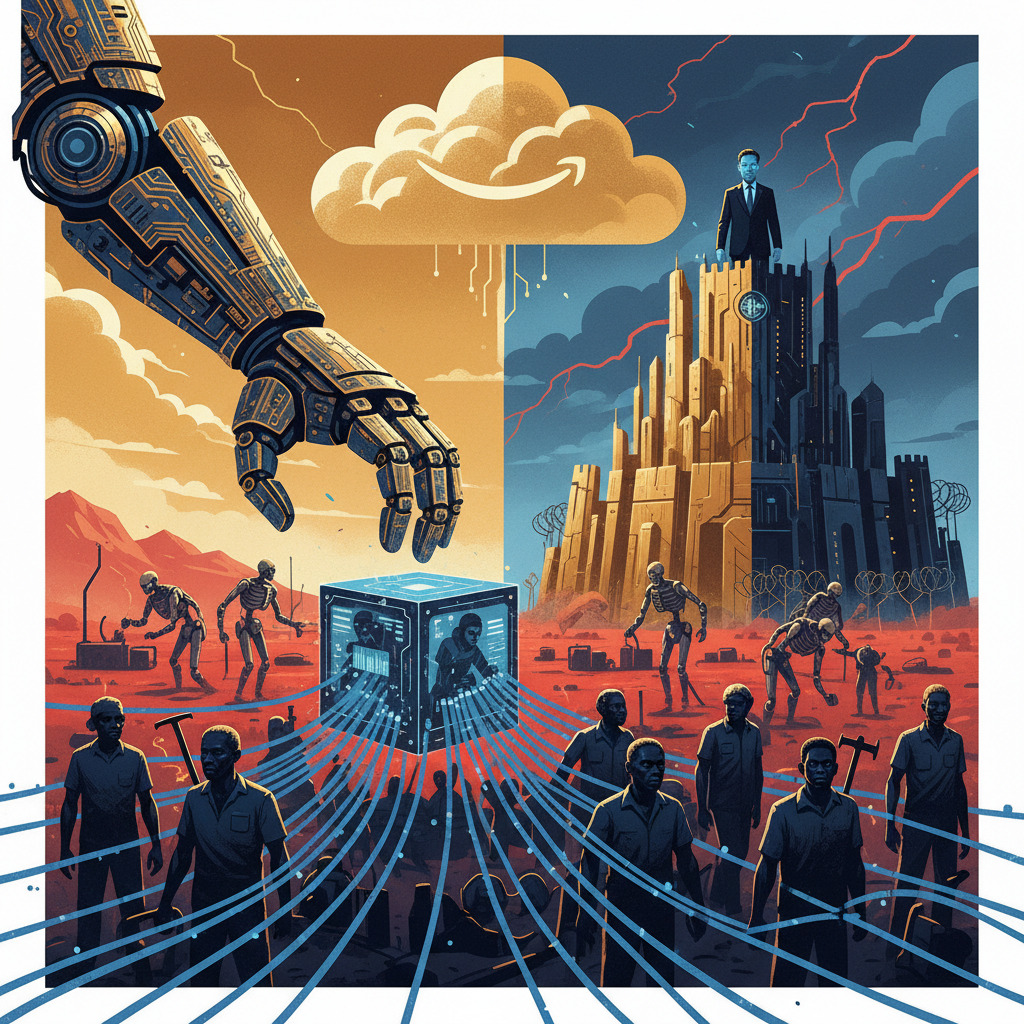

The drums of progress beat loudly, echoing across continents, promising efficiency, speed, and unprecedented convenience. Amazon, under the leadership of Andy Jassy, is at the forefront of this digital symphony, orchestrating a revolution in logistics and warehousing with an army of AI-powered robots. From the outside, it looks like a marvel of modern engineering, a testament to human ingenuity. But here in Ghana, where the echoes of colonial exploitation still resonate, I cannot help but ask: for whom is this revolution truly being waged? Is this a golden age of innovation, or are we witnessing the construction of a digital gulag for global labor?
My grandmother used to tell me about Sankofa, the Akan principle of looking back to retrieve what is good from the past to achieve progress in the present. As I observe Amazon’s relentless march towards full automation, I see a future that risks forgetting the very human element that has always driven our economies: dignified labor. We are told that these robots will free humans from repetitive, dangerous tasks, allowing us to pursue more fulfilling work. This sounds noble, even utopian. But the reality, as always, is far more complex and, frankly, far more concerning.
Consider the sheer scale of Amazon's operation. They are not just deploying a few robots; they are building entire ecosystems where AI dictates every movement, every pick, every pack. This isn't just about faster delivery; it is about reshaping the very nature of work. In their fulfillment centers, AI algorithms optimize routes, manage inventory, and increasingly, monitor human performance with an intensity that borders on surveillance. What happens when the algorithm decides your pace is too slow, your break too long, your output insufficient? The human worker becomes an extension of the machine, a cog in a vast, impersonal system. This affects every single one of us, whether we work in these warehouses or simply benefit from their expedited deliveries.
“The narrative Amazon presents is always one of innovation and customer delight,” says Dr. Ama Serwaa, a labor economist at the University of Ghana. “But we must critically examine the human cost. When jobs are deskilled, when human agency is diminished, and when the threat of replacement by a machine looms large, what does that do to the spirit of the worker? We are seeing a race to the bottom, where human labor is treated as a variable cost to be minimized, rather than a valuable asset to be nurtured.” Her words resonate deeply with me, echoing the concerns of countless workers whose voices are often drowned out by the corporate narrative.
Amazon’s investment in robotics and AI is staggering. Reports suggest they are spending billions annually on developing and deploying these systems. Their latest generation of robots, like Proteus, are designed to work alongside humans, lifting heavy items and navigating complex environments. On the surface, this sounds like collaboration. But beneath it lies a subtle shift in power dynamics. The human is no longer the master of the tool; the human is increasingly subservient to the pace and demands of the automated system. This is not progress if it strips away our humanity.
Some might argue that this is simply the inevitable march of technology, that automation creates new jobs even as it displaces old ones. They will point to the engineers, the data scientists, and the maintenance technicians required to build and operate these sophisticated systems. And yes, those jobs do exist. But who gets to fill them? Are these opportunities equally accessible to the warehouse worker in Accra, or the logistics operative in Kumasi, whose primary skill set is being systematically devalued? The digital divide is not just about internet access; it is about access to the education and training required to thrive in this new, AI-driven economy. Without deliberate intervention, this revolution will only exacerbate existing inequalities, creating a global elite of AI architects and a vast underclass of the algorithmically managed.
“We are not against technology,” explains Kwame Nkansah, a community organizer working with informal sector workers in Tema. “But we demand technology that serves people, not just profits. Where is the investment in retraining programs for those whose jobs are being automated? Where is the commitment to fair wages and safe working conditions that prioritize human well-being over algorithmic efficiency?” His questions are not radical; they are fundamental demands for justice and equity. Silence is complicity when the future of work for millions hangs in the balance.
We need to talk about this with an urgency that matches the speed of Amazon’s deployments. We need to demand transparency from companies like Amazon about their long-term labor strategies. What percentage of their workforce do they anticipate will be human in five, ten, fifteen years? What are their plans for the displaced workers? How will they ensure that the benefits of this technological advancement are broadly shared, rather than concentrated in the hands of a few shareholders and executives?
Ghana and other developing nations are not merely passive recipients of global technological trends. We have a rich history of innovation and community-driven solutions. We must leverage our collective voice to shape this future, not just react to it. We must advocate for policies that ensure a just transition, investing in education, digital literacy, and social safety nets. We must champion models of technological development that prioritize human dignity, cultural preservation, and equitable access. For instance, imagine if Amazon invested a fraction of its robotics budget into developing culturally relevant AI training programs in West Africa, creating opportunities for local talent to build and manage these systems, rather than just being subject to them. This is not a pipe dream; it is a necessity.
As the world races towards an automated future, we must remember that technology is a tool, and like any tool, its impact depends entirely on how we wield it. Will we use Amazon's AI and robotics to build a society of greater equity and shared prosperity, or will we allow it to construct a new form of digital feudalism? The choice, my friends, is still ours to make. The time for passive observation is over. The time for active participation and fierce advocacy has arrived. We must ensure that the future of work is not just efficient, but also humane and just. For more insights on the broader implications of AI on global labor, consider reading articles on TechCrunch's AI category or MIT Technology Review for deeper analysis. The conversation about AI's impact on workers in developing nations is ongoing, and you can find related discussions, such as the one about Microsoft and Google rethinking AI automation in Pakistan [blocked], which highlights similar challenges.
The future of work is not predetermined by algorithms; it is shaped by our collective will and our commitment to justice. Let us not allow the allure of efficiency to blind us to the profound ethical questions that Amazon's robotic revolution demands we answer.