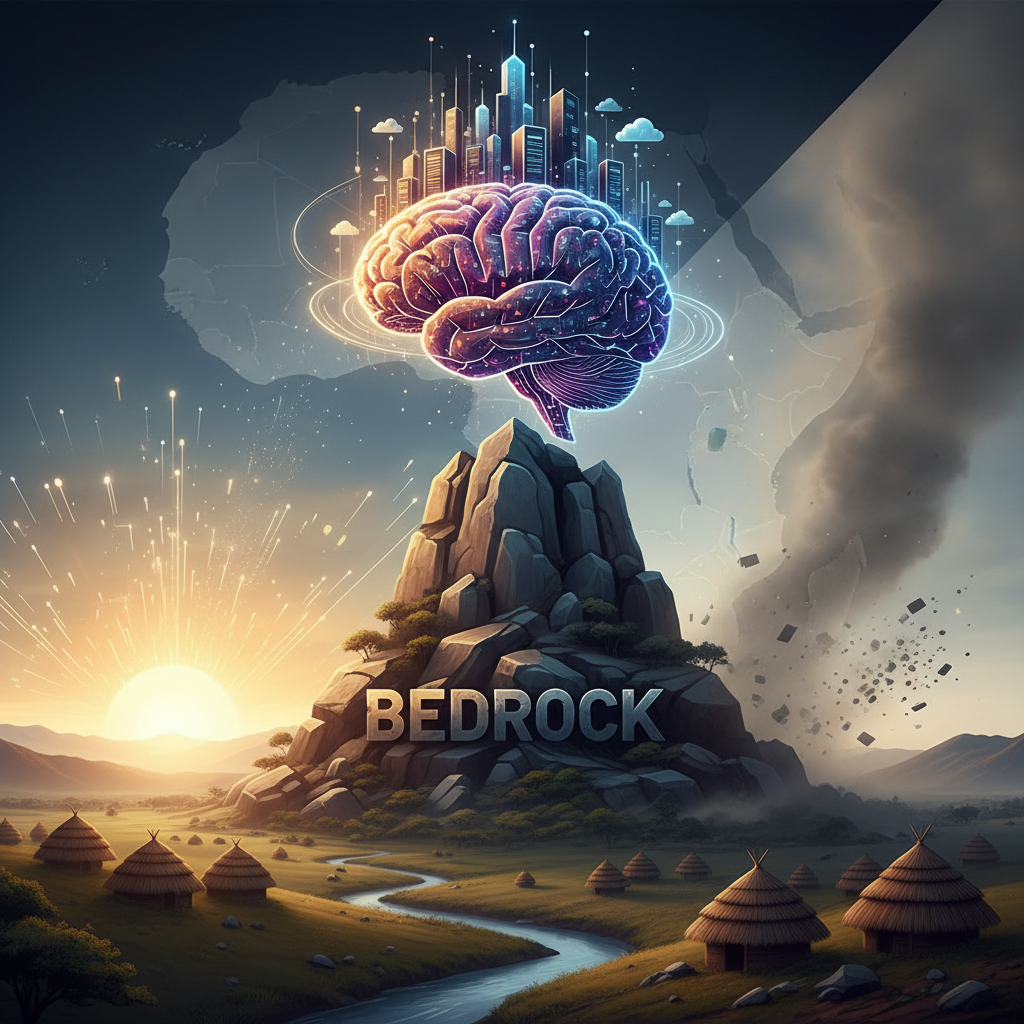

The sun rises over the Malolotja mountains, painting the sky in hues of orange and purple, a sight that always reminds me of the vibrant spirit of Eswatini. Here, in our small but mighty kingdom, we often look to the global stage, not just as observers, but as people who understand that what happens far away can ripple through our communities. Today, my thoughts turn to Amazon, a name as ubiquitous as the morning dew, and their ambitious play with something called AWS Bedrock.
Is this grand strategy by Amazon's Andy Jassy a true new horizon for businesses around the world, including those here in Eswatini, or is it just another layer of cloud dust settling over the digital landscape? It is a question that weighs on my mind, especially when I think about how technology can either uplift or overshadow local ingenuity.
For those not steeped in the digital currents, AWS Bedrock is Amazon's answer to the booming demand for generative AI. Think of it as a toolkit, a set of services that lets companies build their own AI applications using a variety of foundational models from Amazon and other leading AI companies like Anthropic and AI21 Labs. Instead of building these complex models from scratch, businesses can tap into Bedrock, customize a model with their own data, and deploy it. It is about making powerful AI accessible, or so the narrative goes.
Historically, the tech world has always had its giants. From the early days of computing to the rise of the internet and then cloud services, companies like IBM, Microsoft, and Google have vied for dominance. Amazon Web Services, or AWS, carved out its own empire by providing the foundational infrastructure for much of the internet. They made it possible for startups to scale without owning massive server farms. Now, with AI becoming the new electricity, Amazon wants to be the utility provider for this next generation of technology. They are not just offering computing power; they are offering the very brains, the foundational models, upon which new AI systems will be built.
This isn't just about big tech flexing its muscles; it is about a fundamental shift in how businesses will consume and deploy artificial intelligence. Data from IDC suggests that worldwide spending on AI will reach over $300 billion by 2026, with a significant portion allocated to AI software and infrastructure. Amazon, with its established cloud footprint, is perfectly positioned to capture a large slice of this pie. Their strategy is clear: make it easier, make it cheaper, and make it more secure for enterprises to integrate AI into their operations, all within the AWS ecosystem.
“The enterprise market is hungry for AI solutions that are both powerful and manageable,” explains Dr. Nompumelelo Nkosi, a leading technology analyst at the University of Eswatini. “Companies don't want to deal with the complexities of model training or infrastructure management. They want to focus on their core business. AWS Bedrock simplifies that, offering a curated menu of models and tools. It is a very clever move by Amazon to extend their cloud dominance into the AI realm.”
But what does this mean for us, for the small businesses in Eswatini trying to innovate, for our government looking to improve public services, or for our educators shaping the minds of tomorrow? The promise is that even a small company in Manzini could, theoretically, leverage the same cutting-edge AI as a multinational corporation. Imagine a local artisan using AI to optimize their supply chain or a community clinic using a customized large language model to assist with patient queries, all powered by Bedrock.
“We are seeing a clear trend where companies are moving beyond just experimenting with AI to actively integrating it into their core operations,” says Sipho Dlamini, CEO of Eswatini Innovations Hub, a local incubator supporting tech startups. “The challenge for many African businesses, however, is not just access to technology, but also the skills to utilize it effectively and the data privacy concerns. Platforms like Bedrock need to be paired with robust local training and ethical guidelines.”
Indeed, the ethical implications are never far from my thoughts. In Eswatini, we say 'a person is a person through other people', and AI should learn this lesson. The technology must serve humanity, not the other way around. When foundational models are developed by a few powerful entities, there is always the risk of biases being embedded, biases that might not reflect the diverse realities of our world. How do we ensure that the AI models customized on Bedrock are fair, equitable, and culturally sensitive, especially when deployed in contexts far removed from Silicon Valley?
Another perspective comes from Professor Themba Mkhonta, an expert in digital economics at the Eswatini Institute of Management and Public Administration. “Amazon's move is a double-edged sword. On one hand, it democratizes access to advanced AI, which is fantastic for developing economies. On the other hand, it consolidates power. If everyone builds on Bedrock, Amazon becomes the gatekeeper, potentially influencing the direction of AI development and even charging a premium for access to these essential tools. We must always be wary of vendor lock-in, especially in critical infrastructure like AI.”
My verdict? AWS Bedrock is certainly not a fad; it is a significant strategic play that will reshape enterprise AI infrastructure. Amazon's deep pockets, vast cloud infrastructure, and existing customer base give it a formidable advantage. It is a new normal, one where foundational models become commodities, and the real value lies in how they are customized and applied. This tiny kingdom has big ideas about technology, and we must engage with these global trends with our eyes wide open.
For Eswatini, and indeed for many nations like ours, the challenge is to harness the power of platforms like Bedrock without becoming overly dependent. We need to foster local talent that can build on these platforms, rather than just consume them. We need to advocate for open standards and interoperability, ensuring that innovation can flourish beyond the confines of any single tech giant's ecosystem. The future of AI, even when built on Bedrock, must be diverse, inclusive, and reflective of all humanity.
The global AI landscape is shifting rapidly, and Amazon's Bedrock is a cornerstone of this new reality. Its impact will be felt from the largest corporations to the smallest startups, and yes, even here in Eswatini. The question is not whether it will be adopted, but how we, as a community and a nation, will shape its adoption to serve our people and our unique cultural values. As I watch the sun set, I am reminded that sometimes the smallest countries have the biggest vision, and it is this vision that will guide us through the complexities of the AI age. For more insights into how AI is shaping global economies, you can explore reports on Reuters Technology. For a broader perspective on AI's societal impact, Wired's AI section offers diverse viewpoints. And for a deeper dive into the technical aspects of these platforms, The Verge AI often provides excellent coverage. I believe that understanding these global shifts is crucial for our local development, and we must ensure our voices are heard in this evolving conversation. The article on Amazon and Anthropic's 'Project Nightingale': Why Claude's Enterprise Surge Just Rewrote the Rules for USA Inc. [blocked] also touches on Amazon's enterprise AI strategy, offering another angle on their market approach.