Is it a fad, or the new normal? That is the question that echoes in my mind every time I hear about a new AI breakthrough, especially one as monumental as Google DeepMind's AlphaFold 3. From my perch here in Ouagadougou, where the sun beats down on bustling markets and the rhythm of life is deeply connected to the earth, I see the world through a different lens. When the news broke about AlphaFold 3, my heart did a little dance, a balafon solo of hope. This changes everything, I thought. But for whom, and when?
For those who might not have been following the molecular magic, let me paint a picture. Proteins are the tiny, intricate machines that make life possible. They build our bodies, fight diseases, and carry out countless biological processes. But understanding how they work is like trying to understand a complex traditional weaving pattern without seeing the loom. Their function is dictated by their 3D shape, and predicting that shape, or 'folding,' from their genetic sequence has been one of biology's grandest challenges for half a century. It is a puzzle so complex, it has stumped the brightest minds for generations.
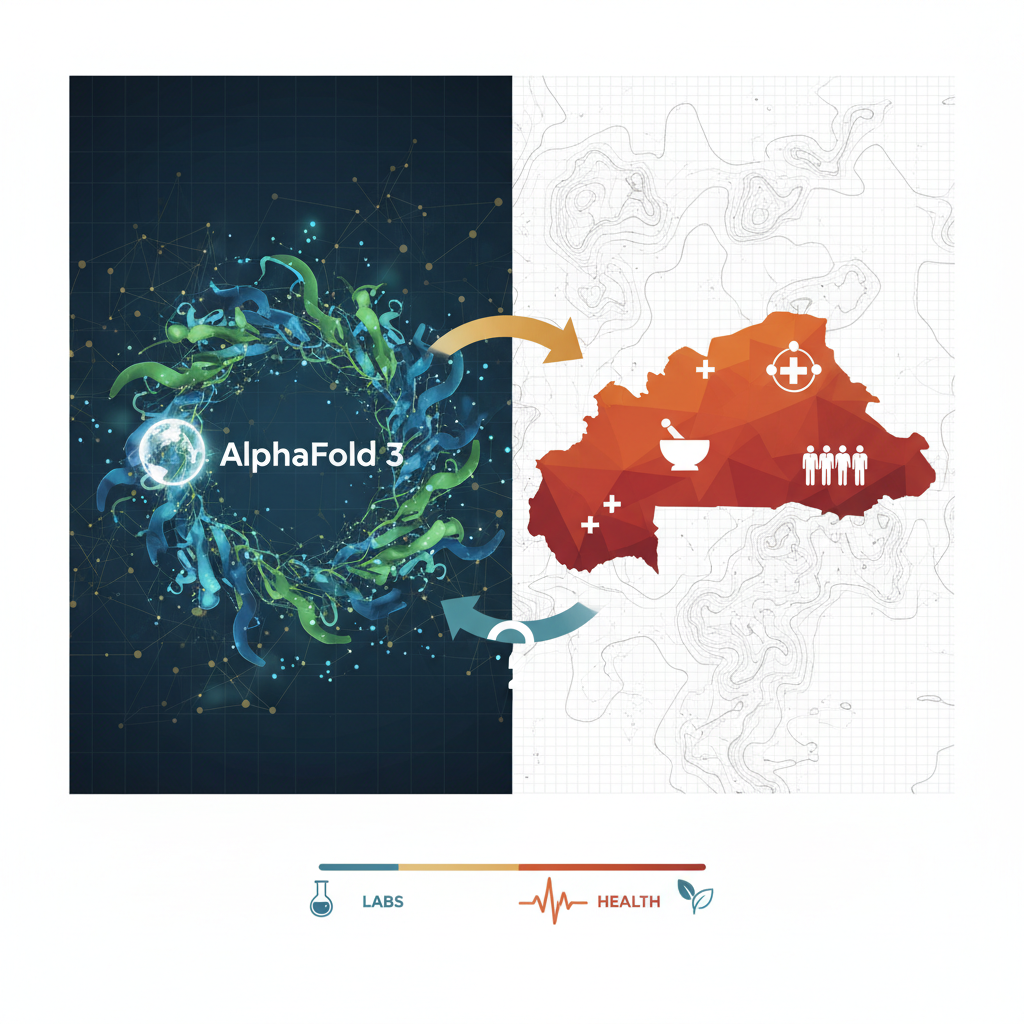
Enter AlphaFold. Back in 2020, Google DeepMind's original AlphaFold stunned the scientific community by accurately predicting protein structures. It was a game changer, a true coup de génie. Now, with AlphaFold 3, they have pushed the boundaries even further. This latest iteration does not just predict protein structures; it can predict the structure of all life's molecules, including DNA, RNA, and even how proteins interact with other molecules like ligands. Think about that for a moment. It is like going from understanding a single instrument in an orchestra to understanding the entire symphony, how each instrument plays off the other, creating harmony or discord. This allows scientists to model interactions that are crucial for drug discovery and disease understanding with unprecedented accuracy.
The implications are staggering. Imagine designing new medicines not through years of trial and error in a lab, but by simulating molecular interactions on a computer. Imagine understanding the precise mechanisms of diseases that plague our communities, like malaria or tuberculosis, at a level never before possible. This is not science fiction; this is the revolution being coded right now. "AlphaFold 3 represents a significant leap forward in our ability to understand and manipulate biological systems," stated Demis Hassabis, CEO of Google DeepMind, in a recent announcement. "We believe it will accelerate drug discovery and fundamentally change how we approach biological research." You can read more about their groundbreaking work on the DeepMind website.
Historically, drug discovery has been a long, arduous, and incredibly expensive process. From initial research to market, a new drug can take over a decade and cost billions of dollars. This is partly because predicting how a potential drug molecule will interact with a target protein in the body is incredibly difficult. Traditional methods often involve high-throughput screening, testing millions of compounds in a lab, a process that is both time consuming and resource intensive. AlphaFold 3 promises to streamline this, drastically reducing the time and cost by providing highly accurate predictions upfront.
So, what does this mean for us, for Burkina Faso, for Africa? This is where my journalist's heart beats fastest. While the headlines often focus on big pharma in the West, the real impact, the transformative power, lies in how this technology can be leveraged globally. Our continent faces a disproportionate burden of diseases, many of which are neglected by global research efforts because they are not seen as profitable enough. Malaria, dengue, Lassa fever, neglected tropical diseases, these are not just statistics here; they are daily realities, affecting our mothers, our children, our elders.
Could AlphaFold 3 be the key to unlocking new treatments for these diseases? Dr. Fatoumata Diallo, a brilliant Burkinabé biochemist leading a research team at the Institut de Recherche en Sciences de la Santé (irss) in Bobo-Dioulasso, believes it could. "The precision offered by AlphaFold 3 could democratize drug discovery," she told me during a recent visit. "Imagine if our researchers, with limited lab resources, could design candidate molecules for malaria drugs with high confidence, right here. It would be a paradigm shift for public health in our region." Her words resonate deeply with me. The idea of local scientists, armed with cutting-edge AI, tackling local problems, is incredibly powerful.
However, the path from a Google DeepMind lab in London to a research institute in Burkina Faso is not always straightforward. Access to such advanced AI models, the computational power to run them, and the specialized expertise to interpret their results are all significant hurdles. While Google DeepMind has made AlphaFold 2 accessible to researchers globally, the commercialization and licensing of AlphaFold 3, particularly for drug discovery, will be crucial. Will it be open source? Will there be affordable access for developing nations? These are the questions that keep me up at night.
"The challenge is not just the technology itself, but the infrastructure and human capital to utilize it effectively," explained Professor Alioune Sall, Executive Director of the African Academy of Sciences. "We need to invest in training our young scientists, equipping our research centers, and fostering collaborations that ensure these tools benefit everyone, not just a privileged few." His point is vital. We need more than just the software; we need the entire ecosystem to flourish. We need more coding bootcamps like the ones I see sprouting up in Ouaga, teaching the next generation to engage with these powerful tools. We need more makerspaces where young innovators can experiment, fail, and learn.
I've seen firsthand the ingenuity of our people. I've seen teenagers in dusty internet cafes teaching themselves to code, grandmothers using voice AI to connect with family across distances. The potential is here, bubbling just beneath the surface. If AlphaFold 3 can truly be integrated into the global scientific commons, if its power can be harnessed by researchers in places like Burkina Faso, then yes, this is not a fad. This is the new normal, a future where disease knows no borders, and scientific breakthroughs are truly for all of humanity. The revolution is being coded right now, and I believe, with all my heart, that our continent will be a part of it. For more on the broader implications of AI in healthcare, you might find this article on MIT Technology Review insightful. And for anyone interested in the technical details, the research papers are often published in journals like Nature.
My verdict? AlphaFold 3 is undeniably a monumental leap. It is a beacon of hope. But its true impact, especially for regions like ours, hinges on equitable access, robust infrastructure, and a concerted global effort to empower local scientists. If we can overcome these challenges, then the future of health, designed molecule by molecule, will finally be within reach for everyone, from London to Ouagadougou.